The Long Women’s March in Osijek
On 16 December 2021, the FFOS Alumni Association and the Museum of Slavonia organised the presentation of the book The Long Women’s March by Ana Rajković Pejić, PhD. The presentation offered an example of research into these topics through the position of women within the education system. It highlighted the importance of the author’s systematic and methodological approach, as well as the socio-political context of research into women’s issues both globally and in Croatia.
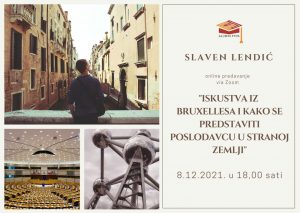
Experiences from Brussels and How to Present Yourself to an Employer Abroad
Another excellent online lecture held via Zoom introduced us to the experiences of our alumnus Slaven Lendić. The lecture was attended online by FFOS students and several lecturers from the FFOS Department of English Language and Literature. In his lecture held on 8 December 2021, Slaven provided some of the missing pieces of the puzzle by explaining how he moved from point A, studying the humanities at the Faculty of Humanities and Social Sciences in Osijek, to point B, working in EU institutions in Brussels. It is fair to say that his path was far from straightforward.
An internship at DG Translation in Brussels served as a springboard for his career in EU institutions. Slaven then guided the audience through the “maze” of EU institutions, explaining internship opportunities within them. He highlighted two options: EPSO internships, organised by the European Personnel Selection Office, and the Blue Book Traineeship. After completing his internship at DG Translation, Slaven wanted to remain in Brussels and continue building his career there. To achieve this, he registered with the Belgian employment service, Actiris Brussels. He also mentioned the temporary employment agency Randstad and useful job-search portals such as EuroBrussels and Euractiv, which provide access to opportunities in the Brussels private sector. He shared numerous useful tips and links and offered his assistance to anyone willing to follow a similar path.
ICT in Education
On Tuesday, 30 November 2021, a lecture entitled ICT in Education was held. The lecture took place online via Zoom, beginning at 6 p.m. and lasting an hour and a half. It was attended by 71 participants from across Croatia, most of whom were teachers working in primary and secondary schools.
The lecturers, Marija Bulut Lukačević, MSc, Marina Arambašić and Ljiljana Marinjak, presented the possibilities and advantages of working with the online tools Canva, Weebly and Genially. Teacher adviser Marija Bulut Lukačević presented Canva, its possible applications in the educational work of teachers and professional associates, the registration process, the features it offers and examples of materials she uses in her daily work. Mentor teacher Marina Arambašić presented website creation using the online platform Weebly. Participants had the opportunity to learn how to create and edit a website, format content and embed interactive content, documents, presentations and photographs.
Teacher adviser Ljiljana Marinjak spoke about the online digital tool Genially, which is used to create and share various types of media content and presentations. She explained how to create a user account and introduced the available options for creating presentations, quizzes, infographics, board games and greeting cards.
Fundamentals of Pedagogy
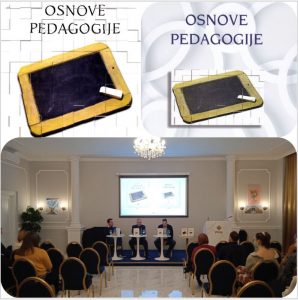
On Tuesday, 26 November 2021, the textbook Fundamentals of Pedagogy, written by Professor Marko Mušanović, PhD, and Associate Professor Mirko Lukaš, PhD, was presented. The event was held in the Small Ceremonial Hall of the Faculty of Humanities and Social Sciences in Osijek, beginning at 5 p.m. The book was presented by its author, Associate Professor Mirko Lukaš, PhD, the reviewer of the second revised edition, Professor Zlatko Miliša, PhD, and Dean Cikovac, PhD.
The textbook Fundamentals of Pedagogy aims to present selected topics that encompass the fundamental knowledge of pedagogical academic discourse. The selected topics explain the basic concepts of pedagogy, beginning with the definition of pedagogy as a science and its methodology, the development of pedagogical ideas and the concept of education, and continuing through the essential components of the pedagogical system. Its content provides a clear and systematic understanding of the phenomenon of education for everyone involved in teaching and education, while also serving as an important resource for preparing university courses dealing with introductory pedagogy, general pedagogy or the fundamentals of pedagogy. The need to expand the textbook with new content arose from the academic necessity of examining contemporary pedagogical processes and their importance for understanding pedagogy as a science.
How to Start and Succeed as a Translator
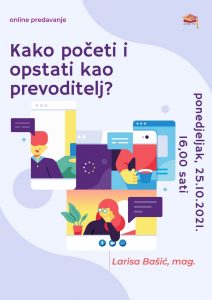
On Monday, 25 October 2021, a lecture entitled How to Start and Succeed as a Translator was held via the Zoom channel of the Faculty of Humanities and Social Sciences in Osijek. The lecture was delivered by Larisa Bašić, who holds a degree in English and German Language and Literature and completed the Translation Studies track at the Faculty.
The lecture attracted many online participants, most of whom were graduate students enrolled in the Translation Studies track. Larisa structured the lecture around her own professional journey as a translator, which began with an internship at a translation service in Brussels. In addition to the Joint Translation Service of the European Committee of the Regions and the European Economic and Social Committee, she introduced participants to other European institutions and explained where they could find relevant information about work and internship opportunities and how to prepare application documents. She explained what it means to work under an author’s contract and how fees are calculated. She also described working in a translation agency and emphasised that, in addition to language skills, employees need teamwork, team-management and mentoring skills. Working in a translation agency gives employees the opportunity to improve their vocabulary in different fields by translating various types of texts or to specialise in a particular field. Larisa highlighted reliable salary payments and the possibility of taking annual and sick leave as some of the greatest advantages of working in a translation agency. A third option is working within a company, which offers additional opportunities for specialisation in a particular field. However, such positions often combine translation or proofreading with administrative tasks, which may not suit everyone. The lecturer explained the differences between translation-related tasks such as localisation, transcreation and the marketing adaptation of text and visual content. Finally, she explained the process of starting one’s own business and highlighted numerous advantages, including being one’s own boss, managing one’s own time, choosing clients and working with international clients, as well as disadvantages such as constant availability, delayed payments, replaceability, cheaper competition, machine translation and unpaid annual leave.
My Path to Brussels
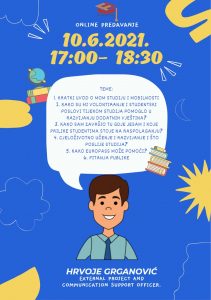
On Wednesday, 23 June 2021, a lecture entitled My Path to Brussels was held via the Zoom channel of the Faculty of Humanities and Social Sciences in Osijek. The lecture was delivered by Hrvoje Grganović, who holds a degree in German Language and Literature and works in Brussels as an external project and communications expert.
Hrvoje emphasised the importance of participating in mobility programmes and offered his professional assistance to all interested participants. Although most students believe that acquiring professional knowledge and skills, accompanied by high grades, is the most important factor, Hrvoje revealed that employers, at least those he had encountered, also look for a willingness to volunteer. Volunteering helps individuals acquire teamwork, communication and interpersonal skills that are developed to a much lesser extent during university studies. Hrvoje therefore highlighted the importance of volunteering, which not only develops these skills but also opens many professional doors and creates lifelong connections.
In the second part of his lecture, Hrvoje presented the new design and features of Europass, the best-known platform for creating CVs and cover letters for jobs, scholarships, internships and similar opportunities. In light of major changes such as the green and digital transitions, the post-pandemic period and the digitalisation of learning, Hrvoje stressed the importance of knowing how to use Europass and prepare a CV. In addition to creating CVs and applications for jobs, scholarships and internships, the new Europass enables users to create an online profile accessible to European employers. Jobseekers can also browse job advertisements that match their profile and preferences. Hrvoje offered his assistance to anyone who needed further guidance.
Virtual Career Day
On Wednesday, 26 May 2021, a Virtual Career Day featuring graduates of the Faculty of Humanities and Social Sciences in Osijek was held via the Faculty’s Zoom channel. As the Faculty’s study programmes are often stereotypically viewed solely through the lens of education, the aim was to bring together FFOS graduates from different study programmes who now work outside the education system.
During the one-hour event, six graduates shared their professional stories, summarised below.
Vladimir Bjelobrk holds degrees in Pedagogy and Croatian Language and Literature. He graduated from the Faculty of Humanities and Social Sciences, Josip Juraj Strossmayer University of Osijek, in 2011 after completing undergraduate and graduate programmes in Pedagogy and Croatian Language and Literature. He worked for several years as a school pedagogue. In 2018, he decided to focus on enhanced care and supervision of children and young people and became the head of such a programme. This move beyond the education system eventually led him to his current position as Director of the Centre for Autism in Osijek. He admitted that he was apprehensive about joining the Centre because he had to assume the most responsible role in an institution working with children with severe disabilities, something for which his studies had not prepared him. Audentes fortuna iuvat – fortune favours the bold – is the motto that guides Vladimir, and he courageously entered a field in which he still has much to learn.
Renata Forjan holds degrees in Hungarian and English Language and Literature. She graduated from the Faculty of Humanities and Social Sciences, Josip Juraj Strossmayer University of Osijek, in 2013. Before beginning her studies, she had worked at the Kopački Rit Nature Park since 2000 in tourism and promotion. She continued working there throughout her studies and remained there until the end of 2019. Although her path differed from that of most students because she worked before deciding to study, she did not see this as an obstacle. On the contrary, her professional experience helped her during her studies. After graduating, she became a court interpreter for Hungarian and English and started her own translation business. Since 2020, she has worked as Director of the Bilje – Kopački Rit Tourist Board, which has signed a cooperation agreement with the Faculty of Humanities and Social Sciences in Osijek to provide short-term internships for Translation Studies students.
Hrvoje Grganović holds a degree in German Language and Literature and completed the Translation Studies track at the Faculty of Humanities and Social Sciences in Osijek. He repeatedly highlighted the financial and operational support he received from the Faculty, for which he remains grateful. In search of professional opportunities, Hrvoje moved to Brussels and attended various job interviews before eventually securing his current position as an external project and communications support officer.
Ana Jurić holds a degree in Psychology, which she completed at the Faculty of Humanities and Social Sciences in Osijek in 2011. She has worked in the profession ever since. She spent five years working in the social welfare system, at SOS Children’s Village Ladimirevci and the Osijek Social Welfare Centre. For the past five years, she has worked with those in blue uniforms who protect us every day. More precisely, she works as a senior psychology adviser at the Osijek-Baranja Police Administration. She has also completed training in Gestalt psychotherapy. Ana admitted that it was initially very difficult to motivate colleagues to confide in her and seek professional help after stressful and traumatic experiences, particularly because policing has traditionally been associated with an “invulnerable” masculine identity. However, through patience and persistence, Ana built trust and succeeded in her role, and colleagues now also seek her help with personal problems.
Branislav Miličić graduated from the Faculty of Humanities and Social Sciences, Josip Juraj Strossmayer University of Osijek, in 2008 with degrees in History and Croatian Language and Literature. He also completed postgraduate studies in Church History at the Evangelical Theological Seminary in Osijek, where he teaches Church History on a part-time basis. In 2010, he enrolled in a postgraduate doctoral programme in the Humanities, specialising in History, at the University of Zadar. He has participated in several academic conferences. His research interests include church, economic and monetary history of the nineteenth and twentieth centuries. He currently works as a curator at the Museum of Slavonia in Osijek, where he manages the Numismatic Department. He has organised several group exhibitions and one solo exhibition. He is a member of the Croatian Authors’ Comics Association and the FFOS Alumni Association and serves as President of the Local Democracy Agency Osijek.
Mirna Šostarko holds degrees in Pedagogy and Philosophy. She has worked in the civil society sector for the past four years. After gaining professional experience at the youth organisation Breza, she now works as a professional associate at DKolektiv and the Croatian Volunteer Development Centre. She is also a co-founder of Mladforma and the Generator Association. Her work focuses on promoting youth activism and critical thinking.
Mišo Tokić holds degrees in Philosophy and Croatian Language and Literature. After completing his graduate studies, he began working in 2011 at the Alfa publishing house as a professional associate in promotion and marketing and became a coordinator in 2016. The following year, he enrolled in the postgraduate programme Management in Culture, Art and Education at the Doctoral School in Osijek. Through various projects, he contributes to the development of the company and the local community. One such initiative was the Alfa Academy, which covers professional topics related to the teaching process. The project included more than 100 professional webinars delivered by 92 lecturers, attracted 31,225 visits and recorded 15,089 video views. Mišo has also delivered numerous lectures in cooperation with the Education and Teacher Training Agency at county-level and inter-county professional conferences. He is especially proud of projects developing materials for gifted students and students following adapted education programmes.
Panel Discussion: Youth Work – Pedagogy of Non-Formal Work with Young People
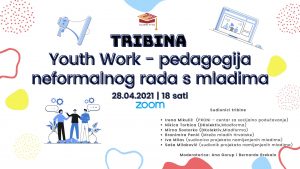
Cooperation between the Alumni Association of the Faculty of Humanities and Social Sciences in Osijek and the Faculty’s Department of Pedagogy resulted in a panel discussion held via Zoom on 28 April 2021. The event focused on youth work and aimed to familiarise participants with the concept. To help the audience understand the field, the moderators hosted four professionals working in youth work and two young people who had participated in non-formal youth work programmes.
Youth work from a professional perspective was discussed by Irena Mikulić, Head of the Education Department at the PRONI Centre for Social Education; Nikica Torbica, Head of Društveni Atelje, co-founder of the Mladforma youth initiative and President of the Executive Board of the FFOS Alumni Association; Mirna Šostarko, also a co-founder of the Mladforma youth initiative and an associate at the Croatian Volunteer Development Centre; and Branimira Penić, a member of the Executive Board of the Croatian Youth Network. The perspective of young people who had participated in youth projects was presented by two outstanding young individuals: Iva Milas, a first-year student at a language grammar school, and Saša Milaković, a second-year student at the Faculty of Economics in Osijek. The discussion was complemented by a video produced by Iva Milas, which illustrated the benefits of participating in such projects. The panel was moderated by Ana Gorup and Bernarda Brekalo, students of Croatian Language and Literature and Pedagogy at the Faculty of Humanities and Social Sciences in Osijek.
Family Strengthening Programme
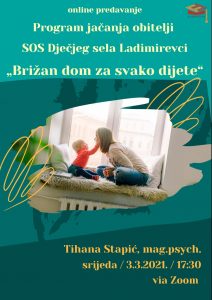
On Wednesday, 3 March 2021, a lecture entitled Family Strengthening Programme – A Caring Home for Every Child was held. The lecture was organised online via Zoom, beginning at 5:30 p.m. and lasting one hour, and was delivered by Tihana Stapić.
The lecture aimed to raise awareness among a broad range of education professionals about the Family Strengthening Programme implemented by SOS Children’s Village Ladimirevci. The programme focuses on intensive support for vulnerable families, helping them overcome current life difficulties, strengthening parenting skills and supporting children and young people throughout their development, education and maturation. Its main objective is to prevent family breakdown and the removal of children from their families.
The Family Strengthening Programme in Osijek-Baranja County involves the social welfare centres of Osijek, Valpovo, Našice and Donji Miholjac, with financial support from Osijek-Baranja County and SOS Children’s Villages Croatia. The programme has been implemented in Osijek-Baranja County since 16 March 2016 and consists of a mobile team and a counselling centre. Its main objective is to enable children at risk of losing parental care to grow up in a caring family environment, prevent separation, support family reintegration and achieve self-sustainability. The mobile team provides educational, healthcare, social, psychological, parenting, financial and legal support, as well as assistance with improving housing and living conditions, food, recreation and clothing.
How to Become an eTwinner?
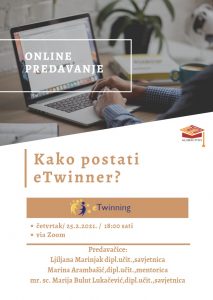
On Thursday, 25 February 2021, a lecture entitled How to Become an eTwinner was held. The lecture took place online via Zoom, beginning at 6 p.m. and lasting one hour.
The main aim of the lecture was to explain the eTwinning portal in greater detail and demonstrate how it can contribute to high-quality professional development. The lecture was divided into three parts, providing participants with both theoretical knowledge and substantial practical experience of using the eTwinning portal. The lecturers were primary school teachers from Ladimirevci Primary School, Ljiljana Marinjak, Marina Arambašić and Marija Bulut Lukačević, MSc, who had been using the eTwinning portal successfully for many years as part of their professional work.
The introductory part explained what eTwinning is and what the platform offers education professionals. The lecturer highlighted numerous advantages of working through eTwinning projects, including opportunities to cooperate with schools at local, national and European levels. Through the online platform and collaborative work, teachers can receive various recognitions and awards that may later contribute to their professional advancement. The introduction also presented the registration process step by step and explained how to begin using the platform.
In the second part, teacher Marina Arambašić provided a practical introduction to navigating the eTwinning online platform. By exploring the platform together in real time, participants learned how to create a profile and find other users and partners. They were introduced to the option of creating a personal portfolio and finding projects suited to their interests and abilities. Through a live demonstration of the portal, the lecturer also showed participants how they could monitor their personal progress on the platform.
In the final part of the online lecture, Marija Bulut Lukačević, MSc, introduced participants to TwinSpace. She explained that TwinSpace is the virtual environment in which eTwinning projects are developed. It is accessible only to teachers and students participating in the projects, although other stakeholders may also be invited. Participants were informed that TwinSpace enables users to organise their own projects with collaborative tools and online meetings. Through a live demonstration, the lecturer explained how to design pages and content, upload materials online and organise online meetings for project partners.
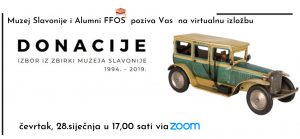
Exhibition “Donations – A Selection from the Collections of the Museum of Slavonia, 1994–2019” – A Virtual Tour of the Museum of Slavonia
The lecture and guided tour were held in the early evening of Thursday, 28 January 2021, ahead of Museum Night. It was the first virtual guided tour held at the Museum of Slavonia and was attended by several interested teachers and students. After a brief introduction and presentation of the host, moderator Ivan Lenard, PhD, gave the floor to the presenter. The host, Branislav Miličić, MSc, a curator at the Museum of Slavonia, began by introducing visitors to the work of a curator and explaining what happens to an object after it enters a museum. Participants learned about the different ways in which objects may arrive at a museum and what curators and museum technicians must do to transform them into museum exhibits.
The virtual tour of the exhibition “Donations – A Selection from the Collections of the Museum of Slavonia, 1994–2019” was led by our host, the Head of the Numismatic Department of the Museum of Slavonia in Osijek. He introduced participants to interesting objects that had entered the Museum as donations and, after professional processing, became museum objects ready for exhibition. These included donated books, old student meal vouchers from Josip Juraj Strossmayer University and even old mobile phones that had begun a new life as museum exhibits.