
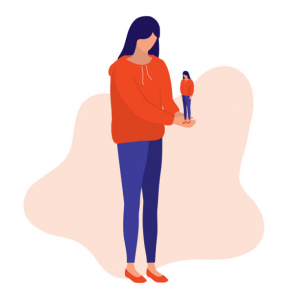
In the simplest terms, self-esteem is the answer to the questions: “What am I like?” or “What is my worth?”.
Self-esteem is not something we are born with; rather, it develops throughout our lives. Many factors influence our self-image, such as life experiences, messages received from important people while growing up and similar influences. However, different ways of thinking also affect how we respond to events, what we think about ourselves, how we feel and how we cope with stress.
What does self-esteem depend on?
Locus of control
Locus of control refers to how we perceive the causes of events and how much responsibility we generally assume for events in our lives, whether positive or negative.
We distinguish between an internal and an external locus of control.
An internal locus of control is characteristic of people who take personal responsibility for events and outcomes and believe that they can influence or control many outcomes. They view themselves as the source of control over their own actions and destiny.
Accepting our share of responsibility is empowering because it directs our thinking towards what we can do in a particular situation or how we can improve it. Even when objectively unable to influence events or outcomes themselves, a person with an internal locus of control will rarely give in to negative thoughts and self-pity, but will instead retain control over their own reactions.
An external locus of control is characteristic of people who believe that outcomes are controlled by external factors, assume less personal responsibility and do not believe that they can control outcomes.
Why is an internal locus of control important? Because a sense of control matters. Events that we believe we can control are far less stressful than those we believe we cannot control. If we think that we have no control over different outcomes, we feel rather helpless and frightened. Taking responsibility encourages us to think about potential solutions and enables us to view the problem more objectively.
People with lower self-esteem are more likely to expect failure, embarrassment or other negative reactions, which causes them to feel uncomfortable in many situations.
Other factors that lead to low self-esteem
We have already established that the way we evaluate ourselves is extremely important for self-esteem, coping with stress and psychological well-being in general. People with lower self-esteem are regularly overly self-critical.
Everyone sometimes experiences moments when they forget their positive qualities, focus on the negative ones and consequently feel discouraged and insecure. Most of the time, however, these moments pass without negative consequences. If, on the other hand, we go through life following extremely strict rules, we are highly likely to experience such difficult moments frequently because we will constantly focus on our negative qualities.
Self-criticism stems from the way we evaluate ourselves. Many people use their own expectations, the opinions of others or comparisons with others as sources of information about themselves.
We sometimes have unrealistic expectations or excessively high standards for ourselves. Although having high standards can be positive because they motivate us to achieve, unrealistic expectations (“being good at everything”) and excessively high standards (“being the best”) can be a major source of stress.
Comparison with others is always a losing game! The very need to compare ourselves with others stems from insufficient reliance on our own standards of worth and a need for external validation. The problem with comparison is that we never have enough information about others, yet we believe that our perception of them is accurate. It is therefore important to recognise errors in our thinking so that we can correct them.