
20 and 22 May 2026
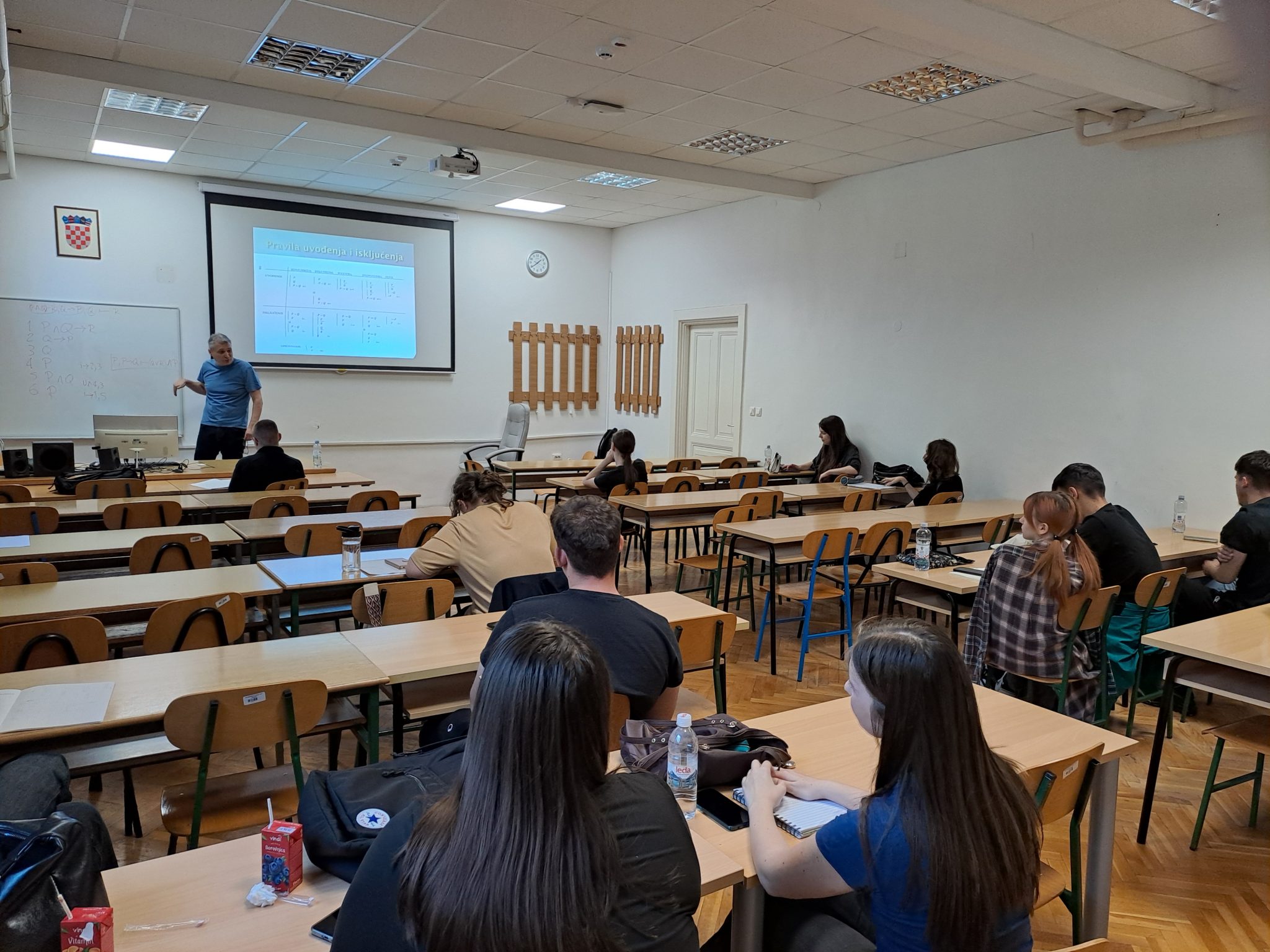
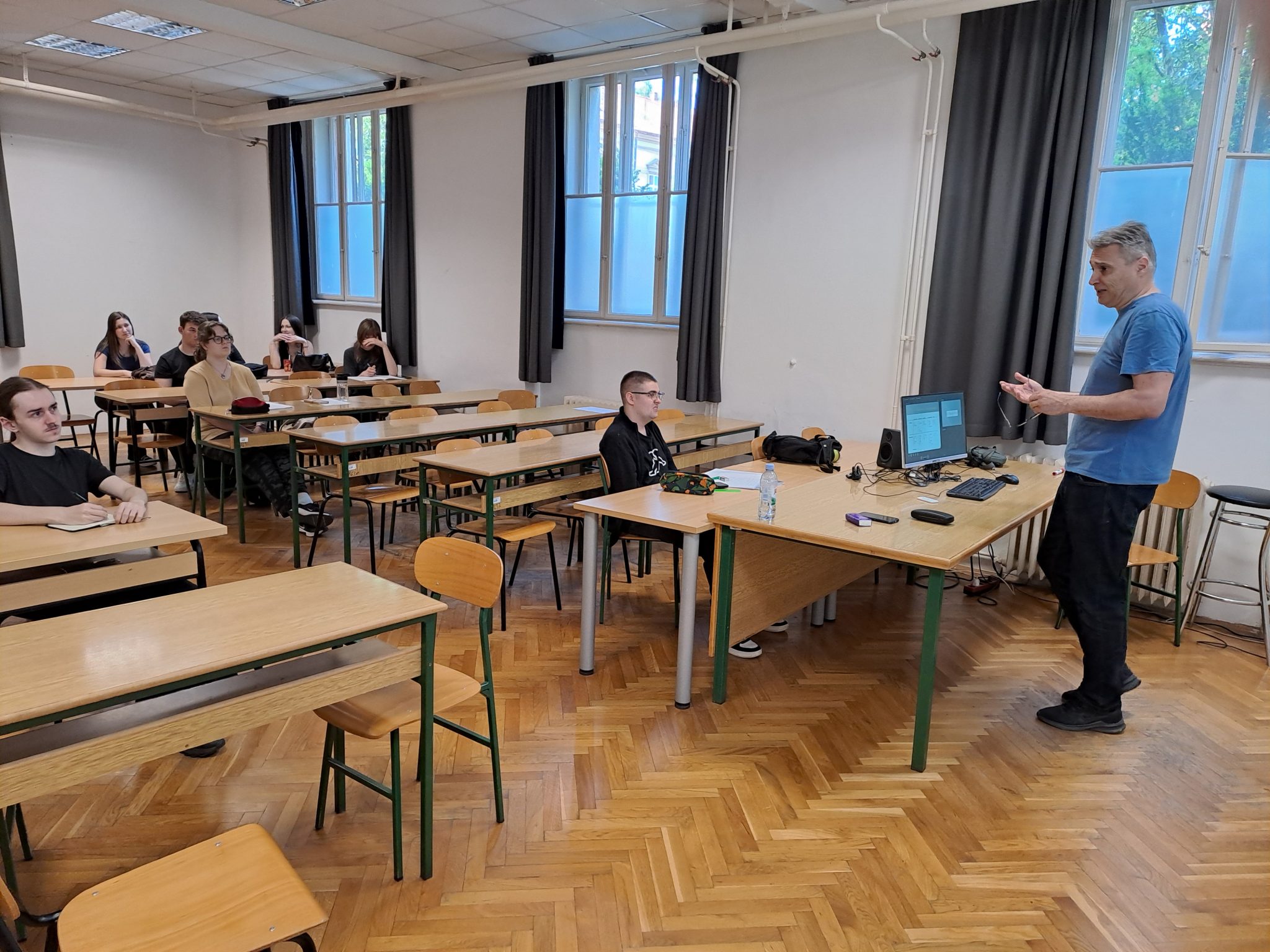
Professor Vladimir Drekalović, PhD, from the Faculty of Philosophy, University of Montenegro, delivered two guest lectures at the Faculty of Humanities and Social Sciences in Osijek (20 and 22 May 2026). Both lectures were delivered to first-year undergraduate students of the double-major Philosophy programme as part of lectures and practical classes in the course Logic.
In the first lecture, he introduced students to the theoretical foundations of natural deduction in propositional logic. He first discussed the historical context of the emergence and development of this system of logical inference, particularly the ideas of the German mathematician Gerhard Gentzen and the Polish logician Stanisław Jaśkowski, after which he presented the basic rules on which the system is based. In doing so, he used the so-called Fitch notation, introduced in the 1930s by the American logician Frederic Brenton Fitch.
In the second lecture, students were given exercises in which they had to apply the rules they had learned. Following one of the fundamental pedagogical principles, he progressed from easier to more complex tasks, focusing on exercises involving the introduction or elimination of conjunction and implication, as well as the introduction of disjunction. Students solved the exercises independently or in pairs and publicly presented their results.
Professor Drekalović presented the material with ease and patiently explained content which, due to its high degree of formalisation and abstraction, is considered particularly demanding both to teach and to master. For this reason, he placed special emphasis on explaining the practical use of the natural deduction system. I am convinced that all of this contributed to many students successfully solving the assigned exercises and becoming prepared to tackle more demanding types of tasks.
Text and photographs:
Hrvoje Potlimbrzović
6 May 2026
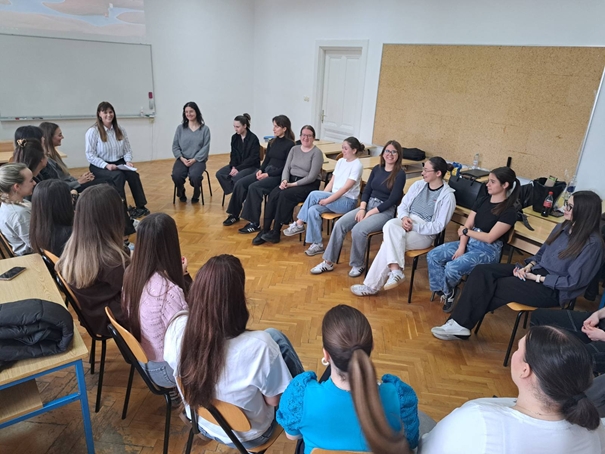
Monika Ećimović, psychologist and Gestalt psychotherapist, delivered a guest lecture on 6 May 2026 entitled “The Gestalt Psychotherapy Approach in Working with Clients”. The lecture was intended for first-year graduate students of Psychology. Students were introduced to the theory and practice of psychotherapeutic work based on Gestalt principles by a licensed Gestalt psychotherapist. Ms Ećimović is a former student from the first generation of Psychology graduates at FFOS and serves as an example to students of successful professional development and continued education after completing a degree in Psychology. Students also received information about the types and duration of licensed programmes leading to qualification as a psychotherapist in the field of Gestalt psychotherapy. This topic expands the course content through examples from practice presented by a licensed psychologist and psychotherapist. It also supplements the intended learning outcomes of the course Psychotherapy Approaches and builds on content from courses in clinical psychology and psychopathology.
Prof. Gorka Vuletić, PhD
1 April 2026
On Wednesday, 1 April 2026, a guest lecture by Prof. Dragutin Kermek, PhD, from the Faculty of Organization and Informatics was held in the Small Ceremonial Hall (Room 39) of the Faculty of Humanities and Social Sciences in Osijek. The lecture, entitled “Challenges in Multithreading and the Use of Reflection in the Java Programming Language”, was organised as part of the course Programming 2 in the double-major graduate study programme in Information Technologies, at the invitation of Assoc. Prof. Tomislav Jakopec, PhD, himself an FOI alumnus.
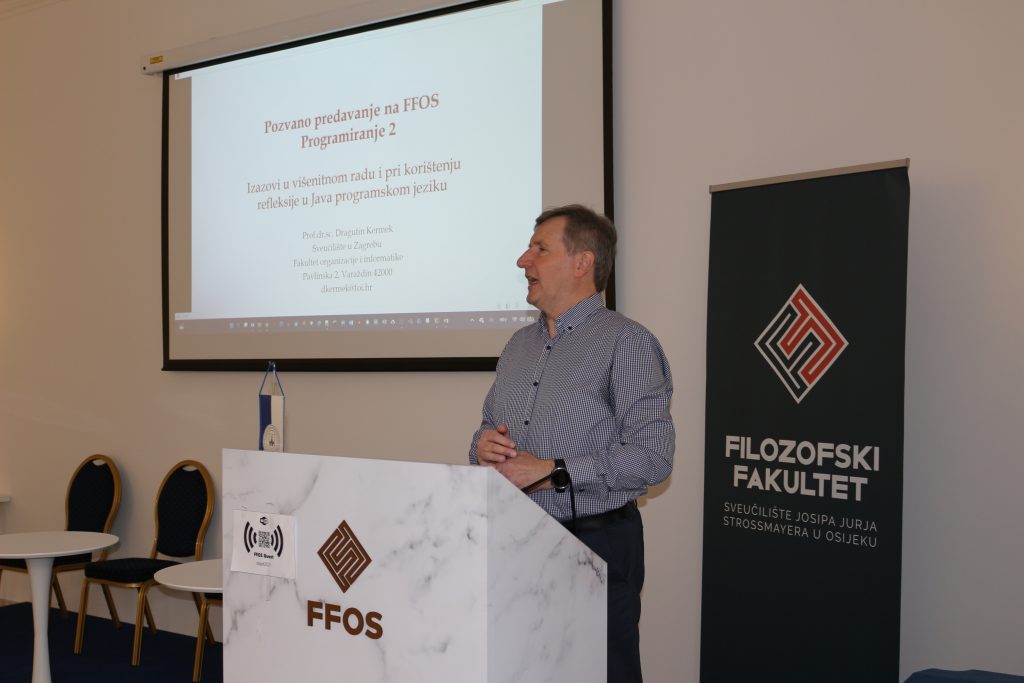
During the lecture, Professor Kermek presented in detail the key concepts of multithreaded programming, with particular emphasis on threads, their creation, management and application in real programming situations. Through a series of concrete examples, he introduced students to the complexity of parallel task execution as well as to the potential challenges associated with such an approach. In the final part of the lecture, the concept of reflection in Java and its connection to thread operation were further explained.
The lecture took place in a highly engaged atmosphere and, in addition to the theoretical framework, provided students with valuable insight into practical aspects of programming. Guest lectures of this kind are particularly valuable because they enable students to connect academic knowledge with concrete practical experience, contributing to a deeper understanding of the material and preparation for future professional work. Professor Jakopec often seeks to organise guest lectures within his courses and to show students how to make practical use of what they have learned during the course.
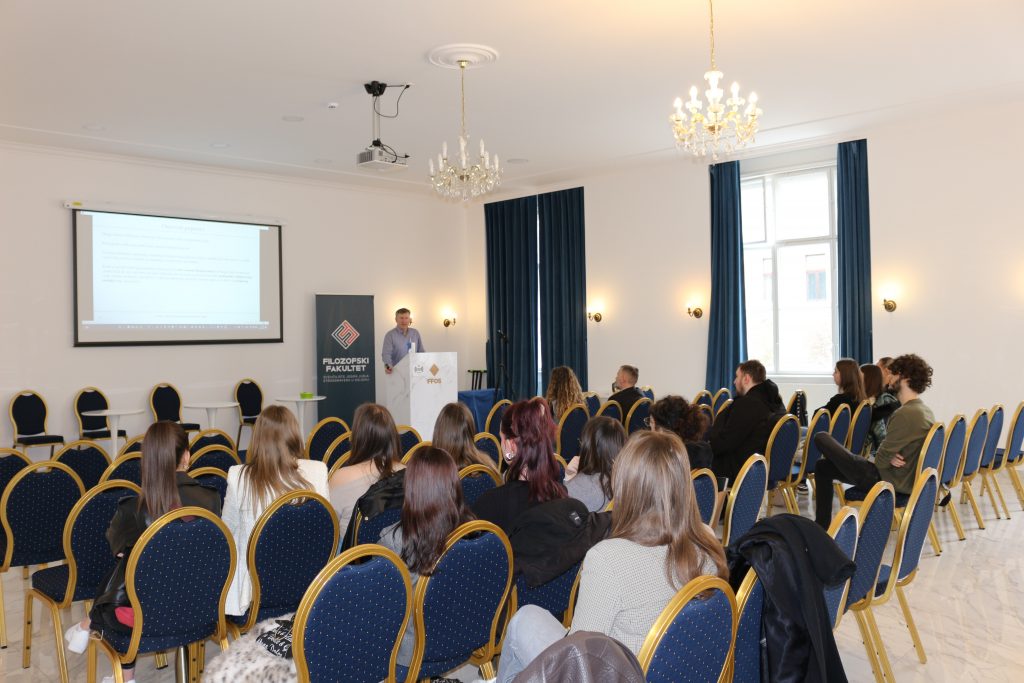
This is precisely where the additional value of hosting a lecturer from FOI lies, as the institution is recognised for its strong integration of IT knowledge with a business context. Students thus had the opportunity to learn from an expert working at the intersection of technology and the real sector, making lectures of this kind especially relevant and useful.
As the students pointed out, the lecture was very interesting, clear and educational, and those present considered it a privilege to attend a presentation by an experienced programming expert.
Text: Roman Šimunović
Photographs: Karla Bulum
1 April 2026
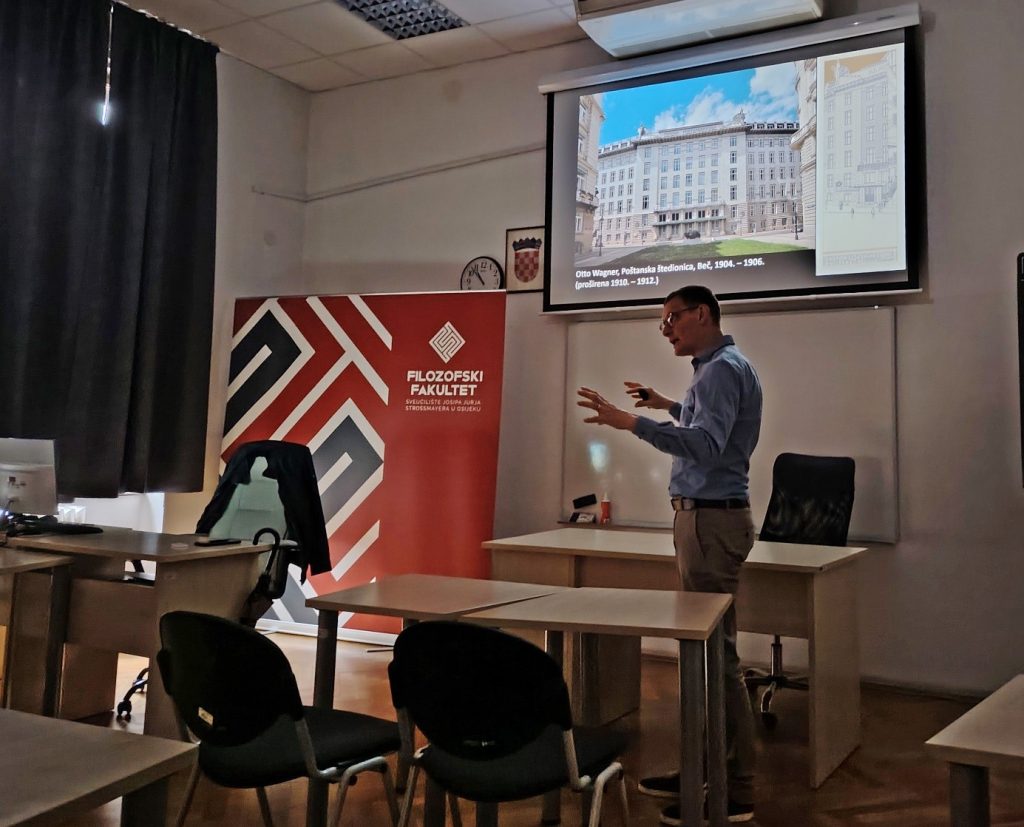
On Wednesday, 1 April 2026, as part of the planned guest lectures at the Chair of Art History, Prof. Dragan Damjanović, PhD, from the Department of Art History at the Faculty of Humanities and Social Sciences in Zagreb delivered a guest lecture. The lecture was held as part of the course Art of the 20th Century within the undergraduate study programme in Art History, in Room 34 from 9:30 a.m. to 11:20 a.m. The lecture was attended by third-year undergraduate Art History students. The topic of the lecture was modern architecture in the first half of the 20th century. As a leading Croatian expert in the history of 19th- and 20th-century architecture, Prof. Dragan Damjanović, PhD, provided a substantial overview of European and world architecture, as well as the most important Croatian examples, presenting a series of interesting details and shaping the cultural-historical and political context of the emergence and development of modern architecture in Europe and America. This highly interesting and successfully delivered lecture formed part of the syllabus of the course Art of the 20th Century.
Asst. Prof. Daniel Zec, PhD
26 March 2026
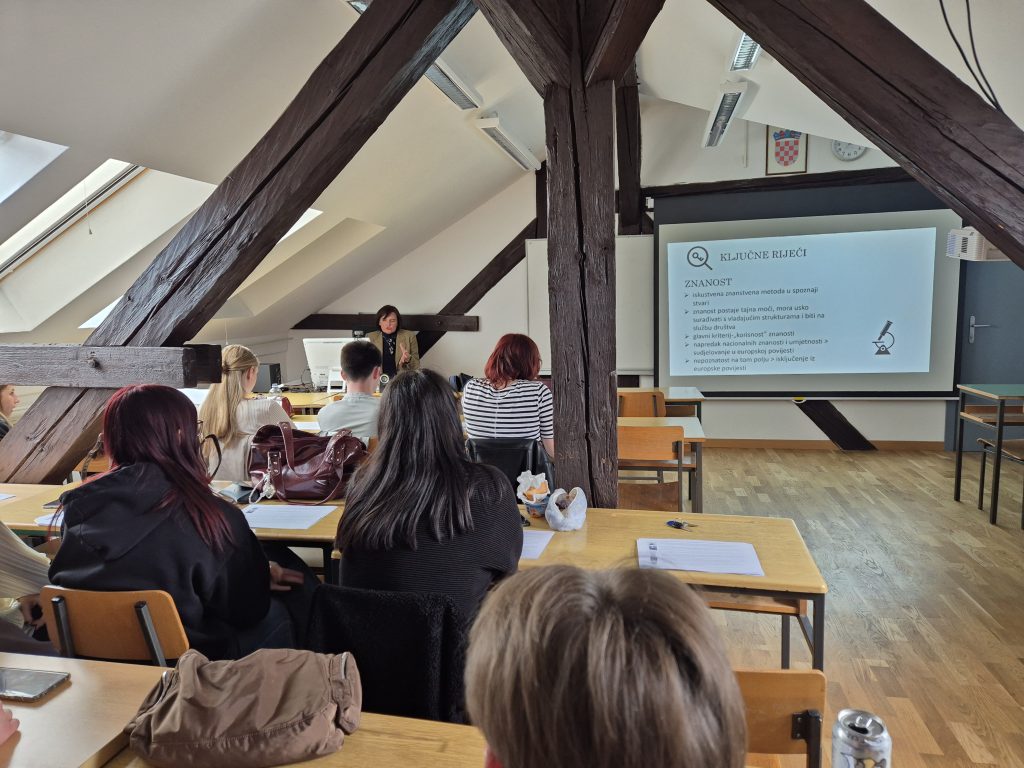
On 26 March 2026, from 12:20 p.m. to 2:00 p.m. in Room 96, as part of the compulsory course World History of the Early Modern Period for second-year students of the double-major undergraduate study programme in History and for all other interested students and Faculty staff, a lecture was delivered by senior research adviser Teodora Shek Brnardić, PhD, of the Croatian Institute of History in Zagreb. The lecture was entitled HRZZ Project “Between Knowledge and Ignorance” and the Keywords of the Enlightenment in the Croatian Lands. The lecturer presented her own leadership of a research project funded by the Croatian Science Foundation and discussed research based on written sources concerning the 18th century in the Croatian lands, particularly the influence of Enlightenment ideas on the social and overall development of the Croatian lands during that period. During the lecture, she engaged the students in discussion about Croatian Enlightenment aspirations during the 18th century and explained how Enlightenment ideas influenced the work of Croatian intellectuals of the period. After the highly interesting lecture, students and the attending lecturers asked the guest speaker several questions.
Assoc. Prof. Anđelko Vlašić, PhD
25 March 2026
As part of Francophonie Days 2026, Suzana Mistro visited the Faculty of Humanities and Social Sciences in Osijek on 25 March at 12:30 p.m. In a bilingual Croatian-French lecture, Ms Mistro introduced the geographical and cultural characteristics of the Valais region, a Swiss canton located in the south of the country. In addition to remaining multilingual today – its official languages are French and German – the region’s geographical and geopolitical position has defined its dynamic historical development as an area crossed by important historical and trade routes, while at the same time remaining strongly rooted in tradition. The specific charm of the region is still marked by an interplay between relative isolation and openness to influences from outside the region.
Ms Mistro, a geography teacher by profession, has channelled her broader cultural interests into researching and popularising the rich heritage of the Valais region, which has in the meantime also become her home. She founded the Valais Cultural Heritage Festival and distinguished herself as a collaborator on the documentary film “In the Heart of the Alps – World Literature in the Swiss Alps”, which was screened after the lecture. In her presentation, she referred to well-known cultural and political figures such as John Evelyn, George Sand, Hans Christian Andersen, Katherine Mansfield, Alexandre Dumas, Harriet Beecher Stowe, Johann Wolfgang von Goethe, Charles Dickens, Mark Twain, Fyodor Mikhailovich Dostoevsky, James Baldwin and others, all of whom spent a period of their lives in Valais.
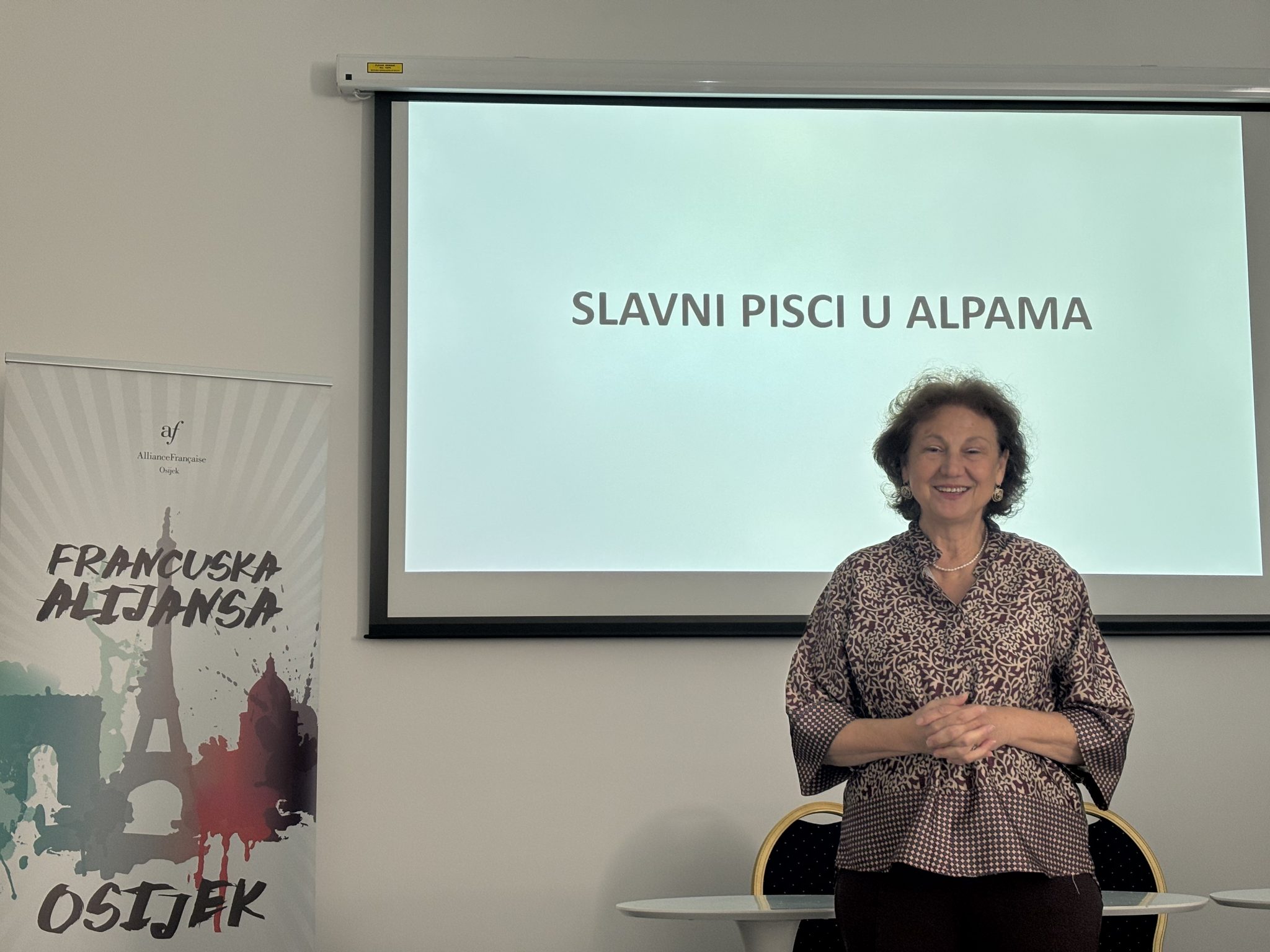
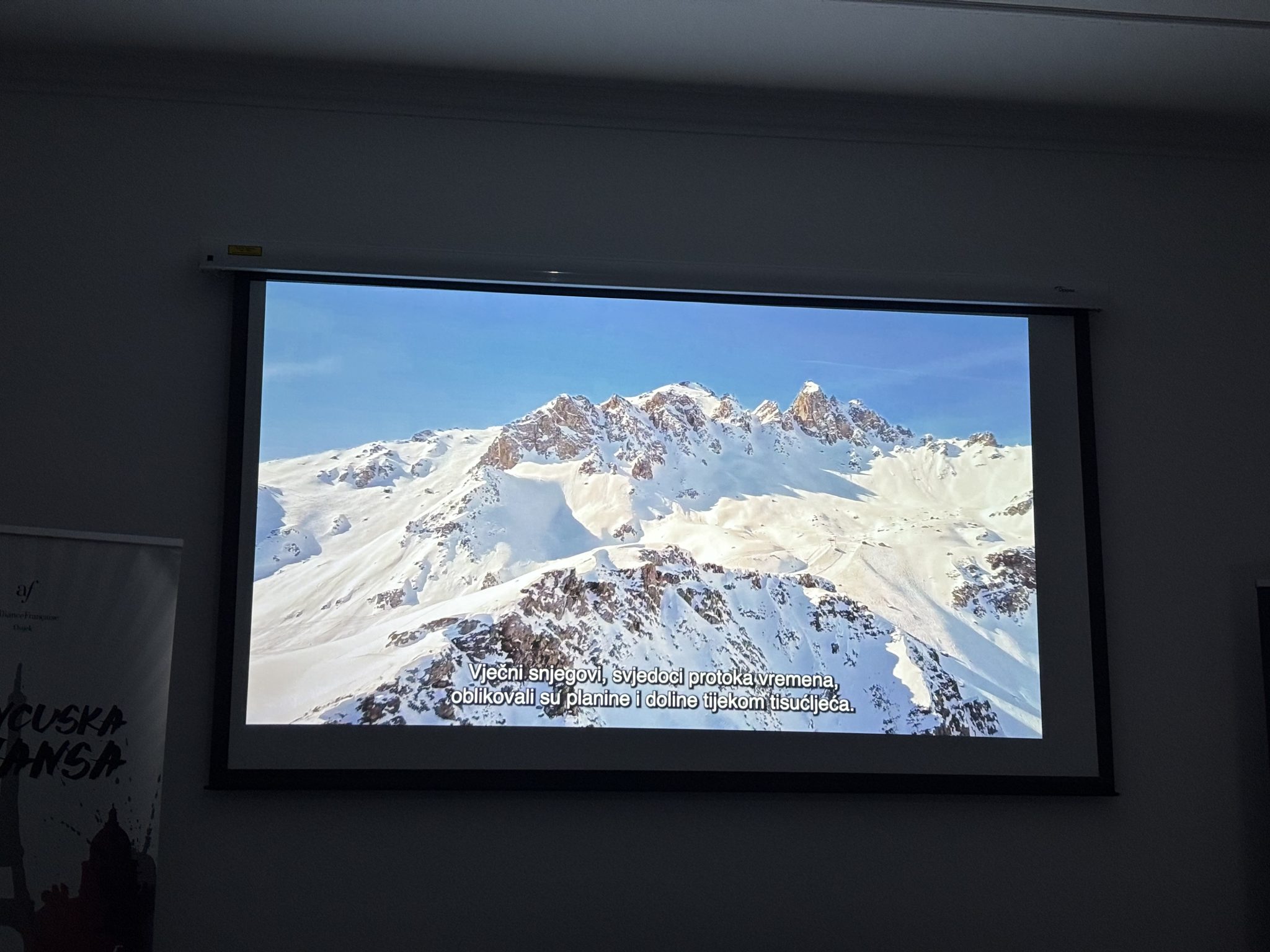
While the lecture introduced the audience to figures, especially writers, who left their mark on the region just as the region influenced them and their artistic expression, the documentary offered breathtaking views of the Swiss Alps, charming traditional hotels rich in history and other important cultural sites such as churches and museums. The approximately 90-minute documentary is visually impressive and rich in information provided by experts from different fields, ranging from archaeologists and historians to hoteliers.
Suzana Mistro was born in Belgrade and grew up in Omiš, where she still lives periodically. In her youth, she moved to Switzerland, where she was educated and worked in her profession and where she continues to reside primarily today. After the screening and a short discussion, she expressed great satisfaction at having had the opportunity to visit Osijek and become acquainted with the city and region, as maintaining Croatian-Swiss cultural ties is particularly important to her.
Asst. Prof. Stephanie Jug, PhD
17 March 2026
Marko Marincel, MA in Psychology and Human Resources Director at Factory, delivered a guest lecture on 17 March 2026 entitled “The Psychologist in an Organisation (How We Apply Social Psychology in an Organisation)”.
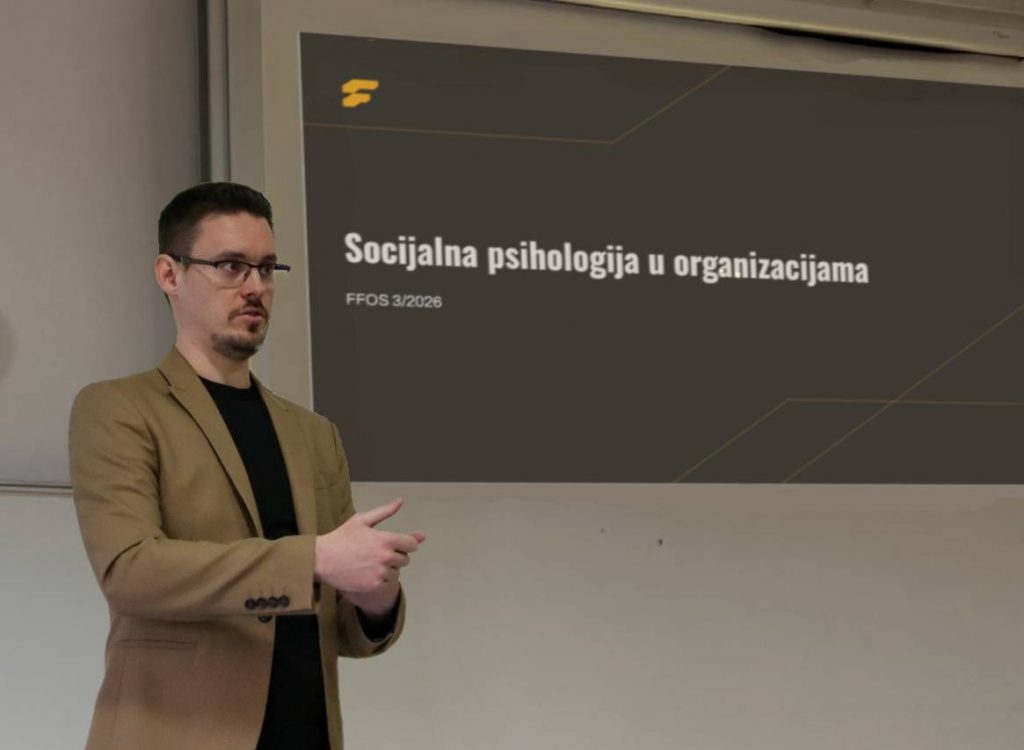
The lecture was intended for first-year students of the university single-major graduate study programme in Psychology. Students were introduced to possibilities for applying social psychology in the work of a company that is unique in operating exclusively in a digital environment in the post-pandemic period. They had the opportunity to learn about the importance of work roles, company norms, attitudes, leadership and social influence in an organisational environment. These and other important topics were presented in an interactive lecture by Mr Marincel, who is also an alumnus of the Faculty of Humanities and Social Sciences in Osijek. Using activities involving adapted realistic scenarios, the guest lecturer encouraged students to connect and apply knowledge from social psychology in an organisational context. Mr Marincel’s lecture also had an important motivational role, as he provides future psychologists with an example of how to actively and entrepreneurially create professional opportunities while grounding their work in psychological knowledge and awareness of labour-market needs.
Prof. Daniela Šincek, PhD
26. 11. 2025.
Guest Lecture by Prof. Sanja Ninković, PhD
Prof. Sanja Ninković, PhD, from the Department of German Studies at the Faculty of Philosophy in Novi Sad delivered a guest lecture on 26 November 2025 at the Department of German Language and Literature of the Faculty of Humanities and Social Sciences in Osijek entitled “Nonverbale Euphemismen und nonverbale Tabus im Deutschen” (“Non-Verbal Euphemisms and Non-Verbal Taboos in German”). The lecture was attended by undergraduate and graduate students of German Language and Literature, as well as fellow lecturers. Prof. Ninković first explained the concepts of euphemism and taboo in a simple, clear and student-friendly manner, and then discussed, in the same way, the origins and function of taboos in society, their existence in every language and culture, and the attitudes of members of linguistic and cultural communities towards them. The lecturer addressed the issue of non-verbal taboos interactively, giving examples from the European cultural sphere as well as from other cultures, while emphasising the importance of knowing the target culture and its specific features. Since euphemisms are inevitably associated with taboos, the second part of the lecture focused on recognising non-verbal euphemisms in different contexts. Prof. Ninković provided numerous examples of non-verbal euphemisms from her own teaching experience as well as from pop culture, the media and everyday communication. The guest lecture was not only extremely interesting to both students and fellow lecturers, but also encouraged them to recognise non-verbal euphemisms and taboos in their own environment.
Assoc. Prof. Ivana Jozić, PhD
14. 11. 2025.
Guest Lecture “Language Mediation in the European Union – Translators’ Experiences”
On Friday, 14 November 2025, as part of the course Consecutive Interpreting taught in the second year of the graduate study programme in Hungarian Language and Literature, translator and lecturer Claudia Ölbei delivered a guest lecture. She spent ten years working as a translator at the European Parliament and has worked in Strasbourg at the European Court since 2014. Her lecture entitled Language Mediation in the European Union – Translators’ Experiences focused on the specific features of interpreting at the European Court from the perspective of a translator whose working languages are English, German, French, Hungarian and Portuguese. The lecture was followed by a workshop in which students were able to participate actively in the process of consecutive interpreting from Hungarian into Croatian and English, while also having the opportunity to apply appropriate translation strategies and procedures in accordance with the intended learning outcomes of the course.
Asst. Prof. Timea Bockovac, PhD
24. 4. 2025.
Report on a Guest Lecture
On 24 April 2025, from 12:20 p.m. to 2:00 p.m. in Room 62, as part of the compulsory course Croatian History of the Early Modern Period for second-year students of the double-major undergraduate study programme in History and for all other interested students and Faculty staff, a lecture was delivered by Szabolcs Varga, PhD, a historian employed at the Institute of History of the Research Centre for the Humanities in Budapest.
The lecture was entitled The Ottoman Period in Hungarian Historiography and Historical Memory. The lecturer drew on many years of his own research into the topic and on the study of written sources concerning the period of Ottoman rule in the territories of present-day Croatia and Hungary during the early modern period, as well as on research into historiographical production on those topics in later periods. During the lecture, he described how the Ottoman period has been represented in historiographical works and what kind of trace it has left in historical memory. Today, for example, there is a positive image of the Ottoman period in Hungary, while the Habsburg dynasty, which ruled the country from 1526 to 1918, is viewed very negatively. In Croatia, however, the situation developed differently and the image of the Ottoman period has remained negative. After the highly interesting lecture, students and the attending lecturers asked the guest speaker several questions.
Szabolcs Varga, PhD, is a historian employed at the Institute of History of the Research Centre for the Humanities in Budapest. His research focuses on the history of Hungary during the early modern and modern periods. He is the author of numerous books and articles, including works on topics related to Croatia and Slavonia in those historical periods.
Assoc. Prof. Anđelko Vlašić, PhD
23. 4. 2025.
Report on a Guest Lecture
Monika Ećimović, psychologist and Gestalt psychotherapist, delivered a guest lecture entitled “The Gestalt Psychotherapy Approach in Working with Clients” on 23 April 2025.
The lecture was intended for first-year graduate students of Psychology. Students were introduced to the theory and practice of psychotherapeutic work based on Gestalt principles by a licensed Gestalt psychotherapist. Ms Ećimović is a former student from the first generation of Psychology graduates at FFOS and serves as an example to students of successful professional development and continued education after completing a Psychology degree. Students also received information about the types and duration of licensed programmes leading to qualification as a psychotherapist in the field of Gestalt psychotherapy. This topic expands the course content through examples from practice presented by a licensed psychologist and psychotherapist. It also supplements the intended learning outcomes of the course Psychotherapy Approaches and builds on content from courses in clinical psychology and psychopathology.
Prof. Gorka Vuletić, PhD
17. 4. 2025.
Guest Lecture by Prof. Dragan Damjanović, PhD
On Thursday, 17 April 2025, as part of the planned guest lectures at the Chair of Art History, Prof. Dragan Damjanović, PhD, from the Department of Art History at the Faculty of Humanities and Social Sciences in Zagreb delivered a guest lecture. The lecture was held as part of the course Art of the 20th Century within the undergraduate study programme in Art History, in Room 46 from 10:35 a.m. to 1:00 p.m. The lecture was attended by third-year undergraduate Art History students. The topic was modern architecture in the first half of the 20th century. As a leading Croatian expert in the history of 19th- and 20th-century architecture, Prof. Dragan Damjanović, PhD, provided a substantial overview of European and world architecture, as well as the most important Croatian examples, presenting numerous interesting details and shaping the cultural-historical and political context of the emergence and development of modern architecture. This highly interesting and successfully delivered lecture formed part of the syllabus of the course Art of the 20th Century.
Asst. Prof. Daniel Zec, PhD
27. 3. 2025.
Guest Lecture Literary Techniques in William Faulkner’s Yoknapatawpha Fiction
On 27 March 2025, as part of the elective course Literature of the American South for first-, second- and third-year students of the university double-major undergraduate study programme in English Language and Literature, as well as for all other interested students and Faculty staff, a lecture was delivered by Prof. Selma Raljević, PhD, from the Faculty of Humanities in Mostar. The lecture was entitled Literary Techniques in William Faulkner’s Yoknapatawpha Fiction. William Faulkner is one of the most important writers of the American South and of American, as well as world, modernist literature. His fictional Yoknapatawpha County, located within the real US state of Mississippi, serves as the setting for most of his novels and short stories. The aim of the lecture was to introduce students to the narrative techniques and styles found in William Faulkner’s Yoknapatawpha fiction and to analyse them using an example from one of Faulkner’s works belonging to the Yoknapatawpha cycle.
22. 1. 2025.
Stanislava Kuharski Delivers Guest Lecture Mindfulness in Teaching
On 22 January 2025, a lecture entitled “Mindfulness in Teaching” was delivered by teacher Stanislava Kuharski from Franjo Krežma Primary School, who is also a prominent expert in the field of positive psychology. The lecture brought together students of teacher education programmes at the Faculty of Humanities and Social Sciences and provided them with a unique insight into the use of mindfulness techniques in teaching.
Ms Kuharski opened the lecture by emphasising the importance of the school environment as a place that should not only provide knowledge but also equip students to face the challenges of future academic, professional and private life. In this context, mindfulness, as part of positive psychology, offers a tool for strengthening the mental health, creativity and general well-being of both students and teachers. Participants were introduced to techniques that help reduce stress, improve concentration and develop positive thinking. Through practical exercises and guided visualisation, the lecture demonstrated how elements of mindfulness can be integrated into foreign-language teaching. Examples of good practice were also presented, as well as successful projects through which the implementation of these methods has been introduced in European schools. Participants acquired theoretical and practical knowledge of simple techniques that can improve the quality of life and work in the classroom. Ms Kuharski emphasised that mindfulness contributes not only to academic success but also to emotional and mental development, making teachers and students more resilient to stress and challenges. The lecture opened the door to new perspectives that promote the importance of mental health in education. Participants left with useful tools and inspiration for further application of mindfulness in their work, thereby contributing positively to the education system as a whole.
This lecture represents another step towards creating schools that educate happy, healthy and successful generations ready for the future.
22. 1. 2025.
Nikolina Begović Delivers Guest Lecture From University Back to School
As part of the course Information and Communication Infrastructure in the graduate study programme in Information Technologies, our former student Nikolina Begović, an Informatics teacher at Ivan Filipović Primary School in Osijek, delivered a guest lecture entitled From University Back to School. Nikolina shared her experiences of studying and finding employment and introduced students to work in a primary school.
Assoc. Prof. Tomislav Jakopec, PhD
9. 11. – 19. 12. 2024.
QA Skills at FFOS
From 9 November to 19 December, five lectures under the shared title QA Skills were organised at our Faculty for IT@FFOS students, for whom participation was compulsory, as well as for other participants who passed Endava’s selection process:
Software Testing – From zero to QA by Ivana Maleš Galić, Agile/Scrum 101 by Marija Holjevac, QA’s role in the project – Veni, vidi, vici! by Cvijetin Vidaković, Visual Testing mobile applications by Ana Boras and What is Test Automation and why it is important? by Viktor Novački.
A total of 25 participants took part in the Skills programme and were awarded certificates of participation at the end. We thank the employees of Endava for another year of excellent cooperation!
Assoc. Prof. Tomislav Jakopec, PhD
17. 12. 2024.
Ana Mumović Delivers Online Guest Lecture in the Course Contemporary World Literature
As part of the course Contemporary World Literature, Ana Mumović, senior research associate at the Institute for Serbian Culture in Priština, delivered a lecture entitled The Contemporary Relevance of Danilo Kiš’s Work to first- and second-year graduate students and third-year undergraduate students of Croatian Language and Literature.
While presenting Danilo Kiš’s biography, A. Mumović focused on those aspects of his life that had a considerable influence both on the author himself and on the reception of his work. Particular attention was paid to the literary treatment of prohibited subjects that were regularly and rigorously sanctioned in communist countries.
In terms of literary practice, the largest part of the lecture was devoted to presenting D. Kiš’s cult work A Tomb for Boris Davidovich, its reception at the time of publication (1976), and its reception and relevance today.
The lecture was held on Tuesday, 17 December 2024.
Marica Liović
4. 12. 2024.
Elena Palčić Delivers Online Guest Lecture in the Course Information Sources and Services
As part of the course Information Sources and Services, MA in Library Science Elena Palčić from the National and University Library in Zagreb delivered an online lecture to second-year undergraduate students of Information Sciences entitled Ask a Librarian – Subject Searching: Experiences from the National and University Library in Zagreb. The lecture was held on Wednesday, 4 December 2024.
The lecture introduced students to the work of the User Services Department, within which the Ask a Librarian service is provided at the National and University Library in Zagreb. Particular attention was devoted to the organisation of reference librarians’ work and the provision of the Ask a Librarian service, statistics on submitted queries, and challenges in working with users while providing the service.
Assoc. Prof. Snježana Stanarević Katavić, PhD
28. 11. 2024.
Procedure for Categorising Students for an Appropriate Form of Schooling – A School Psychologist’s Perspective
On 28 November 2024, Ljiljana Šapić Kozar, MA in Psychology, delivered a guest lecture within the course Educational Psychology I to first-year graduate students of Psychology on the topic “Procedure for Categorising Students for an Appropriate Form of Schooling – A School Psychologist’s Perspective”.
The introductory part of the lecture was devoted to a discussion of the duties of a school psychologist in primary school. The largest part of the lecture focused on how to recognise when a child needs a special form of schooling and on diagnostic tools that provide a clearer picture of the source of a student’s difficulty in mastering the school curriculum.
At the end of the lecture, students were given insight into several examples of psychologists’ reports on the basis of which, together with other findings and information, decisions are made regarding an appropriate form of schooling.
Ljiljana Šapić Kozar works as a school psychologist at Vladimir Becić Primary School in Osijek.
25. 11. 2024.
Guest Lecture by Darija Novoselović Entitled “Ethical Dilemmas and Challenges in the Work of a School Psychologist”
On 25 November 2023, psychology teacher Darija Novoselović delivered a guest lecture to second-year graduate students of Psychology entitled “Ethical Dilemmas and Challenges in the Work of a School Psychologist”. Darija Novoselović has worked as a school psychologist at the Electrical Engineering and Traffic School Osijek for the past 14 years. She completed her Psychology degree at the Department of Psychology of the Faculty of Humanities and Social Sciences in Zagreb.
The first part of the lecture was devoted to contextualising the work and role of psychologists in the school system, with an emphasis on work in secondary schools. In the second part, students had the opportunity to practise resolving ethical dilemmas using concrete examples from school practice and to receive feedback on the actual solutions to those dilemmas as well as the real consequences for participants in ethically demanding situations. Together with the lecturer, students summarised potential challenges in resolving ethical dilemmas.
31. 5. 2024.
Guest Lecture by Bojan Miljević, PhD, Entitled “The Role of Technologists in the Protection of Cultural Heritage”
As part of the course Management of Cultural Heritage Preservation and Presentation in the first year of the double-major graduate study programme in Information Sciences, Bojan Miljević, PhD, senior research associate at the Faculty of Technology in Novi Sad, delivered a guest lecture on 31 May 2024 entitled “The Role of Technologists in the Protection of Cultural Heritage”. The lecture was also attended by Art History students and colleagues from the Conservation Department in Osijek.
In his lecture, Dr Miljević presented the work of the Laboratory for Testing Materials in Cultural Heritage and emphasised that materials constituting movable and immovable cultural heritage are exposed to the effects of time, that is, deterioration. Such materials are examined using non-destructive or minimally invasive methods and techniques in order to determine their composition and structure, as well as the type and degree of degradation of a particular work of cultural heritage. The results of such research may also serve future generations as a form of historical documentation about the work of art or archaeological artefact itself. The lecture discussed the role of technologists in the protection of cultural heritage, that is, the various ways in which a scientific approach can contribute to a more successful and detailed characterisation of the materials comprising cultural heritage objects and how restoration and conservation can be approached in an interdisciplinary and holistic manner in order to preserve something of invaluable importance to the civilisation to which we belong.
25. 4. 2024.
Guest Lecture “Andrić’s World: Unity of the Work and Continuity of Ideas”
A guest lecture within the course Poetic Horizons of Ivo Andrić, entitled Andrić’s World: Unity of the Work and Continuity of Ideas, was held on 25 April 2024.
Prof. Miloš Đorđević, PhD, professor emeritus, designed the guest lecture around the fundamental results of the research published in his monograph of the same title.
He divided the lecture into two sections:
- The Eastern and Western models of the story
- The Eastern and Western models of culture,
and since the meeting was conceived as a discussion, several days before the guest lecture students were asked to prepare content necessary for its successful realisation (the concept of the story, the concept of culture, and they were asked to read the prologue and epilogue of Bosnian Chronicle, the novella The Story, the short story A Story from Japan and Andrić’s Nobel Prize acceptance speech On Stories and Storytelling). This form of presenting the results of scholarly research proved extremely successful, as most students actively participated in the heuristic discussion.
The aims and tasks of the guest lecture were complementary to the learning outcomes of the course Poetic Horizons of Ivo Andrić, while from a cultural perspective the completed tasks provided an affirmative supplement to the content of the course.
Marica Liović
15. 4. 2024.
Guest Lecture “The Fantastic in the Harry Potter Series”
On 15 April 2024, from 8:00 a.m. to 10:30 a.m. in Room 31, as part of the elective course “Popular Literature” for first-, second- and third-year students of the university double-major undergraduate study programme in English Language and Literature, and for all other interested students and Faculty staff, a lecture was delivered by Asst. Prof. Anđelka Raguž, PhD, from the Faculty of Humanities of the University of Mostar. The lecture was entitled The Fantastic in the Harry Potter Series. The aim of the lecture was to demonstrate that the popularity of J. K. Rowling’s Harry Potter series among readers of all ages is evidenced not only by the number of books sold but also by the continuing interest of literary criticism in the genre of the fantastic novel. During the lecture, Asst. Prof. Anđelka Raguž, PhD, analysed elements of the fantastic novel as well as elements of other canonical and popular genres such as the Bildungsroman, horror fiction and detective fiction, thereby confirming the preceding assumption. Students, attending lecturers and the guest speaker remained in constant interactive communication throughout the lecture.
Biljana Oklopčić
15. 4. 2024.
Guest Lecture by Prof. Jolán Orbán, PhD, “Forms of Melancholy and the Grotesque: László Krasznahorkai and Péter Eötvös”
Péter Eötvös’s Hungarian-language opera Valuska was performed on 2 December 2023 at the Hungarian State Opera in Budapest. The opera libretto was written by Kinga Keszthelyi and Mária Mezei and based on the Hungarian author László Krasznahorkai’s novel The Melancholy of Resistance (1989). The opera was available to watch free of charge for six months from 19 January 2024 on the OperaVision website. This was not the first adaptation of Krasznahorkai’s novel, as a film version entitled Werckmeister Harmonies (2000) had already been directed by Béla Tarr, but it was the novel’s first operatic adaptation.
In the first part of the lecture, Prof. Orbán explained the theoretical background and methodology for analysing Krasznahorkai’s book, referring to the analyses of authors such as Linda Hutcheon, Mónika Dánél and others who offer a broad approach to genre possibilities in the context of novel adaptation. The genre of Eötvös’s opera is comedia tragica, or grotesque opera, that is, film opera. Taking these performance characteristics into account, in the second part of the lecture Prof. Jolán Orbán presented the adaptation and reinterpretation of melancholy and the grotesque in the context of the opera, placing additional emphasis on the acoustic and visual roles of these phenomena.
The presentation used numerous materials and quotations that helped the audience understand what they heard and saw during the lecture. The lively and dynamic presentation was attended by second-, third- and fourth-year students of Hungarian Language and Literature, after which questions followed.
Žombor Labadi
11. 4. 2024.
Guest Lecture “The Gestalt Psychotherapy Approach in Working with Clients”
Monika Ećimović, psychologist and Gestalt psychotherapist, delivered a guest lecture on 11 April 2024 entitled “The Gestalt Psychotherapy Approach in Working with Clients”.
The lecture was intended for first-year graduate students of Psychology and third-year undergraduate students of Psychology. Students were introduced to methods and examples of psychotherapeutic work based on Gestalt principles by a licensed Gestalt psychotherapist. Ms Ećimović is a former student from the first generation of Psychology graduates at FFOS and serves as an example to students of successful professional development and continued education after completing a Psychology degree. Students also received information about the types and duration of licensed programmes leading to qualification as a psychotherapist in the field of Gestalt psychotherapy. This topic expands the course content through examples from practice presented by a licensed psychologist and psychotherapist. It also supplements the intended learning outcomes of the course Psychotherapy Approaches and builds on content from courses in clinical psychology and psychopathology.
Gorka Vuletić
3. 4. 2024.
Guest Lecture “The Eastern Adriatic Hinterland Between Ottoman and Venetian Rule”
On 3 April 2024, from 8:00 a.m. to 9:35 a.m. in Room 62, as part of the compulsory course Croatian History of the Early Modern Period for second-year students of the double-major undergraduate study programme in History and for all other interested students and Faculty staff, a lecture was delivered by Assoc. Prof. Marko Rimac, PhD, from the Faculty of Humanities and Social Sciences, University of Split. The lecture was entitled The Eastern Adriatic Hinterland Between Ottoman and Venetian Rule. The lecturer drew on many years of his own research into the topic and on written sources concerning the period of Venetian and Ottoman rule in the Littoral, Dalmatia and the entire eastern Adriatic coast during the early modern period. This period was marked by significant and dramatic changes that led to a complete redefinition of the political and geographical concepts of Croatian history. During the lecture, the lecturer examined how the emergence and evolution of the Venetian-Ottoman border on the eastern Adriatic coast and in the hinterland influenced this process. After the highly interesting lecture, students and the attending lecturers asked the guest speaker several questions.
Anđelko Vlašić
18. 3. 2024.
Guest Lecture “The 16th Century as a Turning Point: The Reformation and the Beginning of Catholic Confessionalisation”
On 18 March 2024, from 4:45 p.m. to 6:20 p.m. in Room 62, as part of the compulsory course World History of the Early Modern Period for second-year students of the double-major undergraduate study programme in History and for all other interested students and Faculty staff, a lecture was delivered by Asst. Prof. Maja Ćutić Gorup, PhD, from the Faculty of Humanities and Social Sciences, University of Rijeka. The lecture was entitled The 16th Century as a Turning Point: The Reformation and the Beginning of Catholic Confessionalisation. The lecturer drew on many years of her own research into the topic and on written sources concerning Habsburg rule in Istria, western Croatia and neighbouring lands. She pointed out that the Reformation spread in the 16th century thanks to the invention of the printing press and the support of ruling estates, which distanced themselves politically from the Habsburgs and the Catholic Church by establishing national churches. The major Ottoman threat directed Habsburg attention towards the south-eastern border of the Holy Roman Empire, thereby weakening efforts to suppress the Reformation within the Empire. The Peace of Augsburg of 1555 preserved peace in the Empire, but tensions between Catholic and Protestant estates increased due to the rise of Calvinism and the refusal of certain Habsburg rulers to recognise the settlement. The Catholic renewal and Counter-Reformation aimed at re-Catholicising areas permeated by new religious teachings. The struggle for the Bohemian throne and consequently for the crown of Holy Roman Emperor led into war and peace and ultimately resulted in the establishment of a balance of power in 1648. After the highly interesting and expert lecture, students asked the lecturer several interesting questions.
Anđelko Vlašić
7. 3. 2024.
Guest Lecture “Provenance Research of Works of Art in Zagreb Collections”
On Tuesday, 7 March 2024, as an addition to the planned guest lectures at the Chair of Art History, a guest lecture entitled Provenance Research of Works of Art in Zagreb Collections was held. The lecture took place as part of the course Research Methodology and Modes of Writing about Art in the undergraduate study programme in Art History, in Room 42 of the Faculty of Humanities and Social Sciences in Osijek. The lecture was delivered by Ljerka Dulibić, PhD, and Ivana Gržina from the HAZU Strossmayer Gallery of Old Masters, and by Tanja Trška, PhD, from the Department of Art History at the Faculty of Humanities and Social Sciences, University of Zagreb. The lecture was attended by second- and third-year undergraduate Art History students.
The lecture focused on provenance research of works of art in Zagreb collections. Using three concrete examples, the lecturers highlighted the problems and methodology involved in tracing the fate of works of art and art collections in Zagreb as a consequence of changing geopolitical circumstances in different periods of Croatian history, specifically before, during and after the Second World War. Works of art identified and contextualised from the perspective of provenance were examined using traditional art-historical methods, while the research procedures were grounded in archival documents and material traces on the artworks themselves.
The highly interesting and successfully delivered lecture was integrated into the syllabus of the course Research Methodology and Modes of Writing about Art. The expected outcome of the lecture was to demonstrate the fundamentals of provenance research methodology within the methodology of art history.
Daniel Zec
26. 1. 2024.
Guest Lecture “Multilingualism in the European Union – Translators’ Experiences”
On 26 January 2024, from 9:45 a.m. to 11:15 a.m., translator and lecturer Claudia Ölbei delivered a guest lecture as part of the elective course Consecutive Interpreting, taught in the second year of the graduate study programme in Hungarian Language and Literature. She spent ten years working as a translator at the European Parliament and has worked in Strasbourg at the European Court since 2014. In her interactive lecture entitled Multilingualism in the European Union – Translators’ Experiences, she provided a concise overview of the history of the multilingual European Union, with particular emphasis on the work of the European Court, highlighting the complex process of language mediation among 24 official languages. The second part of the session consisted of a workshop with active student participation. In addition to learning about different theoretical models of the interpreting process, students had the opportunity to apply appropriate interpreting strategies and procedures between Hungarian and Croatian in accordance with the intended learning outcomes of the course.
Timea Bockovac
8. 1. 2024.
Sanja Bunić Delivers Guest Lecture in the Course Information Sources and Services
As part of the course Information Sources and Services, library adviser Sanja Bunić from Zagreb City Libraries delivered a lecture to second-year undergraduate students of Information Sciences entitled Conflict Situations in Working with Library Users. The lecture was held on Monday, 8 January 2024, from 5:35 p.m. to 7:05 p.m.
The lecture addressed the importance of communication skills in both direct and indirect work with library users, especially in the context of conflict situations.
The content of the lecture drew on training conducted from late 2017 to late 2018 entitled Workshop on Resolving Conflict Situations in Zagreb City Libraries, whose aim was to empower librarians and improve their communication skills and methods of coping with workplace stress.
The lecture also included a discussion of possible ways of responding to examples of conflict situations from everyday library operations (e.g. refusal to pay overdue fines, replacement of lost or damaged materials, communication with people displaying violent behaviour, etc.).
Snježana Stanarević Katavić
19. 12. 2023.
Ethical Dilemmas and Challenges in the Work of a Clinical Psychologist
On 19 December 2023, Ivana Kostelac, University Specialist in Clinical Psychology, delivered a guest lecture to second-year graduate students of Psychology entitled “Ethical Dilemmas and Challenges in the Work of a Clinical Psychologist”.
The first part of the lecture was devoted to the relationship between professional and personal ethics and their influence on decision-making in clinical practice.
In the second part of the lecture, students had the opportunity to practise resolving ethical dilemmas using examples from clinical practice.
A model for resolving ethical dilemmas was then presented, with emphasis on resolving them depending on a person’s knowledge and motivation, and students were again able to practise resolving the stated ethical dilemmas independently using practical examples.
At the end of the lecture, students and the lecturer summarised all potential challenges in resolving ethical dilemmas, after which the lecture concluded with student questions related to the day’s topic and ethical challenges in the work of clinical psychologists more generally.
Ivana Kostelac is a clinical psychologist who has worked at Virovitica General Hospital for ten years. She initially worked in psychodiagnostics and counselling with children and adults, while over the past four years she has focused on working with children, young people and their families, as well as on the psychodiagnostics of childhood and adolescent disorders.
She completed her Psychology degree at Josip Juraj Strossmayer University of Osijek in 2012. In 2013 she completed Level 1 and in 2015 Level 2 training in cognitive behavioural therapy. In 2021 she completed training as a neurofeedback practitioner, and in 2023 she completed a postgraduate specialist programme in clinical psychology in Zagreb.
She is an active member of the community, a frequent guest on radio programmes and at lectures in public institutions, and since 2022 has served as Vice-President of the Society of Psychologists of Virovitica-Podravina County. She is also an active member and professional associate of the association of children and parents affected by diabetes “Type 1 Diabetes Club”.
Jasmina Tomašić Humer
15. 12. 2023.
Guest Lecture by Josip Mihaljević, PhD
Josip Mihaljević, PhD, from the Croatian Institute of History in Zagreb delivered a guest lecture at the Faculty of Humanities and Social Sciences in Osijek (Room 40) on 15 December 2023 entitled “Gastarbeiters in Socialism” as part of the elective course Croatian Emigration during the First and Second Modernisation, taught in the second year of the graduate study programme in History.
During the lecture, students had the opportunity to learn about the causes, consequences and circumstances surrounding economic emigration during the period of Yugoslav socialism, as well as the meaning of the term “Gastarbeiter”. Particular attention was given to analysing the reactions of the Yugoslav State Security Service (SDB) to this mass phenomenon, the social and territorial structure of economic emigration, and emigrants’ everyday lives. The lecture concluded with observations on the positive and negative economic and demographic effects of emigration during Yugoslav socialism, together with comparisons to the current wave of emigration, after which a discussion followed and students asked the lecturer a number of interesting questions.
The guest lecture by Dr Mihaljević contributed to achieving part of the learning outcomes planned within the course, including analysing the causes and consequences of emigration from the Croatian lands in the 20th century and reconsidering the influence of Croatian emigrants on social, political, economic and cultural developments in the homeland.
Domagoj Tomas
8. 12. 2023.
Procedure for Categorising Students for an Appropriate Form of Schooling – A School Psychologist’s Perspective
On 8 December 2023, Ljiljana Šapić Kozar, MA in Psychology, delivered a guest lecture to first-year graduate students of Psychology entitled “Procedure for Categorising Students for an Appropriate Form of Schooling – A School Psychologist’s Perspective”.
The first part of the lecture was devoted to discussing the duties of a school psychologist in primary school and how to recognise when a child needs a special form of schooling. Ljiljana Šapić Kozar discussed the diagnostic tools she uses to obtain as clear a picture as possible of the source of a student’s difficulty in mastering the school curriculum. Students were given insight into several examples of psychologists’ reports on the basis of which, together with other findings and information, decisions are made regarding an appropriate form of schooling.
In the second part of the lecture, Ljiljana Šapić Kozar discussed the available forms of appropriate schooling depending on a child’s particular difficulty.
Ljiljana Šapić Kozar works as a school psychologist at Vladimir Becić Primary School in Osijek.
Gabrijela Vrdoljak
4. 12. 2023.
Hrvoje Pavić Delivers Lecture in the Course Croatian and Regional Economic History of the 19th and 20th Centuries
Hrvoje Pavić, MA in History and Croatian Language and Literature and a doctoral student in History, delivered a lecture on 4 December 2023 in the course Croatian and Regional Economic History of the 19th and 20th Centuries entitled “Planned Economy in Socialist Yugoslavia – The Example of the Osijek Agro-Industrial Combine”. During the lecture, Pavić discussed the relationship between cooperatives and individual peasant farms and the securing of markets for goods. He explained the process through which the Osijek Agro-Industrial Combine (IPK) was established and the enormous influence it had on the development of the region from 1960 to 1990 – from improvements in production to scientific development in fields ranging from agriculture and chemistry to economics. Following the dissolution of Yugoslavia and during the phase of deindustrialisation, IPK Osijek was broken up into smaller companies.
14. 11. 2023.
Academic Sculptor Asst. Prof. Margareta Lekić, DA, Delivers Guest Lecture at FFOS
On Tuesday, 14 November 2023, as part of the planned guest lectures at the Chair of Art History, academic sculptor Asst. Prof. Margareta Lekić, DA, from the Academy of Arts and Culture of Josip Juraj Strossmayer University of Osijek delivered a guest lecture. The lecture entitled Sculptural Techniques and Materials was held as part of the course Selected Topics in the History of Sculpture in the undergraduate study programme in Art History, in Room 38 from 8:00 a.m. to 9:35 a.m. The lecture was attended by first- and third-year undergraduate Art History students enrolled in the elective course Selected Topics in the History of Sculpture. The highly interesting and successfully delivered lecture on sculptural techniques and materials, ranging from traditional to contemporary approaches, was integrated into the syllabus of the course Selected Topics in the History of Sculpture.
Daniel Zec
18. 10. 2023.
Osijek and Slavonia in the Memoirs of Jelica Belović-Bernadzikovska
Polish historian Tomasz Jacek Lis from the Jagiellonian University in Kraków delivered a guest lecture on 18 October 2023 entitled “Osijek and Slavonia in the Memoirs of Jelica Belović-Bernadzikovska”. The lecture was held as part of the course Croatian History of the “Long” 19th Century. Lis introduced students to the life of Jelica Belović-Bernadzikovska (1870–1946), a writer, ethnologist and journalist who described Osijek society of the late 19th and early 20th centuries in her writings. Lis also discussed her memoirs, which were expected to be published soon. The lecture was followed by a discussion of certain aspects of women’s history, gender relations in the late 19th century, contemporary historiographical production devoted to biographies of prominent women (Vilma Vukelić, Ivana Brlić-Mažuranić, Jagoda Truhelka and others), and the theoretical and methodological challenges faced by researchers dealing with these topics.
Luka Pejić
5. 6. 2023.
Guest Lecture by Helena Sakoman
On 5 June 2023, as part of the course History Teaching Methodology II, Helena Sakoman, teacher adviser from Tin Ujević Primary School, delivered a guest lecture to first-year graduate students of History entitled “Working with Students with Special Educational Needs in History Teaching”. During two school periods, students were introduced to methods of working with pupils with special needs. In addition to the lecture, a short workshop was held in which students had to design activities for use in history classes with pupils following an individualised or adapted programme. The lecture generated considerable interest and participation among students, and we are grateful to Helena Sakoman for bringing this important topic closer to them.
Sergej Filipović
24. 5. 2023.
Guest Lecture by Davorin Vujčić, PhD
On Wednesday, 24 May 2023, as part of the planned guest lectures at the Chair of Art History, Davorin Vujčić, PhD, museum adviser at the Antun Augustinčić Gallery in Klanjec, which forms part of the Museums of Hrvatsko Zagorje, delivered a guest lecture. The lecture was held as part of the course Art of the 20th Century in the undergraduate study programme in Art History, in Room 32 from 3:00 p.m. to 4:30 p.m. All third-year undergraduate Art History students attended the lecture. The topic was the sculptural oeuvre of Vanja Radauš, one of the most distinctive sculptors of Croatian modernism and one of the most significant Croatian artists of the 20th century. As a leading Croatian expert on the life and work of Vanja Radauš, Davorin Vujčić, PhD, presented a comprehensive overview of Radauš’s entire sculptural output and a series of interesting, previously less-known or completely unknown and unpublished details about his life and work. Special attention was given to works by Vanja Radauš installed as public sculpture in the city of Osijek. The highly interesting and successfully delivered lecture fitted well into the syllabus of the course Art of the 20th Century.
Daniel Zec
17. 5. 2023.
Guest Lecture by Asst. Prof. Lana Molvarec, PhD
Within the course Modern Croatian Literature 1 for second-year undergraduate students of Croatian Language and Literature and the course Transmedial Literature and Identity Formation for third-year undergraduate students of Croatian Language and Literature, an invited guest lecture entitled Taboo Topics and Identity Formation in Contemporary Narrative Texts for Young (Adults) was delivered by Asst. Prof. Lana Molvarec, PhD, from the Department of Croatian Studies at the Faculty of Humanities and Social Sciences in Zagreb.
The lecture was organised on 17 May 2023 at 11:30 a.m. in the Ceremonial Hall of the Faculty of Humanities and Social Sciences in Osijek. In addition to students enrolled in the listed courses, it was attended by other students from the same study programme and all other interested students and lecturers. Lana Molvarec is employed at the Chair of Modern Croatian Literature at the Faculty of Humanities and Social Sciences in Zagreb and researches contemporary literature and culture for children and young people. Her presentation examined the problem of social control of texts for young readers using numerous literary examples from Croatian and world literature as well as other narrative media such as films and television series. Taking into account social imperatives concerning the supervision of content in texts intended for adolescents, Asst. Prof. Lana Molvarec, PhD, focused in her lecture on the cultural and political aspects of shaping taboo topics in children’s and young-adult literature in light of more recent theoretical approaches.
16. 5. 2023.
Guest Lecture by Lana Hudeček, PhD
Lana Hudeček, PhD, from the Institute of Croatian Language and Linguistics in Zagreb delivered a guest lecture on 16 May 2023 entitled Monolingual and Bilingual Specialised Dictionaries. The lecture was organised as part of the course English for the Humanities and Social Sciences 2 and was intended for students of the single-major undergraduate study programme in Croatian Language and Literature as well as students of double-major undergraduate programmes.
At the beginning of the lecture, Dr Hudeček presented the Croatian Terminology Portal. The portal brings together contemporary terminological resources in Croatian and also provides translations of specialised terminology into English and other foreign languages. Students were then introduced to the fundamental types of terminological reference works and different structures of dictionary entries in several relevant monolingual and bilingual specialised dictionaries. Finally, Dr Hudeček provided basic guidelines for compiling a bilingual glossary of specialised terminology, together with a number of useful lexicographical recommendations and notes.
Dubravka Kuna
16. 5. 2023.
Guest Lecture by Assoc. Prof. Dubravka Božić Bogović, PhD
On 16 May 2023, from 2:05 p.m. to 3:45 p.m. in Room 53, as part of the compulsory course Croatian History of the Early Modern Period for second-year students of the double-major undergraduate study programme in History and for all other interested students and Faculty staff, a lecture was delivered by Assoc. Prof. Dubravka Božić Bogović, PhD, from the Faculty of Humanities and Social Sciences, University of Rijeka. The lecture was entitled Demographic Trends in Croatia during the 18th Century. The lecturer drew on many years of her own research into the topic and on the study of written sources. Following the highly interesting and expert lecture, students asked several questions and discussed a range of topics, including the consequences of dynamic processes of population migration, the influence of enlightened rulers on the demographic situation in the early modern period, and the limitations of historical-demographic research into population conditions during the early modern era.
Anđelko Vlašić
15. 5. 2023.
Guest Lecture by Aleksandra Šutalo
Aleksandra Šutalo, director of Požega City Library, delivered a lecture on 15 May 2023 entitled Challenges of Changing Organisational Culture at Požega City Library. The lecture was held for first-year students of the double-major graduate study programme in Information Sciences within the course Evaluation of Information Services (course coordinator Prof. Kornelija Petr Balog, PhD). As the lecture was open to the public, several second-year undergraduate students of Information Sciences also attended.
After many years of effort and investment in renovation by the Ministry of Culture and Media of the Republic of Croatia and the founder, the City of Požega, on 15 March 2021 Požega City Library opened the doors of a new, purpose-renovated and extended library building. This distinctive architectural project, which combines a protected cultural heritage building with a modern newly constructed extension, required cooperation with the Conservation Department of the Ministry of Culture and Media in Požega.
With the opening of the new library, the residents of Požega gained not only a new building but also a completely new and differently conceived public library: departments were reorganised, employees received new responsibilities, the collection was revitalised, library services were modernised, and both the number and quality of library programmes increased dramatically. All of this resulted from the director’s efforts to fundamentally change the organisational culture and thereby completely transform the library.
Naturally, this change was neither simple nor quick, and Ms Šutalo described to Information Sciences students the problems and challenges she encountered during the process and how she resolved them.
Kornelija Petr Balog
8. 5. 2023.
Guest Lecture by Andrew Rouse
Dr habil. Andrew C. Rouse delivered a guest lecture on Monday, 8 May 2023 at the Faculty of Humanities and Social Sciences in Osijek for first-year undergraduate students of English Language and Literature as part of the course Contemporary English Language II (course coordinator Vlatka Ivić). In addition to first-year students, the lecture was attended by lecturers from the Department of English Language and Literature and students from higher years of study.
Andrew C. Rouse is a scholar, writer, translator and musician, and the founder of Simply English (1995), the only English folk group in Hungary. He has visited Osijek several times as a guest lecturer, conference participant and musical performer. During the lecture he was accompanied musically by multi-instrumentalist Zsombor Horvath from Pécs, Hungary.
Professor A. Rouse researches English cultural heritage, with particular emphasis on English musical heritage. The lecture RVW 150 revisited focused on folk music collected in different parts of England by the composer and collector of English folk songs Ralph Vaughan Williams (1872–1958). In the early 20th century, Williams collected more than 800 folk songs and dance tunes from 21 English counties and was one of the editors of the Penguin Book of English Folk Songs. During the lecture, various tunes from different English counties were presented (Sussex, Surrey, Durham, Essex, Hampshire, Herefordshire, Suffolk, Norfolk and Cambridgeshire).
Professor A. Rouse spoke to students about customs from the beginning of the 20th century, traditional tunes and common themes found in their lyrics. He also performed all the songs he discussed, introducing students to various old instruments, such as the Appalachian dulcimer. The audience was also able to participate actively in some of the musical numbers.
Vlatka Ivić
8. 5. 2023.
Guest Lecture The Holocaust in History Teaching
On 8 May 2023, as part of the course History Teaching Methodology II, Marija Perković, teacher mentor from Vođinci Primary School, delivered a guest lecture to first-year graduate students of History entitled “The Holocaust in History Teaching”. During two school periods, students were introduced to appropriate methods of teaching the Holocaust to primary-school pupils. In particular, it is recommended that the topic be approached through personal stories rather than traditional factual presentation. A short workshop on the Jewish cemetery in Đakovo was also held as an example of bringing the Holocaust closer to pupils through local-history topics. The lecture generated considerable interest and participation among students, and we are grateful to Marija Perković for the interesting lecture.
Sergej Filipović
3. 5. 2023.
Guest Lecture The Gestalt Psychotherapy Approach in Working with Clients
Monika Ećimović, psychologist and Gestalt psychotherapist, delivered a guest lecture entitled “The Gestalt Psychotherapy Approach in Working with Clients” on 3 May 2023 from 4:00 p.m. to 6:00 p.m.
The lecture was intended for first-year graduate students of Psychology. Students were introduced to methods and examples of psychotherapeutic work based on Gestalt principles by a licensed Gestalt psychotherapist. Ms Ećimović is a former student from the first generation of Psychology graduates at FFOS and serves as an example to students of successful professional development and continued education after completing a Psychology degree. Students also received information about the types and duration of licensed programmes leading to qualification as a psychotherapist in the field of Gestalt psychotherapy. This topic expands the course content through examples from practice presented by a licensed psychologist and psychotherapist. It also supplements the intended learning outcomes of the course Psychotherapy Approaches and builds on content from courses in clinical psychology and psychopathology.
Gorka Vuletić
27. 4. 2023.
Guest Lecture Counselling Work with Students Related to Emotional, Motivational and Disciplinary Problems
On 27 April 2023, Mirna Ilakovac, MA in Psychology, delivered a guest lecture at the Faculty of Humanities and Social Sciences in Osijek to first-year graduate students of Psychology. The lecture, entitled “Counselling Work with Students Related to Emotional, Motivational and Disciplinary Problems”, was held within the course Educational Psychology II. Mirna Ilakovac works as a school psychologist at the Medical School Osijek, and the first part of the lecture was devoted to discussing the duties of a school psychologist, with emphasis on counselling work. The lecturer explained the problems for which students most frequently seek the assistance of a school psychologist and how she plans counselling work depending on the nature of the problem.
The second part consisted of a workshop. Students were divided into small groups and each group received an example of a situation or problem for which they had to design steps for working with the student. After each group presented its ideas, a short discussion was held about the assigned example.
Gabrijela Vrdoljak
26. 4. 2023.
Report on a Guest Lecture by Irma Puškarević
As part of the course Book Design and Production in the double-major graduate study programme in Publishing, Irma Puškarević delivered a guest lecture on 26 April 2023. During the virtual class, she spoke to students about the process of graphic book design and typography. Irma Puškarević is a professional graphic designer originally from Sarajevo. She completed her graduate and doctoral studies in graphic engineering and design at the Faculty of Technical Sciences, University of Novi Sad, and has lived and worked in the United States for the past several years as an assistant professor at Wichita State University.
Josipa Selthofer
25. 4. 2023.
Lecture by Ivica Matičević, PhD
Ivica Matičević, historian of Croatian literature, literary critic and senior research associate, delivered a guest lecture on 25 April 2023 to third-year undergraduate students of Croatian Language and Literature entitled Croatian Playwright Josip Kosor and Austrian Celebrity Stefan Zweig: How to Make Use of a Literary Friend!
Ivica Matičević, who received a commendation on Croatian Book Day for his book Josip Kosor – My Friend Stefan Zweig. Unknown Letters from Josip Kosor to Stefan Zweig, used the biographical method to present to students the stages and strategies of his research, the literary-historical and social context of both authors, with particular reference to the disparity in their literary trajectories, and explained the reasons for and history of their communication.
By interpreting letters sent by Kosor to Stefan Zweig, he analysed the path of Kosor’s literary affirmation and the circumstances of his success within the European literary context, while also problematising the question of Zweig’s role as a kind of patron.
The lecturer supported his presentation with photographs of the authors and letters and also answered students’ questions about what prompted his research into Kosor’s correspondence.
At the end of the lecture, he announced that he would work on a new corpus of Kosor’s letters.
Sanja Jukić
25. 4. 2023.
Lecture by Lovro Kralj, PhD
Lovro Kralj, PhD, from the Faculty of Humanities and Social Sciences in Rijeka delivered a guest lecture at the Faculty of Humanities and Social Sciences in Osijek (Room 15) on 25 April 2023 entitled “Osijek as a Microcosm of Fascism in the Second World War” as part of the compulsory course Croatian History of the 20th Century, taught in the third year of the undergraduate study programme in History.
During the lecture, students and other interested participants had the opportunity to learn how political movements with similar fascist characteristics developed and interacted locally in Osijek during the Second World War in the Independent State of Croatia – the Ustaša movement, German Nazis and the Hungarian Arrow Cross. Particular attention was paid to antisemitism as a common characteristic of all three totalitarian movements and to the implementation of antisemitic policy in practice, which led to mass suffering and the physical extermination of the majority of the local Jewish community within the Holocaust in the Independent State of Croatia and the Third Reich. During the lecture, students had the opportunity to view authentic photographs of mass events and manifestations in Osijek during the Second World War. In addition to participating in discussion throughout the lecture, they asked the lecturer a number of interesting questions at the end.
The guest lecture by Dr Kralj contributed to achieving part of the learning outcomes planned within the course, including explaining social, cultural and economic processes and political phenomena during the Second World War and engaging in reasoned discussion of events and phenomena significant to the period, taking into account the existence of the Independent State of Croatia on the one hand and the Partisan movement on the other.
Domagoj Tomas
21. 4. 2023.
Lecture by Prof. Davor Lauc, PhD
On Friday, 21 April 2023, guest lectures were held as part of the course Logic for first-year undergraduate students of Philosophy at the Faculty of Humanities and Social Sciences, Josip Juraj Strossmayer University of Osijek. They were delivered by Prof. Davor Lauc, PhD, from the Department of Philosophy at the Faculty of Humanities and Social Sciences, University of Zagreb.
The first lecture was entitled “Syntactic and Semantic Logical Consequence”. In this lecture, Prof. Lauc focused on two key problems in logic: truth and provability, or completeness and consistency. Particular emphasis was placed on the incompleteness theorem presented publicly in 1931 by the Austrian logician and mathematician Kurt Gödel.
The second lecture was entitled “The Logical Problem of Induction and Artificial Intelligence”. Although induction is a dominant method in modern and contemporary science, it is marked by numerous problems identified by its critics. Professor Lauc singled out what he considers the two best-known critics of induction: David Hume and Nelson Goodman. He also explained the application of induction in the contemporary phenomenon of artificial intelligence and warned about the problem of bias in machine learning as well as in science.
Hrvoje Potlimbrzović
12. 4. 2023.
Lecture by Milan Vrbanus, PhD
On 12 April 2023, from 3:00 p.m. to 4:45 p.m. in Room 62, as part of the compulsory course Croatian History of the Early Modern Period for second-year students of the double-major undergraduate study programme in History, a lecture was delivered by Milan Vrbanus, PhD, from the Croatian Institute of History – Department for the History of Slavonia, Syrmia and Baranya. The lecture was entitled Socio-Economic Conditions in Slavonia in the First Half of the 18th Century. The lecturer drew on many years of his own research into the topic and on the study of written sources. Following the highly interesting and expert lecture, students asked several questions and discussed a range of topics, including the reasons for the emergence of hajduk activity in Slavonia in the 18th century and the obligations of Slavonian serfs towards their noble landlords.
Anđelko Vlašić
28. 3. 2023.
Lecture by Asst. Prof. Stipica Grgić, PhD
Asst. Prof. Stipica Grgić, PhD, from the Croatian Institute of History in Zagreb delivered a guest lecture at the Faculty of Humanities and Social Sciences in Osijek (Room 15) on 28 March 2023 entitled “The Croatian Peasant Party 1929–1941: From a Banned Party to a Croatian National Movement” as part of the compulsory course Croatian History of the 20th Century, taught in the third year of the undergraduate study programme in History.
During the lecture, students and other interested participants had the opportunity to learn how the Croatian Peasant Party, during the period of the 6 January Dictatorship in the Kingdom of Yugoslavia, emerged as the bearer of a nationwide movement and how it contributed to the establishment of the Banovina of Croatia, where it organised government under the specific circumstances of impending wartime conflict during the Second World War. Students also had the opportunity to see authentic decorations and currency used in the Kingdom of Yugoslavia, and at the end of the lecture they asked the lecturer a number of interesting questions.
The guest lecture by Asst. Prof. Grgić contributed to achieving part of the learning outcomes planned within the course, including acquiring fundamental concepts concerning the position of the Croatian people in the first Yugoslavia and explaining social, cultural and economic processes and political phenomena during the period of the Kingdom of Yugoslavia.
Domagoj Tomas
27. 3. 2023.
Lecture by Ivana Horbec, PhD
On 24 March 2023, from 11:30 a.m. to 1:05 p.m. in Room 53, as part of the compulsory course World History of the Early Modern Period for second-year students of the double-major undergraduate study programme in History, a lecture was delivered by Ivana Horbec, PhD, from the Croatian Institute of History. The lecture was entitled Epidemic Prevention in the Early Modern Period. The lecturer drew on many years of her own research into the topic and on the study of written sources. Following the highly interesting and expert lecture, students asked several questions and discussed a range of topics, including the reasons for establishing a sanitary cordon along the Habsburg-Ottoman border in Central Europe and how quarantine procedures were implemented in quarantine stations in the border region.
Igor Josipović
27. 3. 2023.
Lecture by Marija Karbić, PhD
On 27 March 2023, from 3:00 p.m. to 4:45 p.m. in Room 15 of the Faculty of Humanities and Social Sciences, as part of the elective course Croatian Lands in the High Middle Ages for second-year students of the double-major undergraduate study programme in History, a lecture was delivered by Marija Karbić, PhD, from the Croatian Institute of History – Department for the History of Slavonia, Syrmia and Baranya in Slavonski Brod. The lecture was entitled The Family in Urban Settlements of the Sava-Drava Interfluve in the Middle Ages. The lecturer drew on many years of her own research into the topic and on the study of written sources. She discussed family structure in urban settlements of medieval Slavonia from the 13th to the 16th century. Her research used documents such as town privileges, the Statute of Ilok, statutory provisions preserved in municipal books, and private documents such as property records, court records and wills. She discussed marriage (the meaning of marriage, property relations within marriage and violations of marital norms), the position and role of women in the family and society, children, and the importance of kinship ties in medieval Slavonian towns. Following the highly interesting lecture, students asked several questions, to which the lecturer provided detailed answers.
Danijel Jelaš
20. 1. 2023.
Lecture by Marina Vinaj, PhD
On 20 January 2023, first-year undergraduate students of Information Sciences visited the library of the Museum of Slavonia as part of the course Fundamentals of Information Activities. The head of the Library Department, Marina Vinaj, PhD, introduced students to the valuable library collection and its activities and told them the interesting story of the establishment and development of this library, whose collection supports the work of curators while also bearing witness to the rich history of the city of Osijek. Students also had the opportunity to learn about the challenges faced by this special library, where books are also regarded as objects of museological interest.
Sanjica Faletar
18. – 19. 1. 2023.
Guest Lectures by Prof. Igor Mikecin, PhD
Prof. Igor Mikecin, PhD, from the Department of Philosophy at the Faculty of Humanities and Social Sciences, University of Zagreb delivered two guest lectures for undergraduate Philosophy students. The lecture “Thinking and Listening” was held on 18 January 2023 in the Small Ceremonial Hall (39) for second- and third-year undergraduate Philosophy students and corresponded in content to topics taught in the courses Philosophical Hermeneutics and Aesthetics. The lecture “Thinking and Poetry” was devoted to topics studied by third-year undergraduate Philosophy students within the course Aesthetics. Both lectures were followed by open discussions in which students from the Department of Philosophy contributed thematically through their questions.
Boško Pešić
17. 1. 2023.
Guest Lecture Religious Conversions on the Venetian-Ottoman Borderland in Dalmatia
On 17 January 2023, from 4:45 p.m. to 6:20 p.m. in Room 31, as part of the elective course “Ottoman Croatia” in the graduate study programme in History for first-year students of the double-major graduate study programme in History, a lecture was delivered by Prof. Kristijan Juran, PhD, from the University of Zadar. The lecture was entitled Religious Conversions on the Venetian-Ottoman Borderland in Dalmatia. The lecturer drew on many years of his own research into the topic and on the study of written sources. Following the highly interesting and expert lecture, students asked several questions and discussed a range of topics, including the reasons for the conversions in a number of different cases during the 16th and 17th centuries in the stated geographical area. In addition to students from the course, the lecture was also attended by interested students from other study programmes.
Anđelko Vlašić
13. 12. 2022.
Guest Lecture The Battle of Krbava Field in 1493 in the Context of Ottoman Conquests
On 13 December 2022, from 11:30 a.m. to 1:00 p.m. in Room 38, as part of the compulsory course History of Central and South-Eastern Europe in the Middle Ages in the second year of the double-major undergraduate study programme in History, a lecture was delivered by Assoc. Prof. Hrvoje Kekez, PhD, from the Catholic University of Croatia in Zagreb. The topic of the lecture was “The Battle of Krbava Field in 1493 in the Context of Ottoman Conquests”. The lecturer drew on many years of his own research into the topic, based on written and archaeological sources as well as field research. Following the highly interesting and expert lecture, students asked several questions and discussed a range of topics, including whether the significance of the Croatian defeat at Krbava Field could be compared with the significance of the Serbian defeat at Kosovo. In addition to students, the lecture was attended by researchers from the Croatian Institute of History.
Denis Njari
7. 12. 2022.
Guest Lectures at the Department of German Language and Literature
Dr Gerald Hühner delivered two guest lectures and workshops on Wednesday, 7 December 2022 in Room 25 for graduate students of German Language in the teacher education programme. The topics were Zu Deutsch im technischen Beruf – Shakespeare im Werzeugkasten: Wortschatzarbeit, Quiz, Storytelling from 9:45 a.m. to 11:15 a.m. and Zu Tierische Grammatik from 11:30 a.m. to 1:00 p.m. During the lectures, he explained the concept of CLILIG and ways of implementing it in German-language teaching from early education through secondary-school level.
The lectures were interactive and extremely interesting and useful to the students.
Melita Aleksa Varga, Vesna Bagarić Medve
29. 11. 2022.
Guest Lecture: Responsibilities of History Teachers and the Professional Examination for History Teachers
On 29 November 2022, Hrvoje Knežević, senior adviser at the Education and Teacher Training Agency, delivered a lecture entitled Responsibilities of History Teachers and the Professional Examination for History Teachers. The lecture was held for first-year graduate students of History within the course History Teaching Methodology I and lasted two school periods, from 3:00 p.m. to 4:30 p.m. The lecture was successful, generating interest and positive feedback from the students.
Sergej Filipović
28. 11. 2022.
Guest Lecture The Things We Carry
On 28 November 2022, a guest lecture was held for students attending the course Contemporary American War Prose. The guest lecturer was Staff Sergeant Vlado Rehlicki, who delivered a lecture entitled The Things We Carry. During two school periods (8:50–10:30 a.m.), he demonstrated some of the military equipment and loads that soldiers typically carry during various missions. In this way, he successfully conveyed to students the physical weight of the equipment carried by soldiers and also discussed the psychological burden that inevitably accompanies military service.
The guest lecturer devoted the final part of the lecture to the problem of translating military jargon and terminology from English into Croatian.
During the remainder of the class, students were invited to ask questions and participate in discussion.
Students showed exceptional interest in the topic and the lecturer and concluded that the lecture had greatly helped them understand the various challenges of military work. They also concluded that they could now better understand different literary characters and situations studied in the course.
The entire lecture was delivered in English.
Jasna Poljak Rehlicki
15. 11. 2022.
Guest Lecture by Museum Educator Jesenka Ricl
Museum educator and Head of the Education and Promotion Department of the Museum of Slavonia, Jesenka Ricl, delivered a guest lecture on 15 November 2022 to first-year students of the double-major graduate study programme in Information Sciences as part of the course Project Management. In the lecture entitled Projects at the Museum of Slavonia – Examples of Good Practice, she introduced students to the Museum’s operations and projects. Particular emphasis was placed on the management of projects in which the Museum participates as a partner and which are funded by the European Union. Students had the opportunity to learn about the documentation required to apply for such international projects as well as possibilities for finding project partners.
Gordana Dukić
3. 11. 2022.
Guest Lecture by Asst. Prof. Kristina Katalinić, PhD
On 3 November 2022, beginning at 6:00 p.m., as part of the ceremonial opening of the Festival of Hungarian Science, Asst. Prof. Kristina Katalinić, PhD, lecturer at the Chair of Hungarian Studies of the University of Zagreb, delivered a lecture entitled A nyelvtani és a természetes nem a fordítás tükrében (Grammatical and Natural Gender in the Light of Translation: The Example of Hungarian and Croatian). In her presentation, the lecturer defined the grammatical and natural categories of gender (genus – sexus) and demonstrated how they are realised in the grammatical structures of typologically different languages. She presented in detail the differences between the morphological features of Hungarian and Croatian, drawing attention to changes in the semantic core and the problem of semantic residue. Using examples from conversational style, she applied a comparative approach to analyse problematic points in translation, including translation procedures at the level of literary texts. In addition to classic Hungarian writers such as Magda Szabó, the quoted authors included contemporary writers such as Kiss Tibor Noé. The lecture was interesting, substantial and inspiring and opened a dialogue between the lecturer and the audience, which included students as well as fellow lecturers from FFOS and the Educational and Cultural Centre of Hungarians in the Republic of Croatia, media representatives and members of the “Népkör” cultural association.
Timea Anita Bockovac