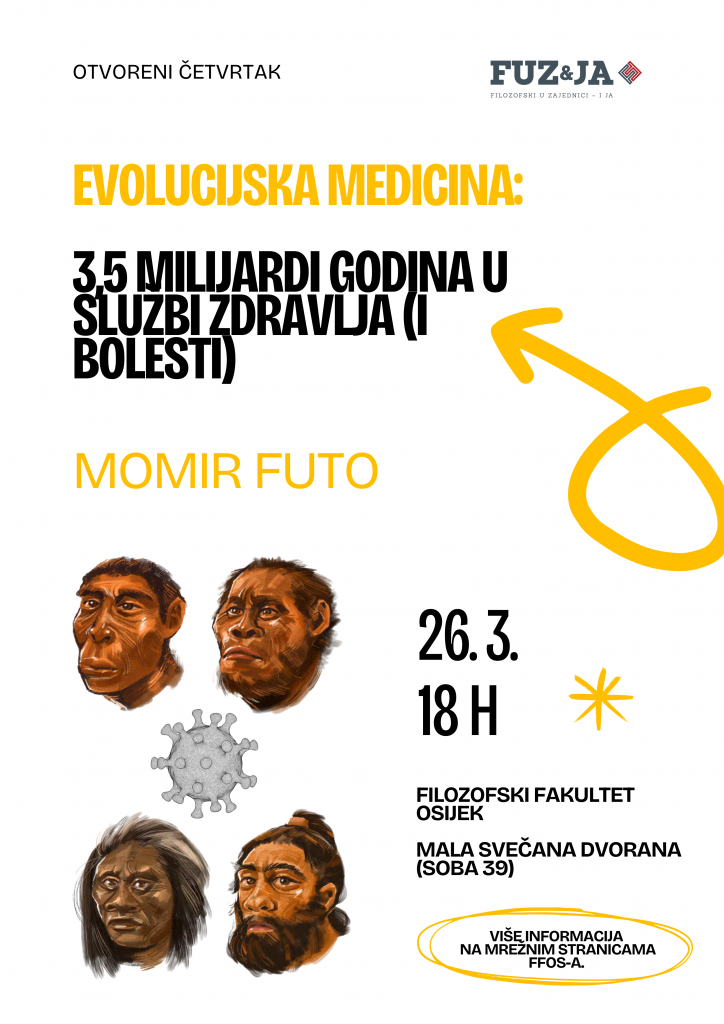
On Thursday, 26 March 2026, the sixth popular science event within the 14th Open Thursday cycle will be held as part of FUZ&JA, the science popularisation project of the Faculty of Humanities and Social Sciences in Osijek. The lecture, entitled Evolutionary Medicine: 3.5 Billion Years in the Service of Health (and Disease), will be given by Asst. Prof. Momir Futo, PhD, from the Faculty of Medicine at the Catholic University of Croatia in Zagreb.
The lecture will take place in Room 39 at the Faculty of Humanities and Social Sciences in Osijek (Lorenza Jägera 9), starting at 6:00 p.m., and is open to the public.
ABOUT THE LECTURE:
Why are we born “helpless” and remain dependent on our mothers for years, while young antelopes and giraffes can run just a few hours after birth? Why do chimpanzees not cry, while we do? What do Neanderthals have to do with our experience of COVID-19? How quickly does antibiotic resistance develop, and how do we contribute to it? Why are some of us unable to digest lactose? Why does diabetes exist, and why are 70% of us overweight? What do the microbes in our intestines have to do with all of this?
And what exactly is evolutionary medicine?!
Take a journey through 3.5 billion years of evolutionary history and discover how nature shaped modern humans and how humans, in turn, have shaped their own health and the diseases that are an inseparable part of their lives.
ABOUT THE SPEAKER:
After completing secondary school in Subotica, he studied biology at the Faculty of Science, University of Zagreb, graduating in 2009. Towards the end of his studies, he developed an interest in evolutionary biology. In 2016, he obtained his PhD in evolutionary immunology with a dissertation entitled “The Role of Microbes as Mediators of Immune Memory in Insects” at the Institute for Evolution and Biodiversity, Faculty of Biology, University of Münster, Germany. After completing his doctorate, he returned to Croatia, where he spent four years as a postdoctoral researcher at the Laboratory for Evolutionary Genetics, Division of Molecular Biology, Ruđer Bošković Institute in Zagreb. He then spent a year working as a researcher at the Department of Applied Computing, Faculty of Electrical Engineering and Computing, University of Zagreb. He is currently employed as an Assistant Professor at the Faculty of Medicine, Catholic University of Croatia in Zagreb, where he heads the Laboratory for Basic Medical Sciences. As part of his teaching activities, he teaches the courses Cells and Tissues, Microbiology and Pathophysiology, Evolutionary Medicine and Research in Biomedicine and Healthcare.
His research interests focus on the causative agents of Lyme disease – Borrelia bacteria – interactions between Borrelia and tick vectors, biofilms, biocontrol and the commercial breeding of beneficial insects.