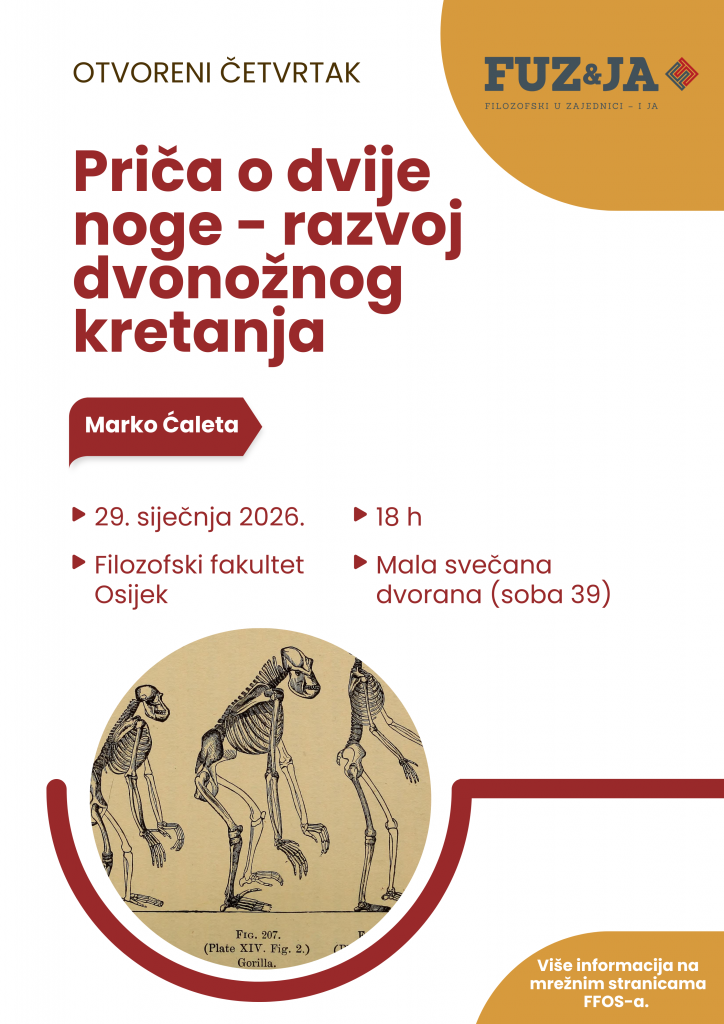
On Thursday, 29 January 2026, the fourth popular science event within the 14th Open Thursday cycle will be held as part of FUZ&JA, the science popularisation project of the Faculty of Humanities and Social Sciences in Osijek. The lecture, entitled A Tale of Two Legs – The Evolution of Bipedal Locomotion, will be given by Prof. Marko Ćaleta, PhD, from the Faculty of Teacher Education, University of Zagreb.
The lecture will take place in Room 39 at the Faculty of Humanities and Social Sciences in Osijek (Lorenza Jägera 9), starting at 6:00 p.m., and is open to the public.
ABOUT THE LECTURE:
Bipedal locomotion is one of the most fascinating characteristics of the human species and is considered a turning point in evolution. There are many hypotheses and theories about the development of this form of movement and the reasons that led to its emergence. However, since humans are the only truly bipedal mammals, the question arises as to whether the development of bipedalism represents an evolutionary advance and a successful form of locomotion, and what its advantages and disadvantages are. Despite the numerous adaptations and changes that have occurred during its evolution, bipedal locomotion remains challenging even for modern humans today.
ABOUT THE SPEAKER:
Marko Ćaleta, PhD, is a Full Professor at the Faculty of Teacher Education, University of Zagreb, where he teaches Natural Sciences. He obtained his degree and PhD in Biology from the Department of Biology at the Faculty of Science in Zagreb. He spent his entire period as a teaching and research assistant at the Division of Vertebrates of the Department of Zoology, Department of Biology, where he was involved in teaching and scientific research. In addition to freshwater fish, which are the main focus of his scientific work, he has always had a particular interest in mammals and has been teaching Mammalogy at the Department of Biology of the Faculty of Science for more than 15 years. He is the author of several dozen scientific articles and around ten scientific and professional books or book chapters. He participates in numerous professional projects and science popularisation activities. He was born in Zagreb, where he still lives. He is married and has two children.