
Publications
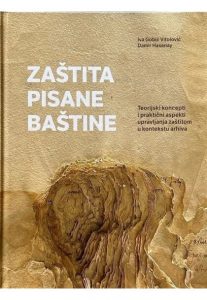
Preservation of Written Heritage – Theoretical Concepts and Practical Aspects of Preservation Management in the Context of Archives
Authors: Iva Gobić Vitolović and Damir Hasenay
Publisher: State Archives in Rijeka
Year of publication: 2025.
About the book:
The scholarly and professional monograph PRESERVATION OF WRITTEN HERITAGE – Theoretical Concepts and Practical Aspects of Preservation Management in the Context of Archives by Iva Gobić Vitolović and Damir Hasenay represents a combination of theory and practice in the management of written heritage preservation in the context of archives, although preservation strategies, methods and activities are in fact common to and applicable in all information (heritage) institutions: archives, libraries and museums.
The first part, entitled Theoretical Concepts of Systematic Preservation of Written Heritage in the Context of Archives, presents the fundamental concepts, approaches and policies in the field of written heritage preservation, explains their significance and illustrates their interrelationships. The second part, entitled Practical Aspects of Systematic Preservation of Written Heritage: The Example of the State Archives in Rijeka, provides detailed information on a case study of a systematic approach to archival preservation management through the implementation of theoretical knowledge in the practice of the State Archives in Rijeka. The aim of the first section is to provide a concise theoretical context for the empirical and practical subject matter of the second part of the publication, while at the same time highlighting the complexity of written heritage preservation in the context of archives and the potential gap between theory and practice due to the uniqueness of each heritage institution, including its holdings, staff, users, infrastructure, etc.
The publication draws on contemporary theory and practice in the field of written heritage preservation, referring to relevant professional literature and online sources, as well as applicable laws, regulations, guidelines and recommendations for the implementation of preservation, i.e. the international, national, regional and institutional framework. The book is intended for anyone wishing to learn about the preservation of written heritage, regardless of their prior knowledge of the subject. The content presented may also be useful to professionals in the field, particularly conservators-restorers, archivists, librarians, curators and all stakeholders who encounter these issues, as well as to the academic community as a source of both basic and, in some areas, advanced knowledge in this field. The first, theoretical section may also serve as a university textbook for courses dealing with preservation processes, while the second, practical section may serve as a guide for professionals implementing systematic preservation procedures on specific heritage collections.
 Planning, Construction and Evaluation of Library Spaces
Authors: Tatjana Aparac-Jelušić, Sanjica Faletar
Publisher: Naklada Ljevak
Year of publication: 2025.
About the book:
The book Planning, Construction and Evaluation of Library Spaces by Tatjana Aparac Jelušić and Sanjica Faletar is devoted to the processes of planning, constructing and evaluating library spaces, whether involving new buildings, the expansion and/or adaptation of existing library spaces, or the conversion of buildings originally intended for other purposes into libraries. Contemporary library architecture attracts considerable interest among architecture and design professionals, as well as the wider public, since some library buildings have become cultural symbols of their communities. Today’s libraries are complex institutions encompassing both physical and virtual spaces. They contain printed and digital materials and various types of equipment, provide support and offer diverse spaces that encourage curiosity, learning, creative work, collaboration and participation, encounters and the exchange of knowledge. When planning space for a new, expanded or adapted library, it is necessary to follow the life of the community at all levels of its development, not only in the area of culture, as was predominantly the case in earlier periods, but also by recognising the potential contribution of libraries to the overall development of society. This requires librarians to become more actively involved in social developments than was generally the case until recently, particularly in the Croatian context.
In Planning, Construction and Evaluation of Library Spaces, emphasis is placed on practical aspects related to the planning, construction, design and evaluation of library spaces so that librarians, as well as all other professionals involved or interested, are as well prepared as possible for this demanding undertaking. The book contains a range of useful guidelines based on the literature reviewed, the extensive experience of many librarians, the authors’ own experience of working with librarians and architects in developing programme briefs for libraries of various types and sizes, as well as their work with students. A substantial body of valuable literature on library architecture has been published internationally and is indispensable to anyone seeking to understand library architecture and the changes taking place in today’s networked society, with the aim of responding to increasingly numerous and complex requirements, both from the perspective of user habits and expectations of librarians and from the perspective of new approaches to architecture, the use of modern building materials, and the application of information and communication technology (ICT) and artificial intelligence (AI). In Croatia, however, there is no contemporary handbook that provides a comprehensive overview of approaches to planning, constructing and evaluating library spaces in one place, which makes this book an exceptionally useful resource for the academic community as well as the wider readership.
 Guide for People with Alzheimer’s Disease and Their Family Members
Editor: Sanjica Faletar
Publisher: Faculty of Humanities and Social Sciences, Josip Juraj Strossmayer University of Osijek
Year of publication: 2024.
About the guide:
The Guide is intended for people with Alzheimer’s disease, their family members and other persons involved in their care in the city of Osijek and the surrounding area, and contains useful information that can make their lives easier. The aim of this publication is to bring together in one place reliable and verified information about the disease, its symptoms and diagnosis, non-pharmacological therapy, communication with people with Alzheimer’s disease, and the various rights available to people with Alzheimer’s disease (AD) and their families and/or caregivers. The Guide also provides up-to-date information on how these rights can be exercised. An especially important section of the Guide concerns legal protection mechanisms, such as guardianship and deprivation of legal capacity, which are explained in a simple and understandable manner. At the end of the publication there is a list of books in Croatian (novels, personal accounts and handbooks) that address Alzheimer’s disease from different perspectives and are available in local public libraries, as well as a list of feature films and documentaries about dementia. The Guide also includes a directory of competent institutions, relevant organisations and non-governmental associations, marked on a map of the city of Osijek and accompanied by contact information. The Guide was originally prepared as part of the project “Information Needs of People with Alzheimer’s Disease and Their Family Members” and was revised and supplemented within the project “Building Dementia-Friendly Public Libraries: Theoretical and Practical Preconditions”.
The Guide is available free of charge and can be downloaded here.
 Commemorative Publication
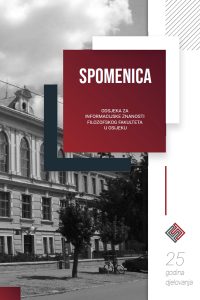
Publisher: Faculty of Humanities and Social Sciences, Josip Juraj Strossmayer University of Osijek
Year of publication: 2023.
About the book:
The Commemorative Publication of the Department of Information Sciences at the Faculty of Humanities and Social Sciences in Osijek was published to mark the Department’s 25th anniversary. The publication can be accessed here.
 The Art of Reading: Writers, Texts and Readers of the 18th Century
Author: Zoran Velagić
Publisher: Faculty of Humanities and Social Sciences, Josip Juraj Strossmayer University of Osijek
Year of publication: 2022.
About the book:
Reading aloud, unless it occurs within specific reading practices and contexts such as religious or therapeutic ones, is most commonly regarded as a historical phenomenon that disappeared as a result of the general modernisation of society during the 18th and 19th centuries. Since then, the dualism of the oral and the written, like any other dualism, has been established through opposing concepts of the modern and the outdated, the desirable and the undesirable, the better and the worse…
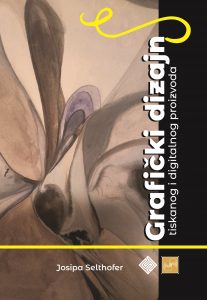
Graphic Design of Printed and Digital Products
Author: Josipa Selthofer
Publisher: Faculty of Humanities and Social Sciences in Osijek, Croatian University Press
Year of publication: 2022.
About the book:
The scholarly monograph “Graphic Design of Printed and Digital Products” by Josipa Selthofer addresses a field for which there is insufficient literature available in Croatian. The book covers topics in graphic design, the history of printing, visual communication, visual identity and the development of graphic printing techniques, the basic elements of graphic design (line, shape, colour, typography, illustration and photography), as well as fundamental aesthetic design principles and the specific characteristics of individual printed and digital products. The book is richly illustrated with Croatian and international examples from the literature, as well as visual materials that illustrate and contribute to understanding the text and the cultural and artistic richness of Croatia and the world. The book is intended for university-level and professional education in the field of graphic design, as well as for the wider public.
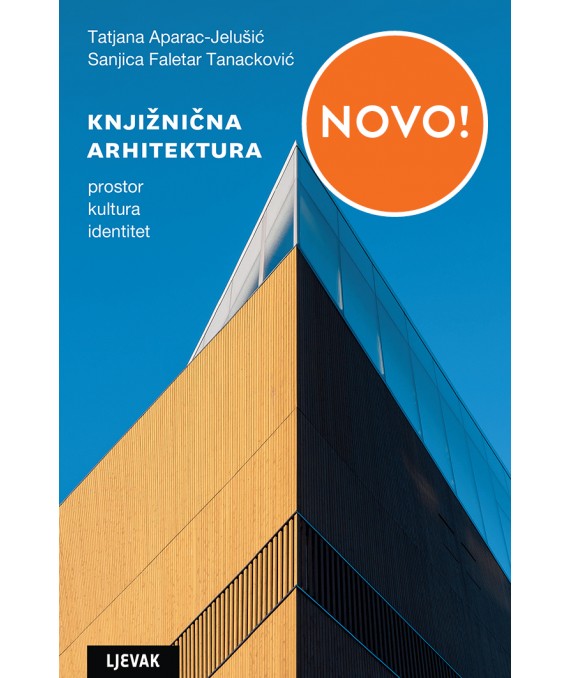
Library Architecture
Authors: Tatjana Aparac-Jelušić, Sanjica Faletar Tanacković
Publisher: Naklada Ljevak
Series: Biblioteka Academica
Year of publication: 2020.
About the book:
The book Library Architecture: Space, Culture, Identity is the first scholarly monograph written in Croatian to provide a comprehensive overview of the historical development of library architecture. The book is intended for a wide range of readers. On the one hand, students of library and information science, architecture and design will find in one place valuable material that will help them become familiar with the issues of library architecture from a variety of perspectives. On the other hand, we believe that both the architectural and library professional communities will recognise it as a useful and stimulating resource in their efforts to better understand and critically interpret the various approaches to designing library buildings whose purpose is to respond successfully to contemporary challenges, primarily those posed by users.
Despite the digital paradigm, the physical space of the library remains extremely important, as recent research shows that citizens, despite the fast pace of everyday life and the ubiquity of networked and digital environments, continue to find time to visit physical libraries, where contemporary spaces provide places for studying and reading, creative work, play, relaxation and social interaction. Given the exceptional appeal of its subject matter and its readability, this book is certain to become a sought-after and useful resource for the academic community as well as the wider readership.

Inside Book Publishing
Authors: Giles Clark and Angus Phillips
Publisher: Faculty of Humanities and Social Sciences, Josip Juraj Strossmayer University of Osijek
Translation: Students of the graduate programme in English Language and Literature at the Faculty of Humanities and Social Sciences in Osijek
Year of publication: 2017.
About the book:
For twenty years, “Inside Book Publishing” has been a classic introduction to the publishing industry, both as a handbook for publishing professionals and as a bestselling textbook for publishing students. The new edition has been updated to keep pace with rapid changes in the market and technological developments.
With its global scope and references, this book explores the tensions and trends affecting the publishing industry, including the growing presence of e-books, self-publishing and online retail, as well as new business models and workflows. The book provides an overview of the fundamental elements of publishing, including manuscript acquisition, product development, design and production, marketing, sales and distribution. The book is essential reading for publishing students, anyone interested in a career in publishing, those who have only recently entered the publishing profession, and authors who wish to gain a better understanding of the publishing world.
Electronic Publishing?
Authors: Zoran Velagić, Tomislav Jakopec, Franjo Pehar, Josipa Selthofer
Publisher: Naklada Ljevak
Year of publication: 2017.
About the book:
Electronic publishing as an independent publishing model probably does not exist. Publishing can be described in various ways, for example as the activity of creating, acquiring, editing, publishing and disseminating content and discourse, but there is nothing inherently electronic about these activities. Computer and information technologies have been implemented in publishing, and one possible final publishing product is a publication in a computer-readable format popularly referred to as an electronic book, but even here the electronic nature is present only at the level of an awkwardly formulated, although generally accepted, concept.
Electronic Publishing? is a scholarly monograph that addresses various aspects of the publishing phenomenon of the same name. It is the result of several years of continuous monitoring of changes in contemporary publishing, analysis and comparison of the literature, and practical research into the publishing market. It is divided into five thematic sections. The first addresses the developmental and social context of electronic publishing, presents its historical development and critically examines dominant assumptions about the role of electronic publications in the global market. The second section presents and analyses the technological prerequisites for the development of e-publishing, particularly the development of e-book file formats, e-book readers, cloud computing and e-book publishing platforms. The third, fourth and fifth sections are practical in orientation and address the publishing of e-books, electronic journals and, finally, the challenges of the visual design of publications in the online environment.
The term electronic publishing reveals the subject matter of this book accurately and unambiguously to both knowledgeable and entirely uninterested audiences — no other title could reflect its topic so precisely. Terminological accuracy is therefore sufficiently addressed by the question mark accompanying the title, which serves to emphasise that electronic publishing, although a widely accepted term, says little about the scope and content of the phenomena it describes.
 Essays on Information Sciences: Festschrift in Honour of Tatjana Aparac-Jelušić
Editors: Sanjica Faletar Tanacković, Martina Dragija Ivanović
Publisher: Faculty of Humanities and Social Sciences in Osijek, Osijek
Year of publication: 2016.
Co-publisher: University of Zadar
About the book:
A collection of papers dedicated to Professor Tatjana Aparac-Jelušić, whose inspiring lectures have shaped numerous generations of library and information science students both in Croatia and around the world. Although the contributions in the volume may appear thematically unrelated, their thematic framework is defined by Professor Aparac-Jelušić’s research interests, which range from information science theory, the convergence of heritage disciplines, education of information professionals, library operations and management to the preservation of written heritage and library architecture. The texts are published in Croatian and English.

Introduction to Publishing
Author: Prof. Zoran Velagić, PhD
Publisher: Josip Juraj Strossmayer University of Osijek, Faculty of Humanities and Social Sciences in Osijek
Year of publication: 2013.
About the book:
The book “Introduction to Publishing” is one of the relatively few publications that address publishing as a creative industry. Conceived as a scholarly work and a comprehensive overview of the publishing industry, this introductory book is intended primarily for publishing students, but also for anyone who wishes to learn more about books, publishing and the development of the publishing industry. Although it provides a synthesis of recent international literature, a concise overview of business solutions and practices, and an account of global publishing trends and contemporary issues in international and Croatian publishing, the book also creates space for examining new and sustainable publishing models. The book is divided into three main parts. The first discusses the historical development of publishing and its paradigmatic nature in the context of information activities and cultural industries, describing the social contexts within which publishing takes place and emphasising the role and responsibility of publishers. The second part is devoted to publishers themselves and describes possible organisational forms of publishing companies, the importance of capital, different categories of publishers and publishing products, and addresses the question of how to create a publishing plan. The third and final part focuses on publishing products and describes the usual and standardised processes of manuscript acquisition and editing and book publication. The book was published by the Faculty of Humanities and Social Sciences in Osijek with the support of the Ministry of Culture.
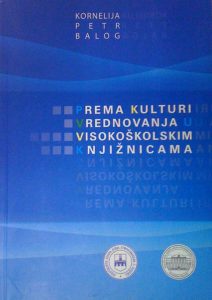
Towards a Culture of Evaluation in Academic Libraries
Author: Prof. Kornelija Petr Balog, PhD
Publisher: Josip Juraj Strossmayer University of Osijek, Faculty of Humanities and Social Sciences in Osijek
Year of publication: 2010.
About the book:
The university textbook Towards a Culture of Evaluation in Academic Libraries was created primarily out of the need to provide the Croatian academic library community with a handbook in Croatian presenting an overview of methods, techniques and procedures related to the measurement of performance in academic libraries. However, given the growing student population and the introduction of courses on the evaluation of information institutions at faculties educating future information science professionals, the content was presented in the form of a university textbook, i.e. its style was adapted to a student audience. The textbook partly developed from the author’s doctoral dissertation but has been updated with new contributions and insights not included in the dissertation. The textbook presents its content in four chapters: Science and Social Development, Theoretical and Methodological Foundations of Academic Library Performance Evaluation, Evaluation in the Context of Academic Library Operations, and Methodological Aspects and a Possible Approach to Evaluating the Performance of Croatian Academic Libraries. The textbook also contains 12 appendices, the most important of which is the translation of performance indicators taken from the second edition of the so-called IFLA handbook (Poll, R.; Boekhorst, P. Measuring Quality: Performance Measurement in Libraries. 2nd revised ed. Munich: Saur, 2007). It should also be noted that these indicators include indicators for public libraries, meaning that this textbook may also be of interest to public librarians. Prof. Tatjana Aparac-Jelušić, PhD states in her review of the textbook: “Establishing an appropriate terminological framework is one of the significant results of the author’s research work, and its use in teaching and professional practice, as well as further examination of new concepts and topics, can be expected. A particularly important place in the manuscript is occupied by a clear and thorough presentation of new methods and measures used in evaluating the performance of academic libraries. I therefore believe that the text will contribute to a clearer understanding of evaluation issues and help students and professionals in practice understand and apply those methods, criteria and measures they determine to be appropriate to the goals and tasks they seek to achieve, whether in the process of learning and mastering course content or in specific working environments in which a culture of evaluation is promoted.”
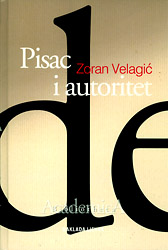
The Writer and Authority: The Nature of Authorship and the System of Authorisation of Religious Books in the 18th Century
Author: Prof. Zoran Velagić, PhD
Publisher: Naklada Ljevak
Year of publication: 2010.
About the book:
The examination of the position of northern Croatian writers of the 18th century in this book was prompted by the complexity of the manifestations of authorship in religious works printed in the vernacular. The aim of the work is to answer a number of intriguing questions, such as: how was it possible for anonymous religious books to be published contrary to the decisions of the Council of Trent; why was the author’s name often hidden in half a line on the title page; why did the title page emphasise the title of the work or the name of the patron rather than the author’s name; why does it seem that the author’s name on the title page was reluctant to stand alone; why did the author’s “I” in a sense give way to the authorial “we” of the many names appearing in the work; why did title pages most often state that a book had been “compiled” rather than written; why did authors themselves usually describe their work as “compiling” rather than writing; why did they repeatedly stress that their work was not an original novelty but another contribution to the tradition to which they belonged; and why did they seek to demonstrate that their works, in contemporary terminology, were not works of authorship?
Answers to these questions are offered by contextualising writers within a temporally and spatially defined environment, then examining their professional vocation, which influenced both their motives and their practices in writing religious works, and finally analysing ideas about the tasks of the writer and the text expressed in dedications and prefaces to printed books of the period. This approach partly draws on Michel Foucault’s concept of the “author function” and the methodology evident in the works of Roger Chartier, and partly follows a research procedure based on studying so-called paratextual elements (title pages, introductions, prefaces, notes, illustrations, etc.). By combining these approaches, the book investigates and explains the reasons that enabled the publication of anonymous books, the retreat of the writer’s “I”, the authorisation of works through the institution represented by the writer, and the literal transfer of social hierarchy onto the title pages of religious works. It also seeks to explain how such a system may have influenced readers’ reception of a work.
The book is divided into two main parts, a chapter on the writer and a chapter on authority. The part devoted to the writer relativises concepts of originality and individuality which, both legally and in popular perception, are regarded as fundamental attributes of authorship. The modern concept of authorship is neither universal nor timeless; a considerable gap separates it from the actual life of a written work, as is evident both in today’s application of copyright law and in discussions concerning the historical author. In these studies, the Foucault-Chartier concept of the “author function”, i.e. the writer whose activity is significantly conditioned by professional vocation and the environment in which they work, has proved to be the only satisfactory model for explaining writers’ interactions with their immediate surroundings. The second part of the book, devoted to authority, analyses the system of authorisation of 18th-century religious books. The hierarchy of the title page, for example, with the prominent name of a bishop-patron and the concealed name of a friar-writer, or a hierarchy that emphasises generally accepted Christian values while again concealing the author’s name; the system of dedicating works to dignitaries, in which the patron’s name serves to authorise the work; the frequent dedication of books to saints, demonstrating that the common understanding of dedication as an exchange for material benefits is incorrect in the case of religious literature; and, finally, the active connections and numerous acquaintances among 18th-century Croatian writers all demonstrate that behind the printed book stood not an isolated writer, but the institution they represented.
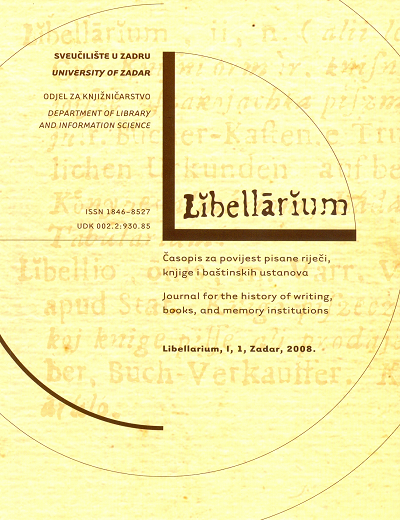
Libellarium: Journal for Research in Information and Related Sciences is an open-access scholarly and professional journal published by the Department of Information Sciences at the University of Zadar and the Department of Information Sciences at the Faculty of Humanities and Social Sciences in Osijek. The journal covers a broad range of topics in information and related sciences, including information science theory and methodology, the history of books, printing, publishing and bookselling, the preservation, presentation and protection of written and digital cultural heritage, heritage institutions and their activities, the sociology of books and reading, information literacy and information behaviour, visual communication, knowledge organisation, e-learning, bibliometrics, scientometrics and informetrics, digital humanities, contemporary trends in publishing and bookselling, technological changes and human-technology relations, etc. The Editorial Board encourages the publication of interdisciplinary papers, particularly those promoting research in accordance with contemporary scientific paradigms. The journal publishes original and review research articles, preliminary communications, professional papers and book reviews. Libellarium is published electronically twice a year, in June and December. The Editorial Board accepts papers in Croatian and English and, in exceptional cases, in other languages, particularly Italian, French and German. The quality of texts and scholarly excellence are ensured by an international Editorial Board and a double-blind peer-review process. Every contribution published in the journal is subject to scholarly evaluation and categorisation by two reviewers, while the entire editorial process is conducted through the OJS system, ensuring its transparency. Libellarium does not charge submission or publication fees.
Editor-in-Chief
Prof. Jelena Lakuš, PhD (Department of Information Sciences, Faculty of Humanities and Social Sciences, Josip Juraj Strossmayer University of Osijek)
Deputy Editor-in-Chief
Asst. Prof. Drahomira Cupar, PhD (Department of Information Sciences, University of Zadar).
Editorial Board
Prof. Anne Gilliland, PhD (UCLA, USA)
Mate Juric, PhD (Department of Information Sciences, University of Zadar)
Assoc. Prof. Ivana Martinović, PhD (Department of Information Sciences, Faculty of Humanities and Social Sciences, Josip Juraj Strossmayer University of Osijek)
Asst. Prof. Franjo Pehar, PhD (Department of Information Sciences, University of Zadar)
Prof. Erich Renhart, PhD (Vestigia, Manuscript Research Centre, University of Graz, Austria)
Asst. Prof. Josipa Selthofer, PhD (Department of Information Sciences, Faculty of Humanities and Social Sciences, Josip Juraj Strossmayer University of Osijek)
Prof. Alenka Šauperl, PhD (Department of Library and Information Science and Book Studies, Faculty of Arts, University of Ljubljana, Slovenia)
Assoc. Prof. Marijana Tomić, PhD (Department of Information Sciences, University of Zadar)
Website: https://morepress.unizd.hr/journals/index.php/libellarium
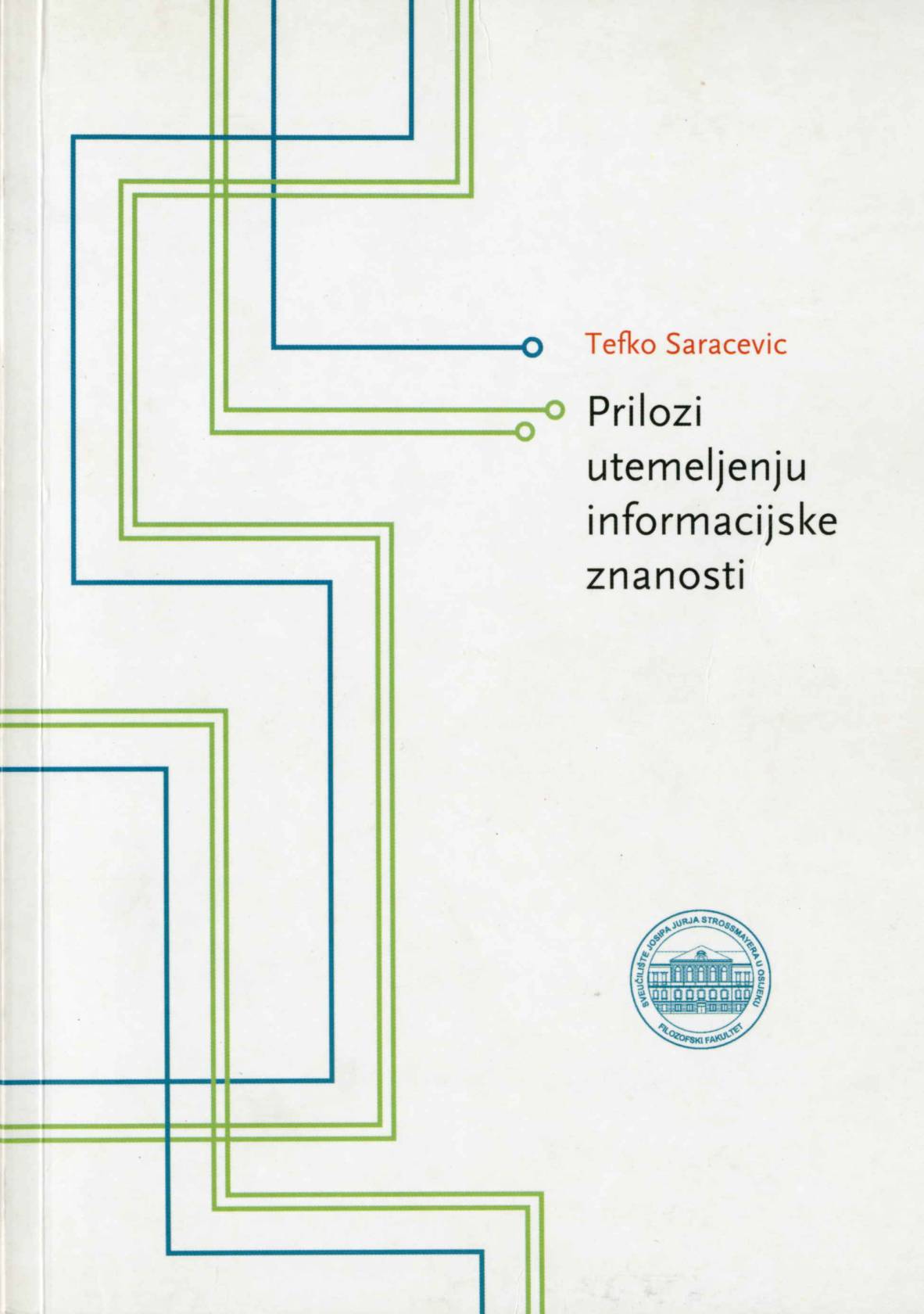
Contributions to the Foundations of Information Science
Author: group of authors
Publisher: Josip Juraj Strossmayer University of Osijek, Faculty of Humanities and Social Sciences in Osijek
Year of publication: 2006.
About the book:
The book was prepared by the Department of Information Sciences at the Faculty of Humanities and Social Sciences in Osijek to mark the 75th birthday of Tefko Saracevic.
The book can be accessed here.
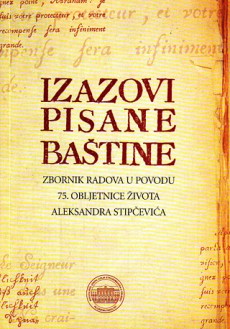
Challenges of Written Heritage: Proceedings Marking the 75th Birthday of Aleksandar Stipčević
Author: group of authors
Publisher: Josip Juraj Strossmayer University of Osijek, Faculty of Humanities and Social Sciences in Osijek
Year of publication: 2005.
About the book:
This publication is dedicated to Aleksandar Stipčević on the occasion of his 75th birthday. It is customary for colleagues and students to publish commemorative volumes marking important anniversaries of their distinguished professors and teachers, and this volume is therefore an expression of gratitude to Professor Stipčević for his many years of research into the history of books and libraries, as well as for his teaching through which he educated generations of library science students.
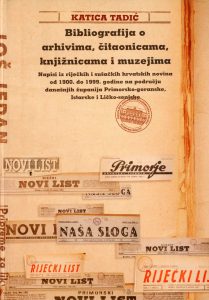 Bibliography of Archives, Reading Rooms, Libraries and Museums: Articles from Croatian Newspapers Published in Rijeka and Sušak from 1900 to 1999 in the Territory of Today’s Primorje-Gorski Kotar, Istria and Lika-Senj Counties
Author: Katica Tadić
Publisher: Faculty of Humanities and Social Sciences in Osijek
Year of publication: 2005.
About the book:
The book presents a bibliography of works on archives, reading rooms, libraries and museums published in Croatian newspapers in Rijeka and Sušak from 1900 to 1999 in the territory of today’s Primorje-Gorski Kotar, Istria and Lika-Senj Counties. Articles on the activities of archives, libraries and museums are arranged chronologically across 13 newspaper titles, beginning and ending with the same newspaper title (Novi list). The publication is a contribution to the research project “Organisation, Preservation and Use of Croatian Book Heritage”.
News of the Department of Information Sciences
In the world of printed publications, small publications such as these News primarily serve as collections of reflections on previous achievements and announcements of current events. The fundamental aim of such publications is to provide interested members of the public with brief information about events and plans in a particular field, thereby strengthening or even initiating communication within that field. Our intention follows the same principle. We wish to publish, communicate and consider all useful suggestions. We believe that the exchange of information can improve the research and teaching activities of the Department of Information Sciences. We also consider it our duty to highlight important events related to the Department’s activities and draw attention to contemporary trends in the field of information sciences. The concept of News was designed in accordance with these principles. The theme of each issue will always be devoted to the most significant events taking place at the Department.
Prof. Tatjana Aparac-Jelušić, PhD
News is available here.