
This year’s 23rd Science Festival, held at Josip Juraj Strossmayer University of Osijek from 20 to 24 April 2026 under the theme Energy, brought together a large number of faculty members, researchers and students from various constituent units of the University. Within this extensive programme, the Faculty of Humanities and Social Sciences in Osijek stood out for its particularly broad and interdisciplinary approach to the theme, demonstrating how energy can be viewed not only as a natural-science and STEM concept, but also as a social, cultural, educational, media and psychological phenomenon.
The Faculty’s activities included numerous lectures, posters, workshops, exhibitions and off-site programmes, all sharing the aim of bringing the concept of energy closer to the wider public through everyday contexts and different scientific perspectives. This diversity clearly reflects one of the Faculty’s greatest strengths: its ability to connect the humanities and social sciences with current issues in contemporary society and make them accessible to different age groups.
In this regard, the contribution of faculty members and students was particularly valuable, as their work demonstrated that the topic of energy does not belong exclusively to STEM, but is also deeply rooted and recognised in language, literature, media, pedagogy, psychology, information sciences and social practice. In doing so, FFOS once again confirmed the deeply interdisciplinary and strongly socially oriented nature of its work.
The Energy of Words and Media
One of the central thematic strands of the FFOS programme was dedicated to literature, language and media. In the paper Energy in Mary Shelley’s Frankenstein, Prof. Tina Varga Oswald, PhD, examined energy as a driving force of the narrative, but also as a symbol of scientific and social progress, while raising the important question of the ethical consequences of technological development. Similarly, in the activity How Words Carry Energy: The Journey of a Verse through Media and Readers, by Ivona Martić and Prof. Jakov Sabljić, PhD, energy was understood as the force through which words travel across different media forms and change their meaning depending on the channel and context. Professor Sabljić emphasised that energy in their contribution was considered as “the driving force of words, ideas and interpretations, from the literary text to radio expression and visual media”. Building on this idea, student Ivona Martić’s poster focused on visualising the “energy of words”, exploring how the meaning of a verse changes across different media and how the relationship between author and reader is constructed.
Radio programmes on Radio UNIOS were also an integral part of this approach, allowing audiences to engage with literary works through an interdisciplinary lens. As Prof. Sabljić pointed out, “the aim was to connect literature with philosophy, film and contemporary social issues, using analyses of the novel Perfume and the animated film Spirited Away as examples”. This clearly demonstrated how energy can also function as an inner driving force of identity, emotion and action, rather than merely as a physical concept.
The poster What Do Primary School Pupils Learn about Energy? A Corpus Analysis of the Lexeme Energy by Prof. Višnja Pavičić Takač, PhD, and associates highlighted the role of language in teaching STEM subjects, while Dubravka Brunčić prepared the lecture Memories as a Source of Creative Energy: What Is Remembered in the Works of Slavonian Writers? Assoc. Prof. Ivana Martinović, PhD, and Assistant Mirna Gilman Ranogajec held the workshop Information as Energy at Franjo Krežma Primary School.
An important contribution to this thematic block was also made by the paper entitled The Synergistic Effect of Literature in Language Studies by Assistant Sanja Ivanović Grgurić, Univ. Spec., and Assoc. Prof. Tihomir Engler, PhD, which further emphasised the importance of an integrated approach to teaching and knowledge transfer.
This group of activities was rounded off by the lecture The Energy of Work and the Energy of Emotions in the Rural Novel by Prof. Kristina Peternai Andrić, PhD, which focused on the novel Na njivama by Mila Miholjević, set in a Slavonian village at the beginning of the 20th century. The novel was read as a text in which work and emotions are inseparable, depicting rural everyday life marked by exhausting labour, poverty, violence and social inequalities. Particular emphasis was placed on how female characters, class relations and the emotional dimension of everyday life reveal the village economy of survival, showing that vital energy is strained not only through physical labour, but also at the emotional level.
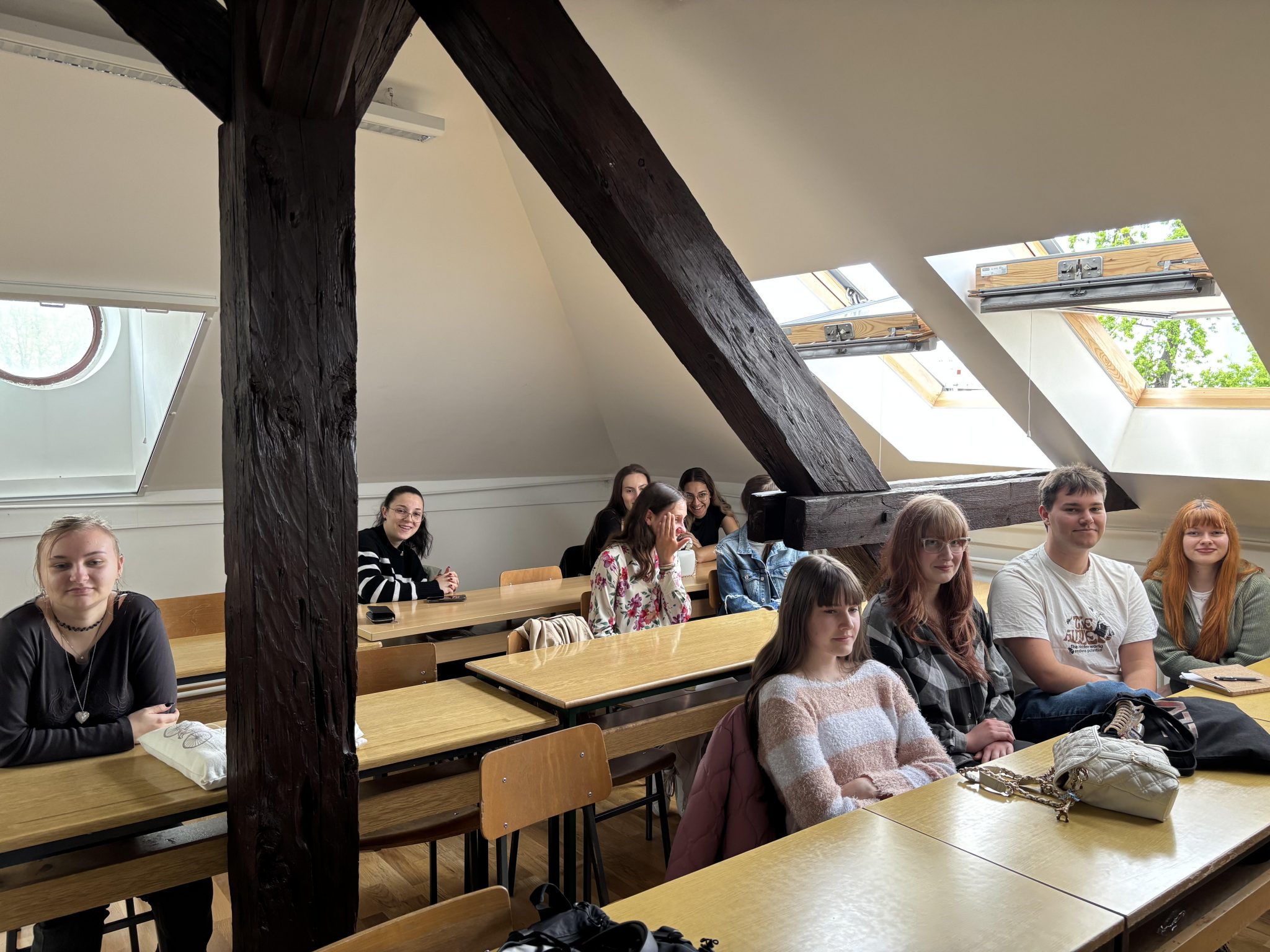
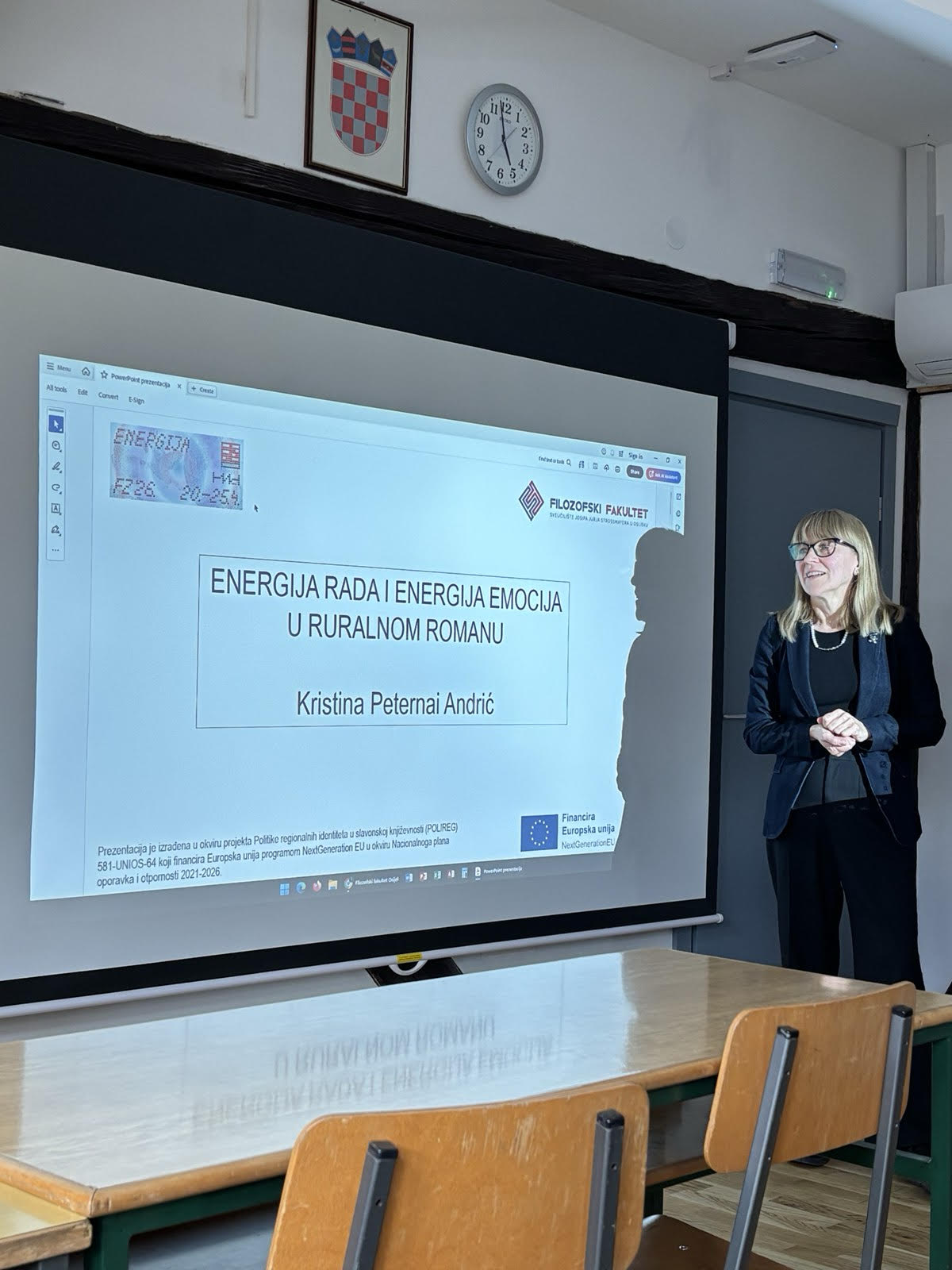
The shared message of these activities is that literature, language and media can serve as powerful tools for developing critical thinking and cultural literacy.
Media, Politics and Society
A significant part of the programme focused on the social and political dimensions of energy, particularly in relation to Chernobyl and public policy. In the paper Chernobyl after 1986: Economic Stigma and a Shift in Public Policy, Asst. Prof. Ivana Perkušić, PhD, and associates analysed the long-term consequences of the nuclear disaster for economic and political decision-making. The paper Media Representation of the Disaster in the Miniseries Chernobyl, prepared by Ana Kekez and Ivana Perkušić, demonstrated how the media shape public perceptions of disaster and the way it is remembered in collective consciousness.
This thematic framework also included the paper Energy, Security, Geopolitics – The (In)visible Boundary of Energy Power by Asst. Prof. Tomislav Dagen, PhD, who placed particular emphasis on the connection between energy resources, global power relations and security issues. Historical and media representations of energy in the local context also added particular value to this section, for example through the activities The First Electric Tram in Osijek through the Lens of Hrvatski list and How Glas Slavonije Reported on the Chernobyl Nuclear Disaster by Tihana Lubina and associates.
Activities dealing with the responsible use of technology and learning from past events also stood out in this context. As Asst. Prof. Dragica Dragun, PhD, explained, the aim of the workshop The Chernobyl Story was “to introduce pupils in a simple way to the disaster that occurred in Chernobyl forty years ago and its long-term consequences”, with the topic being explored through Josip Cvenić’s children’s novel Čvrsto drži joy-stick. Professor Dragun emphasised that nuclear energy was presented to pupils as a form of energy used to generate electricity, but one that is “somewhat less safe”, while the key message of the workshop was that “we must perform our work responsibly, use technology responsibly and learn from past events in order to protect people and nature”. This approach once again demonstrates how seriously FFOS takes social responsibility in its humanities and educational content.
Digital Society
Within the contemporary context, FFOS also raised questions about digital energy, the cost of information and the impact of technology on attention, memory and the environment. In the paper How Much Energy Does Memory Consume: Digital Archives, Artificial Intelligence, the Cloud and the CO₂ Footprint of Information, Asst. Prof. Tihana Lubina, PhD, and associates raised an important question concerning the environmental consequences of digital infrastructure. A related topic was addressed in the paper How Much Energy Do We Consume When Subject-Indexing Proverbs with the Help of Artificial Intelligence? by Assoc. Prof. Kristina Feldvari, PhD, and associates, which connected technological development with educational processes, as did the workshop The Energy of Data: How Much Electricity Does the Internet Consume? by Senior Assistant Ines Hocenski, PhD.
The student project Digital Detox Challenge by students Ines Bičanić, Greta Žanko and Amanda Glavaš also formed part of this thematic strand, drawing attention to the problem of digital exhaustion and the need for more conscious management of attention in everyday life. The paper Digital Exhaustion: Media as Energy Vampires by Senior Assistant Karlo Bojčić, PhD, further emphasised the psychological and cognitive consequences of excessive exposure to digital content.
Education and Learning
A large part of the FFOS programme focused on pedagogy, motivation and the quality of learning. The papers Parental Energy under Pressure: Parental Stress and Burnout in the Light of Contemporary Research by Asst. Prof. Sara Kakuk Fridl, PhD, School as an Energy System by Prof. Renata Jukić, PhD, The Energy of Relationships: What Drives Us in Learning by Barbara Milinović and Asst. Prof. Sanja Simel Pranjić, PhD, and Protocols as Pedagogical Energy Meters in the Classroom by Assistant Mia Filipov, PhD, as well as the poster Transformation of Pedagogical Energy: From Idea to Self-Employment, created by Assistant Filipov together with Katarina Mikulić, demonstrate how important relationships, organisation, motivation and engagement are for a successful educational process.
The paper Energy in Motion – Do You Learn Better While Moving? by Senior Assistant Katarina Bogatić, PhD, and associates explored specific teaching methods and their relationship with active learning. In this way, FFOS once again demonstrated that educational energy is never reduced to an abstract meaning, but is always connected to real teaching practices and pupils’ experiences.
The paper The Child as a Source of Energy: Encouraging Natural Curiosity through the Montessori Method by Prof. Marija Sablić, PhD, also stood out in particular, emphasising learner autonomy, natural curiosity and intrinsic motivation as important sources of educational energy. This approach nicely rounds off the image of the Faculty as an institution that views education as a dynamic and relational process.
The poster Digital Exhaustion: Media as Energy Vampires by Senior Assistant Karlo Bojčić, PhD, calls for caution in media use.
At the Second Grammar School in Osijek, Asst. Prof. Jasna Poljak Rehlicki, PhD, held the workshop Etched in My Memory: Human Books as a Renewable Source of Energy.
Utopia, Dystopia and Sustainability
One particularly thought-provoking activity was the workshop Between Utopia and Dystopia: Prose Perspectives on Energy and the Urban Future, led by Assistant Marijana Mandić, PhD, from the Department of German Language and Literature in cooperation with Iris Spajić, PhD, and Assoc. Prof. Katarina Žeravica, PhD, from AUKOS. The workshop was held at Isidor Kršnjavi Secondary School in Našice and was intended for upper-year secondary school students.
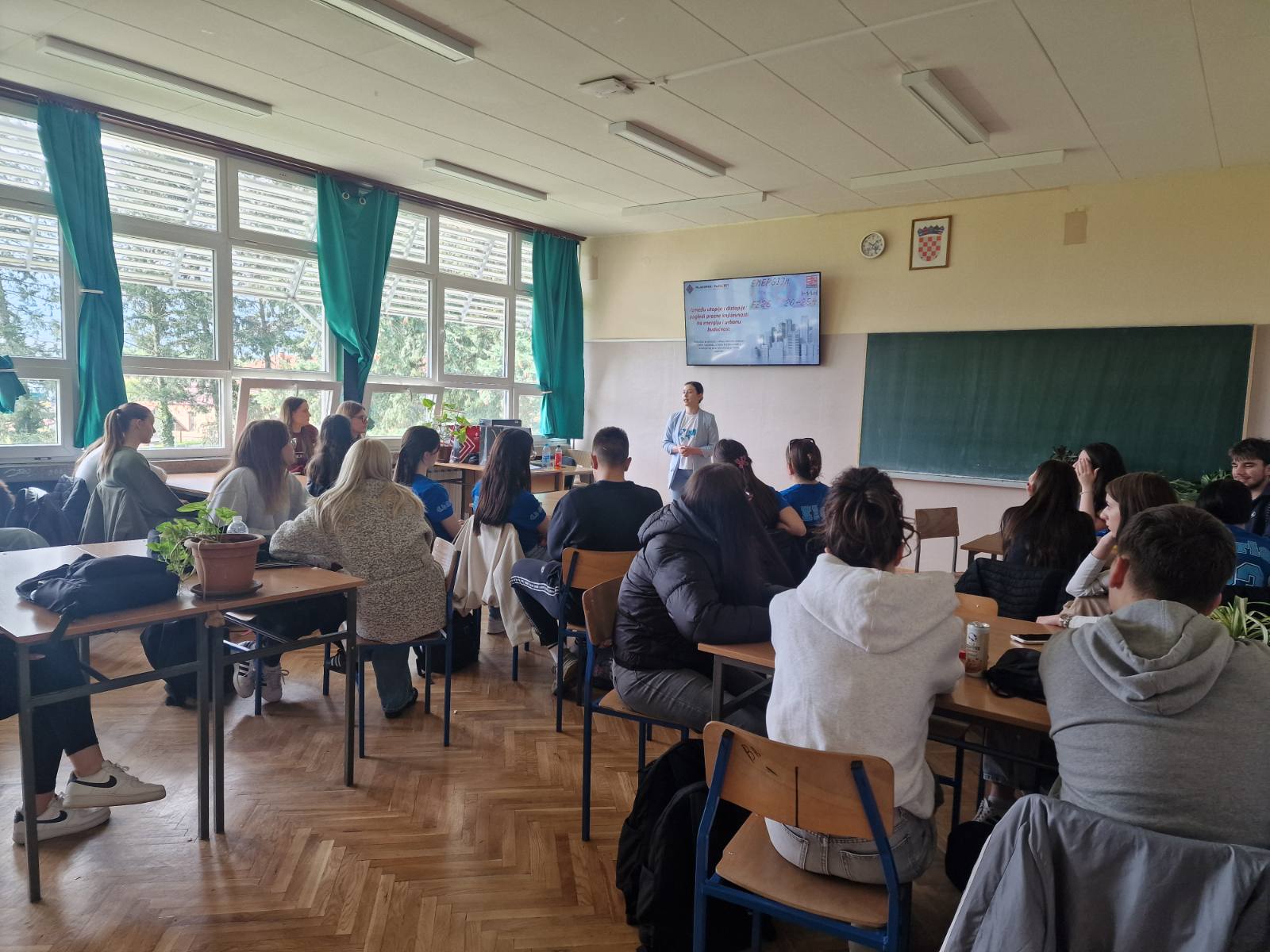
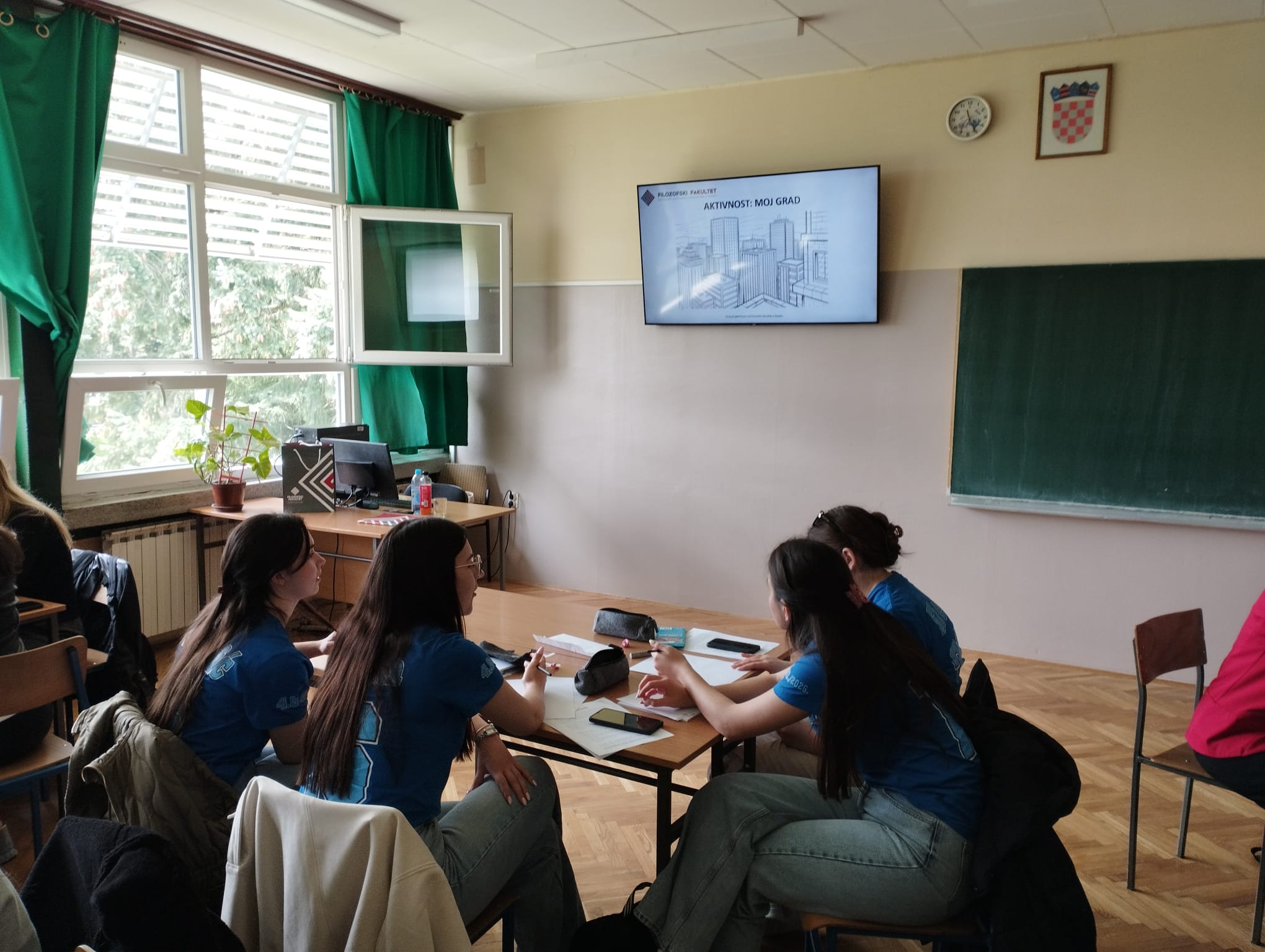
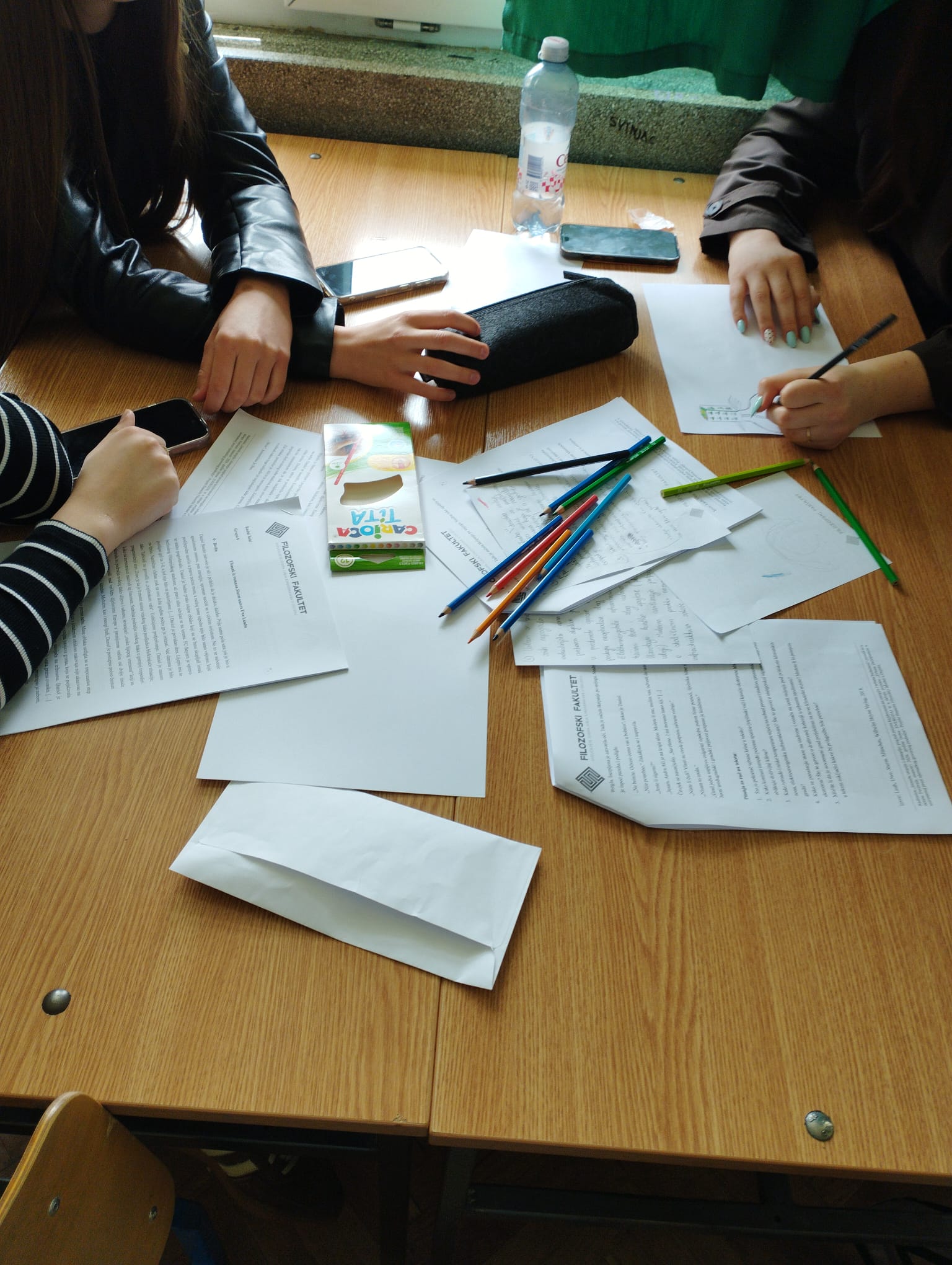
As Mandić explained, the main idea was “to encourage pupils, through creative work and literature, to recognise how important energy, fair access to energy and sustainability are for the stability of an urban system”. By analysing dystopian representations of space, pupils were able to identify problems arising from a lack of energy or its unequal distribution, while the final activity focused on designing an energy-efficient city. Assistant Mandić also emphasised that the workshop reflects the strengths of the Faculty of Humanities and Social Sciences because it is based on teamwork, communication, cooperation and respect for the opinions of others. According to her explanation, the topic is relevant because, through fiction, it “opens up real questions of energy poverty”, social inequality, environmental pollution and possible ways of addressing these challenges. This is precisely why such content can motivate pupils to participate actively in society and use energy responsibly.
Community and Openness
The FFOS programme also included content that encouraged stronger connections between the Faculty and the community in which it operates. The posters The Energy System of Early Modern Slavonian Glagolitic Script and Renewable Energy Sources in Slavic Mythology by Prof. Milica Lukić, PhD, demonstrated how the topic can also be approached through historical, linguistic and cultural layers. An exhibition featuring the poster Her Energy Changed the World – Maria Skłodowska-Curie and Radioactivity and an online quiz, created by Polish language lecturer Małgorzata Stanisz Hanžek, further connected scientific and social perspectives.
The posters by Assoc. Prof. Jasmina Tomašić Humer, PhD, Does Connectedness with Nature Activate Energy for Proactive Environmental Behaviour? and Energy in Later Life – The Importance of Social Relationships (created with associates), point to the importance of environmental awareness and social relationships, while Prof. Gorka Vuletić, PhD, and co-authors, through the poster Brain Energy Underlying Our Thoughts, Emotions and Behaviour, highlight the biological basis of human functioning.
Lecturer Narcisa Vrbešić-Ravlić held a highly successful workshop with pupils of Antun Mihanović Primary School to mark Earth Day. In the workshop Earth Day – Earth Is Our Home, pupils had the opportunity to explore how the Faculty of Humanities and Social Sciences encourages environmentally responsible behaviour, and they also showed an interest in how the Faculty is managed. The Dean of the Faculty, Prof. Ivan Trojan, PhD, also answered their questions.
Students from the Osijek School of Economics and the Osijek Secondary School Student Dormitory took part in the workshop Your Energy, Your Freedom: Turn Off the Darkness, Take the Power, designed by Asst. Prof. Sanja Španja, PhD. Through dynamic and participatory activities, students explored the energy transition not only as a technological process but also as a socio-political one. They concluded that energy issues concern us all because they directly affect quality of life, citizens’ rights and the development of the local community. The central activity of the workshop was a decision-making simulation in the “Municipality of Light”, in which students assumed the roles of investors, scientists, activists and citizens. Particular emphasis was placed on the concept of energy justice.
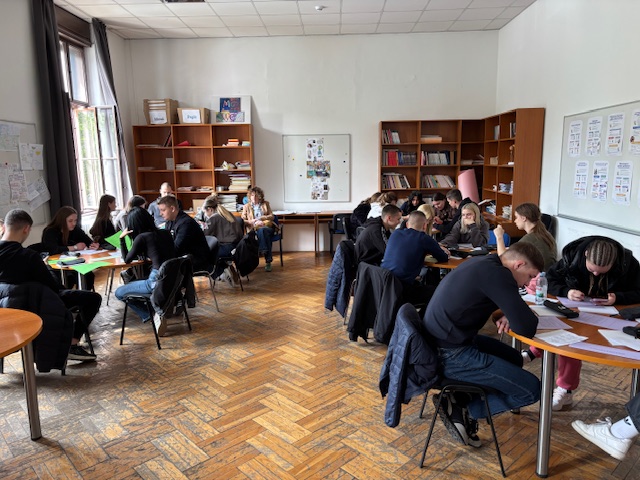
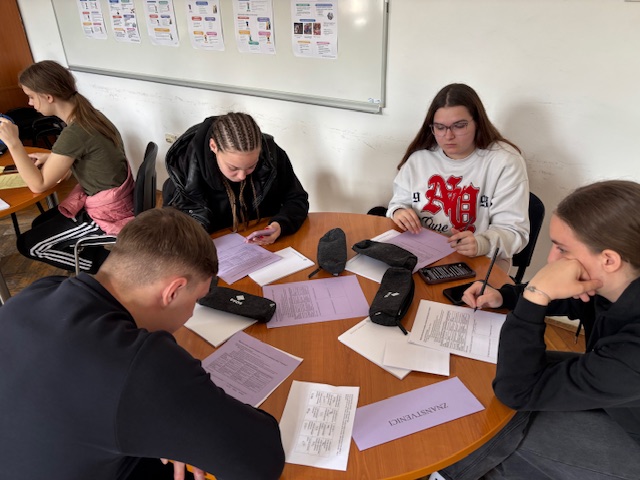
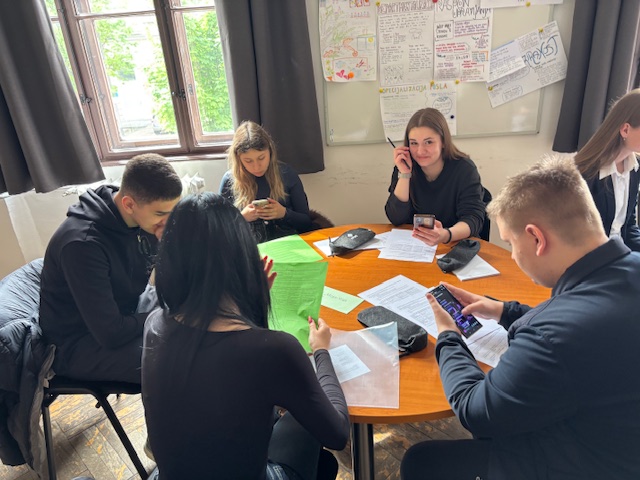
An important aspect was also the Faculty’s outreach to the community. The Delete for the Planet project by Assistant Amanda Glavaš and students Azra Staščik and Matea Sopić was carried out in a primary school and focused on strengthening environmental awareness among younger pupils. The workshop Energy Sells: Reading Between the Lines (and Images) at the Second Grammar School in Osijek demonstrated how the language of advertising and media messages can be analysed in a way that creates space for critical thinking and raises awareness of hidden persuasive strategies. In her statement, Senior Lecturer Ksenija Benčina, PhD, further explained that pupils analysed advertisements for energy drinks, energy bars and electric cars while developing critical language awareness and the ability to recognise how advertising language shapes beliefs and perception. Benčina emphasised that energy served as a starting point for various contexts, from food products to technology, and that “the aim was to show how advertisements often highlight only certain aspects of a product and can be both predictable and misleading”.
The Strength of the Faculty
Finally, the participation of the Faculty of Humanities and Social Sciences in Osijek in the 23rd Science Festival in 2026 once again demonstrated its ability to interpret a shared theme through a range of different yet interconnected perspectives. By integrating literature, language, media, education, psychology, history and digital culture, the Faculty reaffirmed its role as a space for interdisciplinary dialogue and critical reflection.
It is precisely in this breadth, as well as in the active involvement of faculty members, associates and students and the openness towards schools and the wider community, that one of FFOS’s key strengths can be recognised. The Science Festival once again demonstrated the continuity of a Faculty that does not treat knowledge as a static resource, but as energy that drives society, education and culture.
Text: Roman Šimunović and the authors of activities at the Science Festival
Photographs: Karla Bulum and the authors of activities at the Science Festival