
On Thursday, 29 January 2026, the fourth popular science event within the 14th Open Thursday cycle was held as part of FUZ&JA, the science popularisation project of the Faculty of Humanities and Social Sciences in Osijek. The lecture, entitled A Tale of Two Legs – The Evolution of Bipedal Locomotion, was given by Prof. Marko Ćaleta, PhD, from the Faculty of Teacher Education, University of Zagreb.
Professor Ćaleta explained in an accessible and engaging way that bipedal locomotion did not emerge suddenly, but is the result of a long evolutionary process spanning millions of years. Although it is not possible to determine with certainty the extent to which early hominins used bipedal locomotion in the same way as modern humans, numerous anatomical findings indicate that this form of movement developed gradually and eventually became dominant.
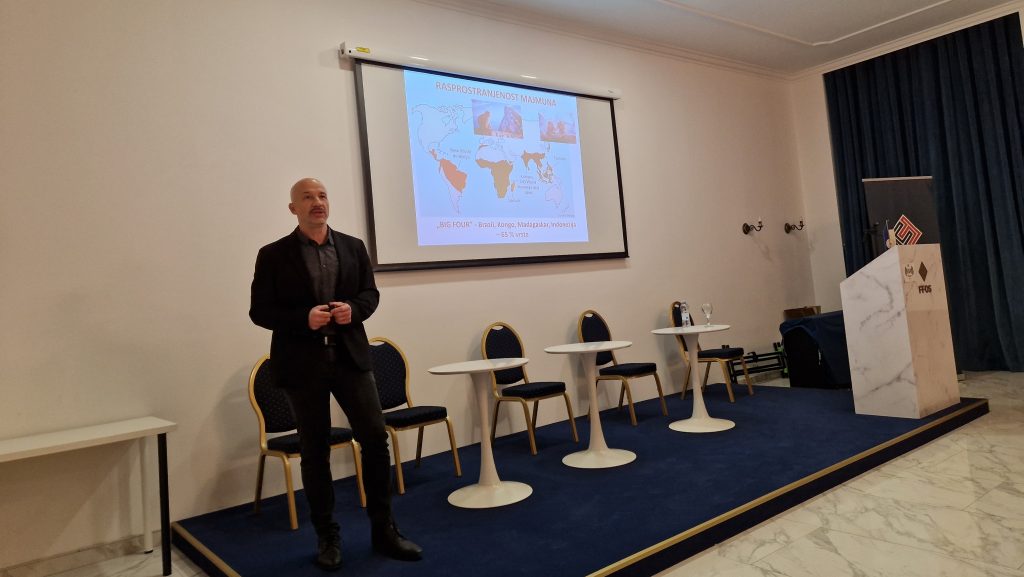
The introductory part of the lecture emphasised that humans belong to the order of primates, an exceptionally diverse and numerous group of mammals. Their wide geographical distribution, differences in size and ways of life were highlighted, along with interesting examples such as Japanese macaques and the tailless Barbary macaque, the only monkey species that naturally inhabits Europe. Particular attention was paid to primate characteristics important for understanding human evolution, including well-developed stereoscopic and colour vision, sensitive fingers with nails, opposable thumbs and flexible joints, which enable precise grasping and manipulation of objects. The professor then presented various theories concerning the emergence of bipedalism, emphasising that none of them can fully explain this evolutionary transition on its own. He discussed hypotheses related to an arboreal way of life, adaptation to living in open environments, more efficient thermoregulation, carrying food and caring for offspring. He particularly emphasised that an upright body posture frees the hands, creating new opportunities for carrying loads, using tools and developing more complex forms of behaviour.
The central part of the lecture focused on the anatomical adaptations associated with bipedal walking. Changes in the skull were explained, along with adaptations of the spine, which takes on its characteristic S-shape. Changes in the pelvis, legs and feet were also described, as these enable stability, balance and efficient transfer of body weight during walking. The role of the foot and big toe in pushing off the ground and maintaining balance was emphasised, making bipedal locomotion more energy-efficient. A separate part of the lecture was devoted to the disadvantages of bipedal locomotion. These include slower running, which means that almost any predator can catch a human, as well as reduced stability and a greater tendency to lose balance. Climbing ability is also reduced because the hind limbs have lost their grasping function and the toes have become shorter. An upright body posture makes humans more visible to predators and increases the exposure of vital organs to attack. A leg injury can lead to significant immobility, while carrying young is more difficult because the feet have lost their grasping function as a result of bipedal walking, and an upright body posture prevents infants from holding on securely to their mothers on their own. Another disadvantage is the long period required to learn to walk, as it takes approximately a year for a child’s spine to develop from its initial C-shape into an S-shape and for the child to master upright movement. Particular emphasis was placed on difficulties during childbirth, which are a direct consequence of adaptations of the pelvis for stable bipedal walking and the increased size of the newborn’s skull.
The final part of the lecture highlighted problems associated with bipedal locomotion in modern life and with increased life expectancy. Prolonged strain on the spine and lower limbs resulting from upright walking leads to common spinal and joint problems, hernias, varicose veins and haemorrhoids. Flat feet were also discussed, a condition that may be genetically determined but is often associated with modern lifestyles. In older age, bipedalism further increases the risk of falls and injuries due to reduced balance and mobility. The lecture concluded by asking whether bipedal locomotion represents a turning point in evolution. From a human perspective, it does, because freeing the hands enabled the development and use of tools, weapons and fire, which consequently led to brain development, more complex behaviour and the formation of communities. Greater availability of food further encouraged brain development, while fire made it possible to prepare food, defend against threats and illuminate dark spaces. Bipedalism also had a major impact on the expansion and geographical distribution of humans, including their migration out of Africa. On the other hand, from an evolutionary and biological perspective, bipedalism cannot be considered a universal turning point because most mammals do not move in this way, and Homo sapiens is the only surviving species within its evolutionary lineage. Therefore, bipedal locomotion is not a turning point for life as a whole, but it is a decisive one for humans as a species.
Karlo Bojčić, PhD, Senior Assistant, Co-Host of Open Thursday