
On 23 March 2026, the fifth round table entitled “The Battle of Mohács as a Turning Point in Hungarian and Croatian Historiography” was held in the Great Ceremonial Hall of our Faculty. The topic proved particularly timely ahead of the commemoration of the 500th anniversary of the battle in August this year. As in previous years, this well-established series of public forums was jointly organised by the Consulate General of Hungary in Osijek and the Department of History of the Faculty of Humanities and Social Sciences in Osijek.
A distinctive feature of this year’s round table was the introduction of simultaneous interpreting from Croatian into Hungarian and vice versa. This innovation made it possible for the event title to be presented in Croatian this time, whereas previous editions had been titled exclusively in English as a linguistic compromise.
The participants included Associate Professor Kornelija Jurin Starčević, Professor Hrvoje Kekez, and Hungarian historians Norbert Tóth, PhD candidate, and Szabolcs Varga, PhD. The discussion was moderated by Associate Professor Danijel Jelaš from our Department of History, who, together with Consul General János Magdó, welcomed the colleagues, students and interested members of the public in attendance.
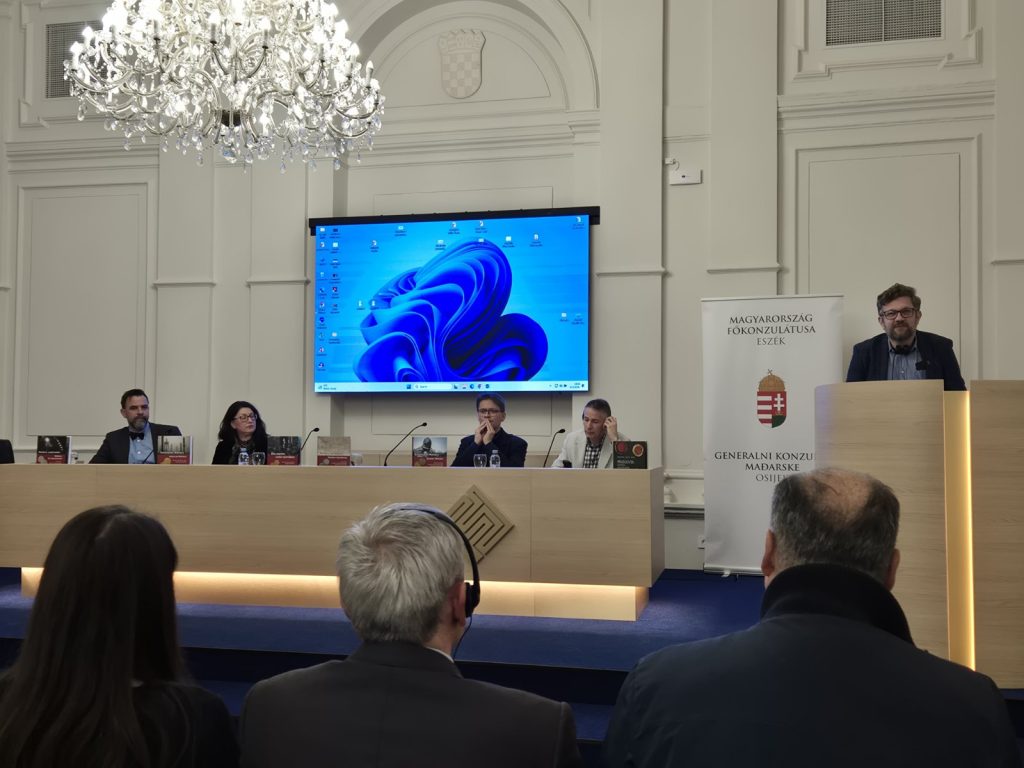
Varga responded to the first question by introducing the topic with a brief overview of the causes and consequences of the Battle and recalling the circumstances that led to the collapse of the Kingdom of Hungary. He then raised the question of possible shortcomings and actions the defeated side might have taken to achieve a different outcome, highlighting a number of strategic and military factors essential to understanding this historical event. He also emphasised that Hungarian historiography devotes considerable attention to the battle, regarding it as one of the greatest tragedies in the country’s history.
Norbert Tóth then introduced the audience to the surviving reports on the battle and other relevant historical sources on which contemporary research is based, while also announcing new studies currently in preparation. He particularly emphasised the importance of critically assessing the reliability of historical sources. Responding to a question about the composition of the army, he succinctly concluded that all those who, given the circumstances, were expected to take part in the battle did so.
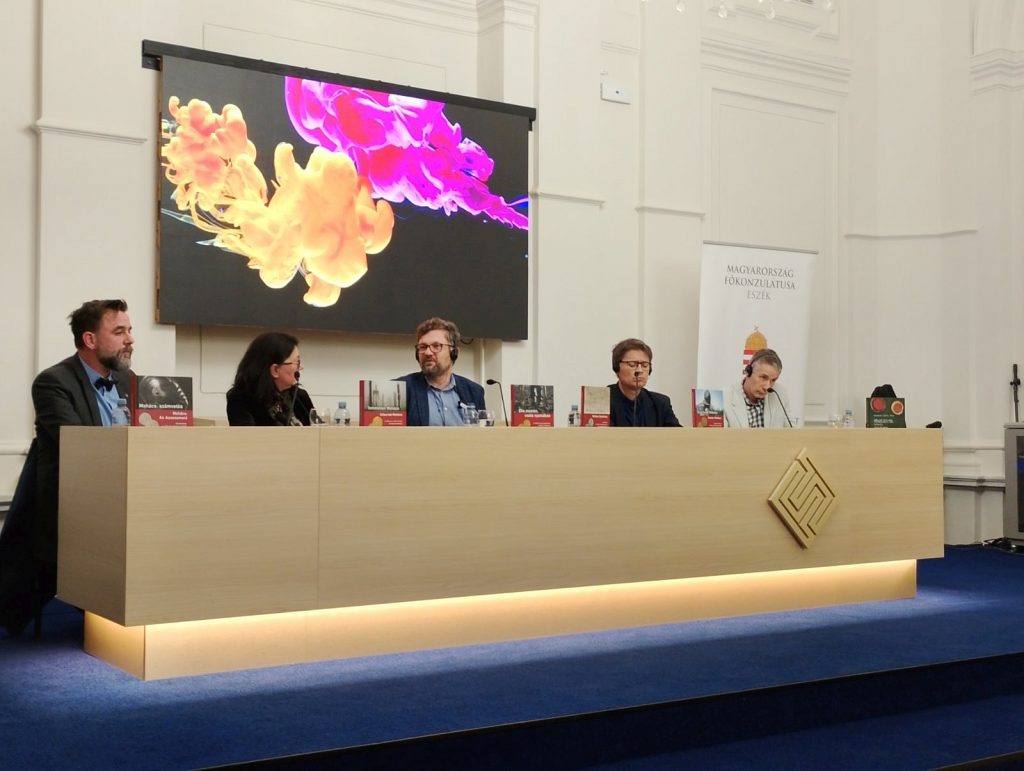
Kornelija Jurin Starčević analysed and explained in detail the military aspects, including the organisation of the standing army and the importance of the territories conquered during the reign of Selim I as a foundation for the rise of the Ottoman Empire. She pointed out that during the reign of Suleiman the Magnificent, Vienna represented a kind of “red apple”, symbolising the ultimate objective of Ottoman expansion. She identified Ilok and Petrovaradin as key fortresses on the route to Mohács. She also discussed the strategic, tactical and military factors that contributed to the Ottoman victory, including the use of chained cannons as a barrier that prevented the Hungarian army from advancing and at the same time functioned as a kind of trap.
Hrvoje Kekez pointed out that the Croatian historical lands were among the first to experience the Ottoman threat, while also addressing the question of the participation of Croatian troops in the Battle of Mohács. He further emphasised the importance of Belgrade as an exceptionally strong fortress in a favourable strategic position, particularly in the context of controlling river routes.
In the concluding part of the discussion, the participants considered the Ottomanist perspective and historiographical interpretations of the event. The round table moderator, Professor Danijel Jelaš, concluded that the event had provided an exceptional opportunity for distinguished experts from both countries to discuss this important historical topic and that the Battle of Mohács represented a turning point between historical eras in both Croatian and Hungarian historiography.
The round table continued the established series of scholarly meetings, once again confirming significant public interest, while the next gathering was announced for the autumn.
Lana Trabak