
On Monday, 30 March 2026, the discussion “Translation and Proofreader Nitpicking” was held at the Faculty of Humanities and Social Sciences in Osijek as part of the FUZ&JA project. The discussion featured Petra Gverić Katana, a teacher at the XVIII Grammar School in Zagreb, proofreader and editor, and Mišo Grundler, a translator from Swedish, Danish, Norwegian and English. They opened the discussion with the idea that we cannot simply speak of good and bad proofreaders and translators, but rather of a broad spectrum. They compared earlier prescriptivist tendencies, which did not reflect the actual language used by Croatian speakers, with the contemporary neglect of language that leads to a decline in the quality of expression. They emphasised that care for language does not depend solely on linguists, but also on institutions that need to recognise its importance and support its preservation. Proofreaders, translators and editors play an important role in this, although they are often insufficiently paid.
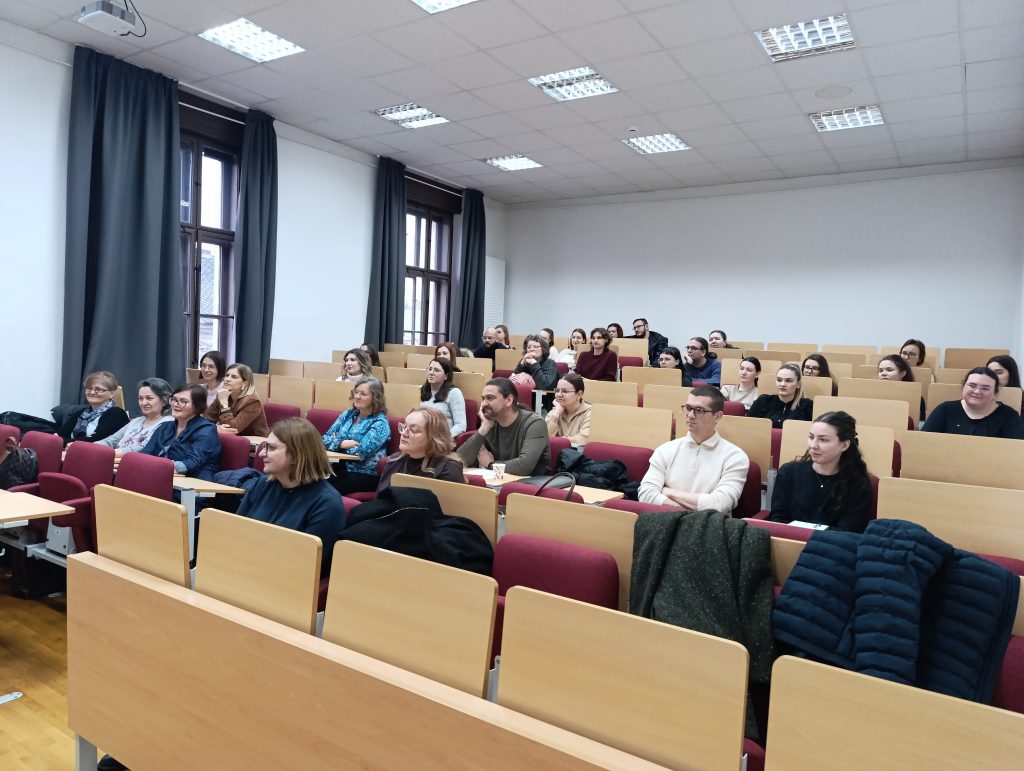
In the central part of the discussion, the guests addressed the obstacles they encounter in their work. Among them, they highlighted the overproduction of content, which forces them to sacrifice the quality and artistic value of a work. In addition, disagreements sometimes arise between translators and proofreaders or editors, always requiring compromise and flexibility. They stressed that a proofreader should never interfere with a translator’s style, while a translator should never omit parts of the source text. Other challenges include words without a direct equivalent, cultural differences, the increasingly noticeable influence of English in various linguistic constructions, and spending hours working on a single page of text. The guests then touched on the low level of book readership in Croatia, which makes it difficult for publishers to sustain themselves through sales and prevents their profession from achieving the necessary stability. Precisely because of low readership, Grundler and Gverić Katana underlined the importance of education and the need to draw young people into the world of literature, which should be done through topics relevant to contemporary audiences.
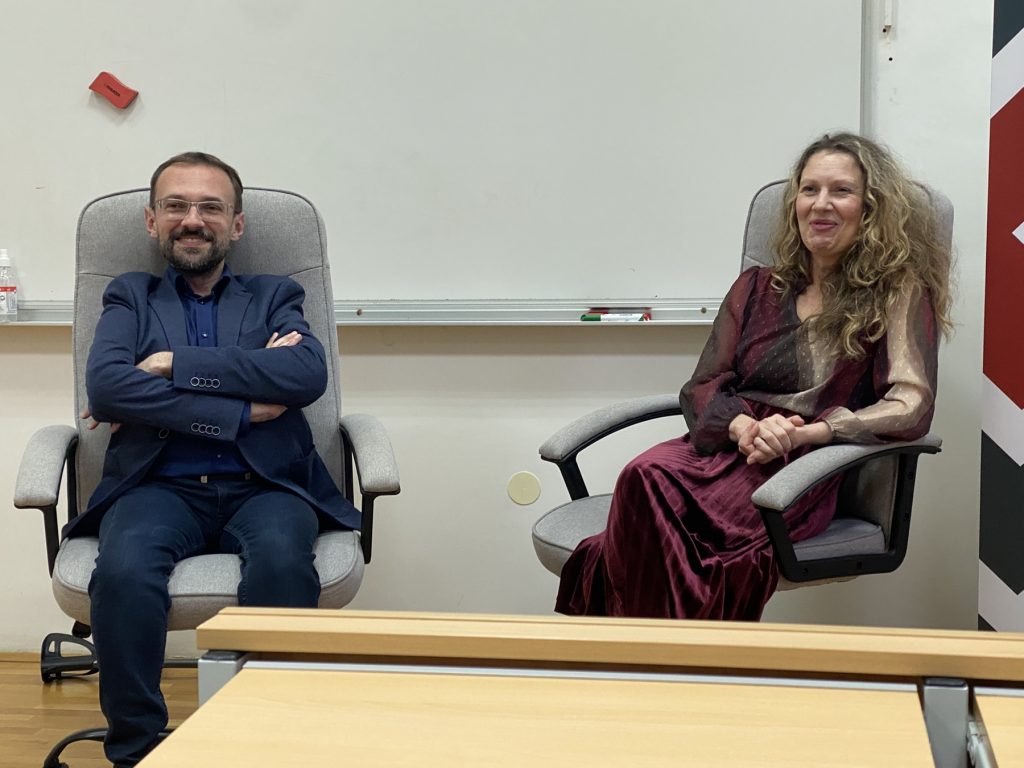
In the final part, the guests explained how to begin pursuing this career path, what to expect and what is worth fighting for. They also highlighted other types of translation that are more profitable on the market, though no less demanding. Although they themselves cannot know exactly what the future holds for their profession, they emphasised the importance of preserving the written arts and of continuously advocating for rights that will provide the profession with stability and visibility. The discussion concluded with answers to numerous questions, particularly those concerning the future of translation and proofreading in a time increasingly reliant on artificial intelligence.
Matej Gabud