
EstLab
EstLab Colloquium: Heidegger’s Letter on Humanism
Više >
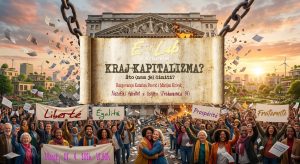 How and why is capitalism destructive? Is capitalism merely a particular socio-economic-political regime, or is it rather a “religion” (W. Benjamin)? Finally… when will we (and will we at all) witness the “end of capitalism”?
These questions, as well as many others, were raised that afternoon in Room 54 at FFOS. Why? Well, of course, because Katarina Peović was a guest of the cooperative known as EstLab! This remarkable woman, a member of the Workers’ Front and also of the band FRONTA, a professor of Cultural Studies in Rijeka… simply, Comrade Kate… spoke with philosophy students, Osijek residents who joined us, and the author of these lines.
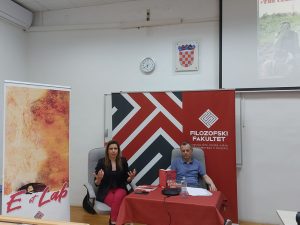 Can materialist analysis be brought back into the public sphere? Why should the proletariat constitute itself as a nation? What is “protagonist democracy”? In her inspiring formulations, Katarina tried, as best she could, to answer the many contentious issues of the world we inhabit. Furthermore, the conversation inevitably had to address a neuralgic point of “Our Beautiful Homeland”… namely, the inability to articulate “left-wing thought” in Croatia. No, our people are not stupid(?); rather, the structural necessity of the power of Capital is such that it appears inevitable. (What cannot be excused, for example, is the total lack of awareness and political responsibility of political elites in the EU and Croatia regarding the condemnation of the genocide against Palestinians.)
In the end, the question of WORK and SOLIDARITY emerged as crucial. Let us become aware and finally “wake up” from this “nightmare weighing on the brains of the living” (Marx)! Una mattina mi son svegliato… https://www.youtube.com/watch?v=oZfuAUyCU90 and https://www.youtube.com/watch?v=dMqiw4Ibo_s
mk
Recording of the event: EstLab – The End of Capitalism? – guest Katarina Peović
TIME: Tuesday, 28 April 2026 at 6:30 p.m.
VENUE: Room 54 on the second floor of the Faculty of Humanities and Social Sciences
Can we look forward to the End of Capitalism? And… can we hope that this, the most radical incarnation of the dominant economic-political regime in the history of class antagonism, between those who rule and those who are ruled, will one day reach its (desirable!) end?
“Capitalism does not work, but it still rules,” reads the cover of the publication appearing before us hic et nunc. Before whom? Before us, of course, those who still care about a better, truer, more real, more just and, ultimately… more beautiful world. Or at least a more bearable one, we might say with a degree of cynical restraint. The subtitle of Katarina Peović’s book itself introduces a certain reservation regarding the context in which the publication’s title question appears. Namely, “While the old is dying and the new cannot be born,” the time of monsters arrives (as Antonio Gramsci would put it in his Prison Notebooks). How are we to cope with all this while what we call the “world” plunges into the abysses of war, poverty and hunger? All because of the unquestioned rule of the only subject-substance of the present, Capitalism.
Katarina Peović, a professor of Cultural Studies at the University of Rijeka, is the best possible person to discuss this topic with. Alongside her university vocation, her second Beruf is activism and the constant struggle for the rights of the most vulnerable in society (or what remains of it). Katarina was also a member of the Croatian Parliament from 2020 to 2024. Yet her intellectual habitus is not exhausted by official positions, but is expressed through her constant presence in the public sphere and her ceaseless effort and STRUGGLE for improvement in the society in which we live.
The End of Capitalism? While the Old Is Dying and the New Cannot Be Born is a collection of texts published in Obzor, the supplement of Večernji list, from June 2024 to July 2025. Adapted into the form of a scholarly study, the texts are not merely intellectually stimulating reading, but much more than that. “As a fortunate fusion of journalism and theory, Katarina Peović’s book is above all an argument for libertarian disobedience, for a spirit that refuses submission to the prevailing rule.” This was how one of the most important guests in EstLab’s five-year history, Viktor Ivančić, described the book.
In Croatia, things have only grown worse since the final entry recorded in the book. Especially after the epochal(!?) rupture and the “festivity” at the Hippodrome on 5 July 2025.
In our conversation with Katarina Peović, we seek to evoke a “call… to awaken from social apathy… for those who feel that the system is bursting at the seams and are seeking a clear political… answer”: Что делать??
What can we, here and now, still do about it? Hear it at the forum, in EstLab’s dialogue with Katarina on 28 April 2026 at 6:30 p.m. in Room 54 at FFOS. Come, listen, ask questions… let us talk!
mk
TIME: Tuesday, 24 March 2026 at 5:30 p.m.
VENUE: Room 39 on the first floor of the Faculty of Humanities and Social Sciences
Comment redonner un sens au l’expression “L’ age du Lumière”? Why do we paraphrase the beginning of a long-ago philosophical text in French? And why do we use a Heideggerian expression concerning meaning?
Kant’s text An Answer to the Question: What Is Enlightenment? states that Enlightenment is “man’s emergence from his self-incurred immaturity”, the goal set by such a project (Entwurf) of this “age of light”. The article, published in the Berlinische Monatsschrift back in 1784, may strike some as hopelessly outdated and… “surpassed”(?) Does the motto Sapere aude!, that is, dare to use your own reason, still have any meaning? Any sense?
The legacy to which we wish to restore enthusiasm is the French Revolution of 1789. In Kant’s later text The Conflict of the Faculties (1798), this is an important motif. Enthusiasm for the revolution is not tied to the concrete outcome it produces in socio-economic-political terms, but rather to the enthusiasm it arouses in people, in those who observe it in an enlightened manner, Kant says. And… what is its “meaning as such” (Heidegger)?
Of course, we all (do we?) know what we must do in order to become mature, decisive, intelligent and honest people. We also know the difference between the “public” and “private” use of reason… But what are we to do with this knowledge in a “world” that is one in name only? A “world”… because every moment in which we live today painfully and soberingly tells us that we long ago abandoned the idea of “EMERGING” from the immaturity for which we ourselves are responsible. We prefer books (today, self-help manuals!), pastors and doctors to take care of us. Because… we are cowards, lazy and full of fear. We no longer have genuine thought grounded in the “public use of Reason”, corresponding to the dimension of the Universal. Everything has shifted into “private use”, in the service of universal submission… To what? TO EVERYTHING, especially to the grotesque world order that mercilessly tramples everything the Enlightenment bequeathed to us as a projection of a better and more just “lifeworld”. (It is enough to look at today’s “Europe”, which protects… its interests/!?/ in Ukraine while showing no compassion whatsoever for the suffering and killings in Iran/!?)
Through a reading of Kant’s text and Michel Foucault’s lecture of 5 January 1983 (second hour), we attempt to pose similar questions while also anticipating some new answers. Must we, in this entire endeavour, adhere only to the dispositif of “security”, or can we perhaps (still?) appeal to the revolutionary enthusiasm for freedom in Kant’s 1798 text The Conflict of the Faculties?
We address all this at the colloquium “Is There (Still) an Enlightenment?”, through a conversation between philosophy students and members of EstLab, on Tuesday, 24 March 2026 at 5:30 p.m. (Room 39).
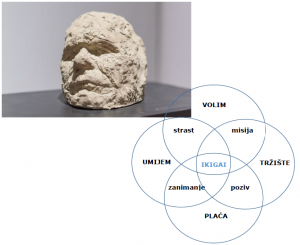 The Aesthetics Laboratory once again explored the possibilities and limits of aesthetics in the contemporary world, this time through the prism of the visual arts. In a conversation with academic sculptor and jewellery designer Ivan Midžić Midžo (https://www.midzo.art/), he immediately answered the question “Can one make a living from art?” in the affirmative. He himself lives quite comfortably from what he calls applied art. Through his sculptural and design work, he began creating sculptural, one-of-a-kind jewellery from various metals, quickly making a name for himself on the fashion and design scene and earning a respectable income from sales in Croatia and abroad. In this way, he has certainly come close to the idea of a life goal advocated by the Japanese concept of “ikigai”, which involves the unity of one’s interests in life, creative passion and life mission with what one is genuinely capable of doing. When this is combined with what the world needs and with the fact that one can earn a living from it, we arrive at the perfect life situation known as “ikigai”.
During the conversation, Midžo proved to be a playful but also precise interlocutor who insisted on distinguishing design from art. Design, he argued, is an idea, a utilitarian plan that represents the fulfilment of the goals of both the creator and the audience or user, whereas art is an expression of the artist’s own passion and need to shape an idea that may prove successful in its realisation, but may equally fail completely and be rejected by the audience. In describing his artistic path, he showed that, as an academically trained sculptor, he found his most immediate form of expression in various conceptual projects such as binding stones and rooms, while his love of metal, inherited from his father and other family members who worked with metal, was organically and spontaneously transferred into the design of metal jewellery. Through work on jewellery and other sculptural pieces, he also found his visual expression in drawing. As a self-taught guitarist, he then made a sensory shift by pairing his independently composed and performed musical miniatures with drawings used as animations, creating original multimedia works that represent both a departure from his earlier expression and a natural development of his artistic curiosity and search for new ways of expressing his artistic observations.
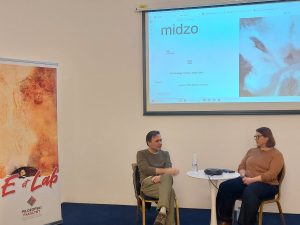 In describing today’s art scene, he also revealed the harsh reality faced by contemporary artists, who are constantly searching for places to exhibit and trying to break into the “higher classes” of artists, as he calls them. The constant search for galleries willing to exhibit their work, fairs where they can sell it, and patrons showed that the history of the visual arts is full of examples in which artists’ persistence and entrepreneurial spirit proved crucial to preserving their life’s work (e.g. Giotto, Caravaggio). He also pointed to secondary applications of art through art education and positions such as gallery curators and art critics, in which knowledge about art, if not art itself, can also be monetised.
He also spoke very positively at the end of the conversation when we discussed contemporary trends and the use of artificial intelligence. He noted that, in the history of artistic practice, even tempera was regarded as a threat when it first appeared, and that artificial intelligence should be seen as yet another (useful) tool. He also emphasised the need in art to distinguish originality from authenticity. Anyone can be original and invent something new, but only a few artists are authentic, that is, faithful to their own expression and character. Midžo proved both original and authentic, and through his work and practice demonstrated the importance of living for art, but also from art.
Tanja Gradečak
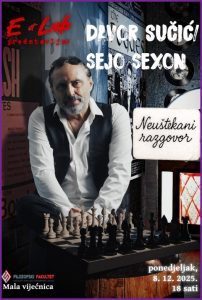 John Lennon was murdered on 8 December 1980. On that day, one “spirit” of rock ’n’ roll also departed with him, back when R’N’R “was young”. EstLab sought to evoke Lennon’s authenticity and playfulness through an equally sincere, and indeed equally playful, figure from the YU-ROCK scene, Sejo Sexon!
The frontman, “heart and soul” of ZABRANJENO PUŠENJE, Davor Sučić (aka SEJO SEXON), appeared at FFOS on 8 December 2025 in a packed Room 39, through the efforts of EstLab’s new “acquisition”, Goran Faletar. He is truly a source of “good spirit”, of the “Sarajevo crowd”, while ZABRANJENO PUŠENJE is marking its longevity on the scene with its fourth (4th!) consecutive “unplugged concert” in Osijek.
 In conversation with him, the audience had the opportunity to learn about the origins of one of not only the longest-lived but also one of the most important rock bands of the former Yugoslavia, as well as about the pivotal moments when Sučić revived the band in 1997 with the definitive album Fildžan viška. It was also a triumphant entry onto the Croatian rock scene. At that point SEJO SEXON, after many years spent in the background behind Nenad Janković (aka Dr NELE KARAJLIĆ), stepped into the spotlight in the best possible way as guitarist, singer and principal songwriter of ZP.
During the conversation we also learned that “DAIDŽA”, Elvis J. Kurtović (Mirko Srdić), helped make “Možeš imat moje tijelo” a major hit as the only song on the album Fildžan viška written in “proper” Croatian… We also learned that, for Sejo Sexon, the essence of rock ’n’ roll lies in the openness and honesty of its songs and music, which ZABRANJENO PUŠENJE has been offering its audience for more than four decades. Indeed, with this event, 45 years after Lennon’s death, the spirit of “rock and roll” came alive again, as did that of the “Good Mates”: Sejo Sexon and his loyal audience. mk
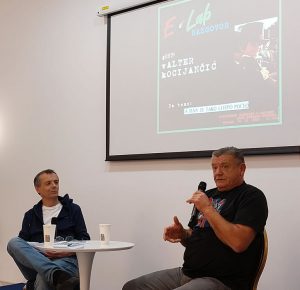
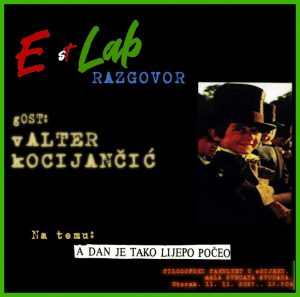 And the day ended so beautifully, with a conversation and encounter with a representative of punk, a free spirit and an authentic example of a rock poet, Valter Kocijančić, the bearer of the original, primordial sound of Paraf. Students and lovers of music of resistance had the opportunity not merely to listen, but to experience punk, on 11 November in a lecture hall at FFOS. Through a kind of listening session, we travelled back to a time when young people uncompromisingly sought their place in the universe and, with memorable melodies and simple lyrics, hit hard at anyone looming over them, even when this meant the people’s militia. Valter vividly showed us that the period gave punk its maxim: YOUNG PEOPLE who ACT while searching for their FUTURE. In his lyrics, Valter described and depicted what was happening around him, things as they were, everyday life itself; the point was not to theorise, but to signal dissatisfaction and get moving (as another punk/rock musician once put it: move, change yourself). Punk was not merely the scream of hopeless youth unable to submit to authority. No, the punk of a band such as Paraf was a powerful expression of precisely those who believed in a movement of free spirits whose rebelliousness could topple regimes(?) whose sole aim was to suppress every form of action and change:
 Everything is in perfect order
The yellow lines are respected
Children cheerfully wave little flags
(…)
And something tells me, something tells me
Something tells me, something tells me
(You are infected, you are infected
You are infected, you are infected)
Valter bore witness to this, and we punk lovers pass it on: our own times need punk as well; they need young people who will, if not act, at least identify the existing, metastasised cancers of society.
Luka Prijić
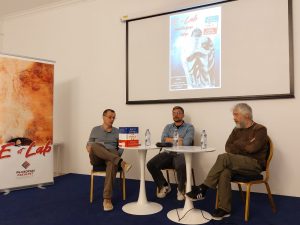 What is the “Literary Republic of Yugoslavia”? What, in turn, is the (post-)Yugoslav literary field? And can one speak freely at all about the toponym called YUGOSLAVIA?… at least within the so-called “academic establishment”?
The affirmative answer to the latter questions shows that one CAN! On Tuesday, 14 October, FFOS hosted Boris Postnikov. The author of the book mentioned in the opening sentence spoke with the participants and audience at the first session of the Osijek Aesthetics Laboratory’s new season. The main thesis of the publication’s narrative, accepted by numerous literary theorists and literary historians, is that even after the dissolution of the country called the SFRY, a “shared cultural space” continues to exist. It is inhabited by writers who do not wish to be confined within any canonical “national space”. All future research into literary developments in this region must therefore take a position on the continuity of “post-Yugoslav literature”.
Among other things, the conversation considered the role and place of the most prolific “post-Yugoslav” writer, Miljenko Jergović, as well as the role Dubravka Ugrešić has played in defining the “literary field”. The contribution of self-declared “post-Yugoslav” writers such as Marko Pogačar and, in particular, Aleš Debeljak was also discussed. The final conclusion of the discussion was that there can be no dispute about the diversity and productivity of the literary and cultural phenomena that emerged after the dissolution of Yugoslavia. “Post-Yugoslav literature” is an indisputable fact of a free, universal space beyond national Croatian, Serbian, Slovenian and other literatures of the former state.
In conversation with the book’s reviewer Igor Gajin and the author of these lines, the author considered many aspects of literature and Yugoslavism, a topic that provocatively entered the terrain of exclusivism maintained by local nationalist “cultural gatekeepers”. In a well-attended Room 39 at FFOS, one thing was confirmed… YES, it is possible to speak freely about reading and writing in the spirit of the YU cultural tradition.
mk
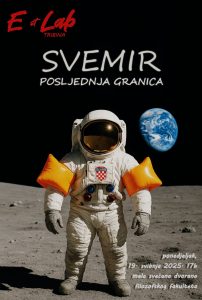 “Two things fill the mind with ever new and increasing admiration and awe… the starry heavens above me and the moral law within me,” Immanuel Kant wrote as early as 1788. Wonder at what surrounds us lies at the origin of philosophy itself, as well as science, but it is also a differentia specifica that has accompanied humankind from the very beginnings of its existence in the world. Wonder at celestial phenomena and the universe not only has no discernible beginning, but no end in sight either. Space, as Captain James Kirk repeatedly reminded us in Star Trek, remains the “final frontier”, whose exploration is a task without foreseeable completion. Relative to the age of the universe, human civilisation is only at the very beginning of such exploration, which first relied on the naked eye, then the telescope, while its most advanced contemporary forms appear in probes travelling through the darkness of space and the International Space Station anchored in Earth’s orbit.
And yet, at the next gathering organised by the Aesthetics Laboratory, we returned once more to the good old eye, mind and conversation, so that together we might marvel at the universe and everything we still do not know. The event “Space, the Final Frontier” was held on Monday, 19 May 2025, in Room 39, beginning at 5 p.m., and our guests were members of the Institute of Cosmology and Philosophy of Nature from Križevci.
In addition to wondering together through dialogue, the gathering also provided an opportunity to launch the third issue of the journal Kozmologija, edited and published by members of the Institute.
Once again, on our small blue island that allows us to float safely through space, we discovered and shared the wonder of existence together.
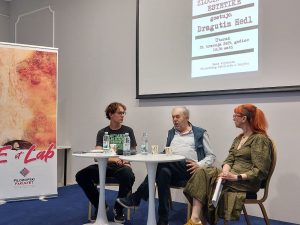 A special edition of the Aesthetics Laboratory held on 29 April 2025 featured distinguished journalist, publicist and writer Drago Hedl. Entitled “Crime and Punishment of Aesthetics”, the event brought together an audience interested in topics at the intersection of journalism, literature and social criticism.
The conversation with Drago Hedl opened numerous questions about the boundaries between truth and fiction, the role and responsibility of the writer, and the power of aesthetics in shaping narratives about real crimes. Through dialogue and reflection, participants discussed ethical dilemmas connected with the aesthetic treatment of violence and the role of literature in shaping, or obscuring, social justice. Fundamental questions were also raised about the nature of literary confession: is it truly an exposure of life, can what is true be beautiful, and what is beautiful be true? In an atmosphere of poetic forensics and aesthetic re-examination, the meeting opened a space for reflection on the role of art in confronting social trauma, particularly in times when institutions often fail to provide adequate punishment in response to crimes committed.
The audience showed great interest in the topic, and the gathering continued with informal conversations after the official part of the event.
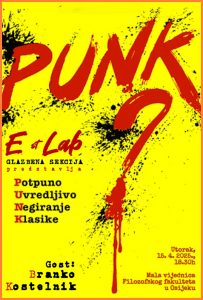 Room 39 at FFOS hummed and thundered that Tuesday, 15 April 2025. For a good hour and a half! What was happening? What caused this tectonic phenomenon at FFOS? Cui bono?
For those who still do not know, we were trying to answer the question: What is PUNK? EstLab’s guest was Branko Kostelnik, Head of the Programme and Exhibition Department at the Museum of Contemporary Art in Zagreb, a sociologist of culture and lecturer at VERN… But most importantly for us, a long-standing rock critic, historian, producer and organiser of rock concerts. Together with him, we tried to answer the question posed above, namely, what is PUNK?
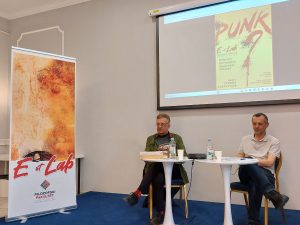 For a good hour and a half, we discussed the meaning of punk music, its habitus and its significance for the ability of young people, but also of everyone who listened to it and those who still devotedly present and practise it today, to change the social circumstances in which they live. Or at least to point to an artistic “rhythm of rebellion”… The CLASH, SEX PISTOLS, The JAM… Talking Heads, RAMONES, Television… STIFF LITTLE FINGERS, Gang of Four, TOM ROBINSON Band… all of them profoundly marked the formative years of the two interlocutors. The conversation sought to show that the humanities in particular, if they still wish to survive at all, cannot do so without the inspiration bequeathed to us by punk and new wave music. Did all of this reach the young people at the Faculty, our students? Out of the corner of my eye (and ear!), I saw the young bodies present surrendering to the PLEASURE of that “rhythm of rebellion”. And what better proof could there be that this conversation and this music fulfilled their purpose?
mk
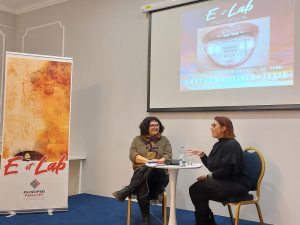 In today’s age of highly specialised knowledge, when experts work within very narrow areas of science or art, we rarely encounter those almost Renaissance-like personalities who effortlessly sail across seas of different forms of knowledge, connecting through their work distant shores that are often invisible and seemingly untouchable. Nataša Govedić is undoubtedly one such personality, as we were able to see during the conversation held on Tuesday, 18 March at 6:30 p.m. as part of an EstLab gathering.
Becoming acquainted with Nataša Govedić’s work and activities, it quickly became clear that she is an experienced navigator who skilfully and effortlessly connects art and science, literature and theatre, poetry and language, reading and living, school and life. The conversation began with the theme of school and life, and through her latest book Pohvala odriješenim rukama – odvažna čitanja i kritičke pedagogije, Govedić opened important questions about how well school actually prepares pupils for life and how a space of freedom can be found within institutional education, whether one is a pupil or a teacher. It was emphasised that such a space can be truly alive only if it encourages creative expression and critical thinking.
The conversation then continued with the theme of sensuality in language, or what the author herself calls the “eros of creation”. Nataša Govedić emphasised the importance of exploring sensory experience when giving linguistic form to one’s personal experience of a book, performance or piece of music. Such an approach enables us, through criticism and creative expression, to recreate ourselves in a multitude of different ways.
Particular attention was devoted to the current state of literary and art criticism. The discussion highlighted the problem of a contemporary world flooded with information, in which it is difficult to find one’s authentic voice and to distinguish constructive criticism from mere fault-finding. Nataša supported her insights and reflections with considerations from her book Oscar Wilde izlazi iz zatvora ili vaša omiljena umjetnost zove se kritika, further enriching the discussion.
During the gathering, many topics opened spontaneously, and the audience had the opportunity to experience a unique intellectual journey. Thanks to the wealth of insights offered by Nataša Govedić, everyone present left the event enriched with new ideas and fresh perspectives.
TIME: Tuesday, 21 January 2025 at 6:30 p.m.
VENUE: Room 39 on the first floor of the Faculty of Humanities and Social Sciences
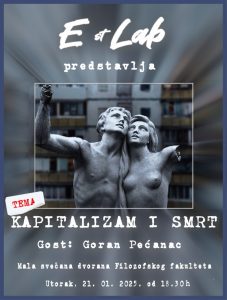 “Consensus reality has thus become subjective (consumer) reality, governed by an online and offline market algorithm” (K i S, 102). But where is reality? And… does any kind of “reality” of our existences still remain? In other words, where is it?
We would say: only in CAPITAL, the sole subject-substance of our contemporaneity. Capitalism, in its (we hope!) terminal stage, is the subject of Goran Pećanac’s book-length study. This “bookish provision”, indebted to psychoanalysis, is a brutal vivisection of Capitalism and Death. Yet this is also a book that ultimately turns towards the possibility of Spirit, that is, Geist, as an “exit from the universe of a single being”. In other words, it remains a genuinely philosophical book.
“Can psychic energy sometimes be given as a gift, rather than only invested?” is the key ontological question of Capitalism and Death. Ultimately, Pećanac proposes the “practice” of the human as the remaining option for “reality”. Thus, in an age dominated by the “psychotechnology of desire control”, amid the general collapse of reality, or the “real ontology of the subjugation of desire”, we should devote ourselves to mentalisation, and then to empathy. In the wastelands of the borderland, we seek cringe. In a “world” (which may no longer be one!?), we need to be better to one another.
The basic idea of the book could be considered, and indeed is called, farcical. Its fundamental Erasmian impulse is anti-scientific. And thank God for that! Philosophy still has much more to tell us in an artistic tone and mode. Only in this way do we arrive at what remains: MEANING. The kind of meaning that draws us away from the position of a Pseudo-God. Because… that is not what we are. The “fear of death” is transcended by the fragile and uncertain hope that the Other, the different is possible. Indeed, as Pećanac concludes this anti-capitalist treatise on the seemingly impossible, “the new political premise… will be based on empathy, freedom and social justice”.
MAD? UTOPIAN? IMPOSSIBLE? Is that really so? Hear for yourselves in the online conversation that EstLab comrades will conduct with the author of this philosophical book, already published in several editions(!). All of this takes place on Tuesday, 21 January 2025 at 6:30 p.m. in Room 39 at FFOS. Come, listen, ask questions… Death to capitalism, freedom to philosophy.
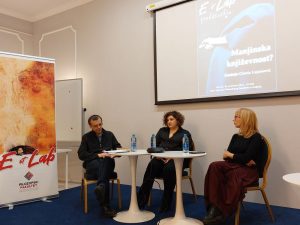 On Tuesday, 10 December, the final EstLab event of the year was held. The distinctive “literary evening” featured Gloria Lujanović. This Croatian writer, originally from Bosnia and Herzegovina, spoke about two notable books from her previous year’s production. One is the distinctive poem OTAC, while the other is a contribution to the “culture of memory”, a record of the wartime suffering of Bosnian Croats in the Lašva Valley, SRCE ZEMLJE.
The conversation also problematised the concept of so-called “minority/minor literature”, and the author expressed her loyalty to a Croatian national identity. At the same time, however, she also acknowledged her regional belonging to Bosnian literature. This distinctive positioning of Gloria Lujanović was also the subject of the conversation conducted with the author by the acclaimed and award-winning writer Ivana Šojat and EstLab co-founder Marijan Krivak.
Finally, the phenomenon of literary “fairs” was also discussed, prompted by the author’s journalistic piece on that year’s Interliber. The event, which attracted considerable interest from those present, opened a series of questions about the place of books and the humanities in contemporary society. Gloria Lujanović offered her view of the phenomenon “first-hand”.
mk
TIME: Tuesday, 5 November 2024 at 6:30 p.m.
VENUE: Room 39 on the first floor of the Faculty of Humanities and Social Sciences
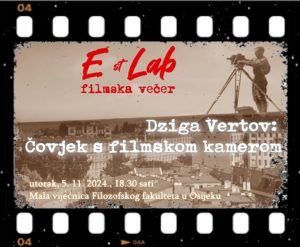 Film is a revolutionary art. From its very beginnings, this artistic human endeavour has sought to reach new horizons and perspectives. One of the classic films of this kind is certainly Man with a Movie Camera (Человек с киноаппаратом, 1929). It is a distinctive cinematic expression separated from the language of theatre and literature. In the dynamic depiction of a single day in Soviet Russia, Dziga Vertov creates his final work. The camera’s constant movement is also a sign of the dynamics of the revolution “in progress”. Jacques Rancière would say: “this is not a film about revolution, but an activity that shows communism in the everyday pulse of life”.
The protagonist of the film is the movie camera. In constant motion it records… LIFE. It climbs factory chimneys and bridges, arrives at bathing places, films from a speeding car or motorcycle. The cameraman lies on the railway tracks in adrenaline-filled anticipation of an oncoming train. Vertov sends his protagonist, the cameraman/camera, into hospitals, maternity wards… cemeteries, funerals… sporting events… streets and squares. In all this, cinematic language is born. On the border between figuration and abstraction, Man with a Movie Camera contributes to Benjamin’s optimism concerning cinema’s effect on the destruction of the sacred role of the AURA in the experience of a work of art. But not only that… This film is the culmination of the Soviet/Russian AVANT-GARDE and its artistic testament. On Tuesday, 5 November, in Room 39, as part of EstLab’s “Filmosophy” section, we will discuss this silent, yet “eloquent”(!), cinema classic. Let us watch the film together and discuss what it means to us TODAY.
mk
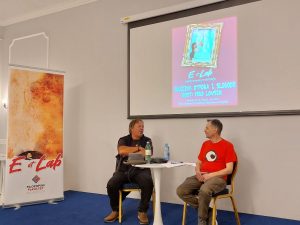
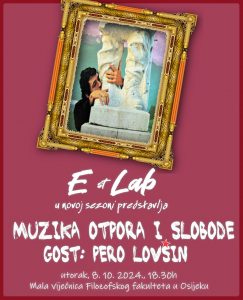 Room 39 at our Faculty echoed with punk on Tuesday, 8 October 2024. We hosted Pankrti, of course, through their “spokesman”. At EstLab’s first forum of the new season, Peter Lovšin spoke with the author of these lines. A beloved “rebel with a cause” from some of our long-ago times, Pero uncompromisingly exposed the artistic provocation of punk and of Pankrti before a packed audience. It became clear that he still has something to say to new generations. Loud and clear, through music and words. Alongside a presentation of their “Rdeči album” and a discussion of Pankrti’s resistance to the rigid socialist regime, the conversation also addressed the political and cultural solidarity among bands, and other artists, throughout the former Yugoslavia.
FROM THE ANNOUNCEMENT: Svoboda? Kaj pomeni svoboda? Or… Freedom? What does FREEDOM mean (to us)? As a local, though alas long-gone, rock poet and undisputed Messiah of this region once said: “Freedom is not the mutual caressing of idiotic heads… Freedom is a Woman, take her.” And YES, one day in that mythical year of 1977, Gregor Tomc travelled to London to bring back evidence of that FREEDOM… in the form of vinyl records. Of course, this was the then-emerging PUNK. It was a “cry of freedom”. And all this at the conservative dawn of Anglo-Saxon neoliberalism. Down south, in the westernmost republic of Yugoslavia, there appeared… PANKRTI. In the spirit of the anarchist cry that they “do not know what they want… but they know how to get it” (Sex Pistols), these Bastards burst onto the YU rock scene like a storm sweeping away everything before it. This “storm”, or rather thunder, ravaged the SC Gallery in Zagreb in the late autumn of 1977. The above-mentioned poet offered a friendly welcome to his Ljubljana comrades in the lyrics of his first single: “I shave my beard and moustache to look like Pankrti” (Azra, Balkan, 1979). Although Houra’s (or rather Cvetković’s!?) Kazalište beat them to the release of a first album, while a little later Rijeka’s Paraf released its now-anthological debut, PANKRTI shaped and conceived their own LP most convincingly. https://www.youtube.com/watch?v=_xekKeGc0bE&t=1494s.
 Dolgcajt was the truest image of growing up amid the greyness of torn city streets in what was then deadly dull Ljubljana. (Its bolezen, the fantje from Kodeljevo and Šiška had already described in the single “Lublana je bulana”.) From Kruh in igre to Podgane iz Ljubljane… It was a cultural SCANDAL. An artistic-political provocation par excellence. But also pure ENERGY, unprecedented in this region. Naturally, it could not pass without a State Award!(?) – the “Seven Secretaries of SKOJ”. Darlings of the state, then, Pankrti(!), long before their fellow citizens from Laibach, used overidentification as an artistic excess, visible on the cover of their second album https://www.youtube.com/watch?v=zp8Z16C0Gqs. “Za železno zaveso, stare babe puljo rdečo peso.” Was it irony? Hmmm…
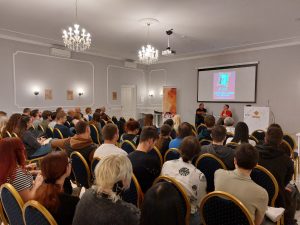 Anyway, now for the main point. Forty years ago came the strongest blow against the stale ideological slogans of an already exhausted socialist Yugoslavia. RDEČI ALBUM — was it subversion? Or was it a revival of authentic “communism and FREEDOM”!? Does the language of music still think critically about the reality it sings about and depicts? Are there still young and rebellious musicians with an idea/message? Hmmm… Neither Pero’s Ljubljana nor the Ljubljana of the revolutionarily conscious Pankrti is, surely, what it once was. Everything is different… and sadder. Yet a glimmer of light appeared at the end of this musical conversation. The young people present, FFOS students, spontaneously enjoyed themselves, some even jumping around, to Pankrti’s rebellious anthem “Bandiera Rossa”!
mk
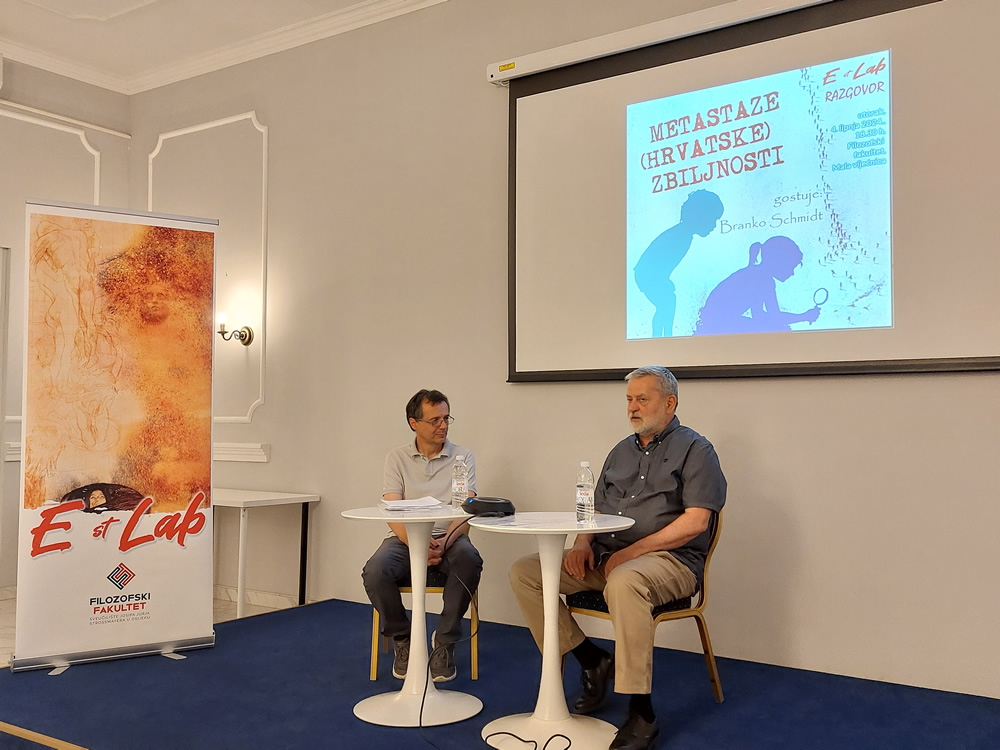 The final EstLab event of this academic year offered those present a rarely exciting, “metastasising” experience. Our guest was Branko Schmidt. The recent recipient of the “Vladimir Nazor” Lifetime Achievement Award in film art spoke with the author of these lines about Metastaze. (The cult film, btw, was screened once again for interested viewers before the conversation itself.)
Everyone present, including director Schmidt himself, agreed that the film has proved astonishingly resistant to socio-cultural change and the passage of time, remaining equally innovative and fresh a full fifteen years after it was made. During the conversation, Branko recalled many memories and experiences associated with the filming. We also learned how he met Alen Bović. Indicative of the society in which we live, Bović had to use a pseudonym when publishing the novel Metastaze, for fear of radical reactions to his literary debut… and who knows what else. For in Metastaze (of Croatian reality!), Ivo Balenović depicts both metaphorically and literally the disintegration of a group of young people amid the local post-war transition, under the sign of hooliganism and violence associated with the formation of “Our Beautiful Homeland”.
Schmidt revealed that the film also marked a kind of metamorphosis in his own body of work. His collaboration with Balenović and the film’s principal protagonist, actor Rene Bitorajac, also produced another important film of Croatian cinema, and beyond, from those years: Ljudožder vegetarijanac (2012).
Ultimately, Schmidt proved to be an inspiring interlocutor, but also a man who remains disappointed by certain manifestations of the country in which we live, including the persistence of a kind of fascist-generating tendency, particularly in connection with the so-called “supporter subculture”. Our homeland remains burdened by many “metastasised” deviations, and the director of the cult film also reflected on the result of our most recent parliamentary elections.
As a native Esseker, and someone who was also a wartime television cameraman in Osijek as the city was being destroyed in the early 1990s, Schmidt is certainly a legitimate witness capable of passing on to younger generations his experience of a country that, in many respects, could and should have been different. Metastaze is a film that makes us aware of all this in a disturbing yet intellectually stimulating way. Fortunately, we can also enjoy it as a sparklingly humorous, witty and full-blooded genre film. Believe me, it remains not only the most important, but truly the best Croatian film since independence. mk
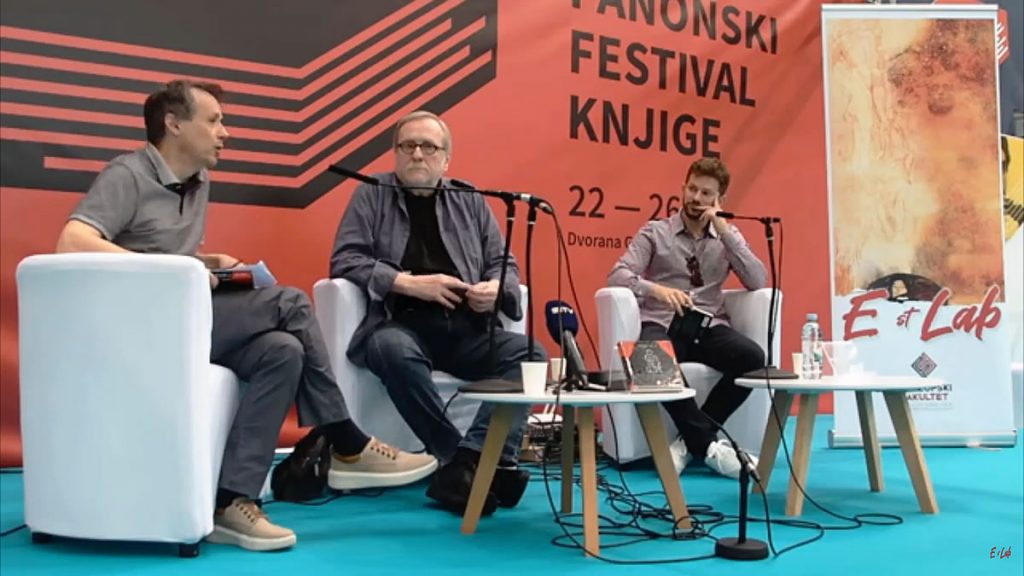 Acting is lived, felt… reflected upon. This much-needed “reflection” took place on Youth Day itself, as part of the Pannonian Festival of Literature. The second edition of the festival hosted perhaps “the most significant living actor” (B. Pešić) “in these parts” (Hladno pivo). And so there was an intellectual encounter between Bogdan Diklić and EstLab! The conversation with this veteran of the artistic “vocation of acting” also included the younger Osijek actor Antonio Jakupčević and the author of these lines. The discussion focused first and foremost on the newest, “updated” edition of Diklić’s book O glumi bez glume (4th ed., 2023). Small in format but great in spirit, this book contains a kind of (ta)O-isms, witty lessons and wisdom drawn, naturally, from Bogdan Diklić’s rich half-century of acting experience. Exceptionally quick-witted and humorous, the actor also offered a number of other perspectives on acting, whether theatrical, cinematic or television. Alongside the expected discussion of the cult film Maratonci trče počasni krug (1982), the conversation also touched on the formative TV series by Srđan Karanović and Rajko Grlić, Grlom u jagode (1975-1976), Goran Marković’s classic Nacionalna klasa (1978), and the distinctive masterpiece of Croatian alternative cinema, Bobo Jelčić’s “artistic gem” Obrana i zaštita (2013). Diklić spoke very emotionally about his embodiment of Slavko, a man from Mostar confronted with the “waiting for Dragan”, a kind of Godot in this allegorical work. YES… in conversation with Diklić, we truly reflected. In many respects, Bogdan proved to be an exceptionally inspiring interlocutor in confronting the essence of art. Particularly when discussing the threefold relationship writer-viewer-actor. In Kairos, after all, “skill… becomes art”. And the actor and his experience become LIFE itself. mk
 As with everything else that remains even remotely meaningful today, the question of “life and death” remains a neuralgic one. The same is true of philosophy itself. What is the condition of its survival? Where lies the thin line marking the boundary of its existence… once again, its life and death? The philosopher who most persistently dealt with this question is certainly Michel FOUCAULT. The concluding text of the first volume of his planned six-volume work, provocatively entitled The History of Sexuality – The Will to Knowledge (1976), bears the title “Right of Death and Power over Life”. Here Foucault uncovers a permanent modern arcanum: the mystery of the knowledge/power relationship. How is the contemporary capitalist world structured? The “archaeology of knowledge” becomes a distinctive “genealogy of power”, while the management of life becomes the fundamental means of enslaving individuals exposed to technologies of knowledge and strategies of power. Towards the end of his life, Foucault sought “salvation” from this in a hermeneutics of the “care of the self” (epimeleia heautou). After bestial sovereign power, most graphically and brutally described at the beginning of his book Discipline and Punish (1975), the body is punished less and less through brutal torture and killing, and increasingly subjected to… discipline. It becomes the stake of Capital’s “care” for labour power, healthy and docile enough for the production process. Foucault raises the entire issue to the level of the so-called history of sexuality. Power over life, at least since the 18th century, develops in two directions. The first is the so-called “anatomo-politics of the human body”, which becomes a murderous machine of death (or a war machine, as Gilles Deleuze and Félix Guattari would later call it). The second is the “biopolitics of the population”, which regulates population hygiene. And not only that… What is “at stake” here includes demography, housing policy, health policy and epidemiology, the science of the “proper shaping of the social body”. The path from sovereign power, guided by the principle “Take life or let live”, through the disciplining of bodies in enclosed spaces, schools, factories, hospitals, barracks… the prison itself, ends in biopower as the driving force of contemporary capitalism. Its principle, therefore, becomes “Make live and… let die”. What does Foucault tell us about all this? What is the power of LIFE as RESISTANCE? And where do we find the “power of resistance/revolt of life against the power that seeks to control it”? What place remains for LIFE within the all-encompassing biopolitics of today’s war machine? Furthermore, how did the “symbolics of blood” become an “analytics of sexuality”, the fundamental dispositif for supervising the life of the individual within “networked societies of control” (Deleuze)? THE RIGHT TO LIFE… Can a human being still be what they are (Who Is!) beyond all oppression and alienation? Is the “law of the sword” the fateful, unavoidable destiny of the individual, both in Foucault’s time and in our own? Do we still have any power at all to oppose that power? We tried to answer these and other questions at the EstLab academic colloquium held on Tuesday, 21 May at 6:30 p.m. at the Faculty of Humanities and Social Sciences in Osijek. Alongside EstLab members Marijan Krivak, Željko Senković, Daniel Horvat, Mislav Uzunić and Boris Bosančić, philosophy students from our Faculty also joined the event. mk
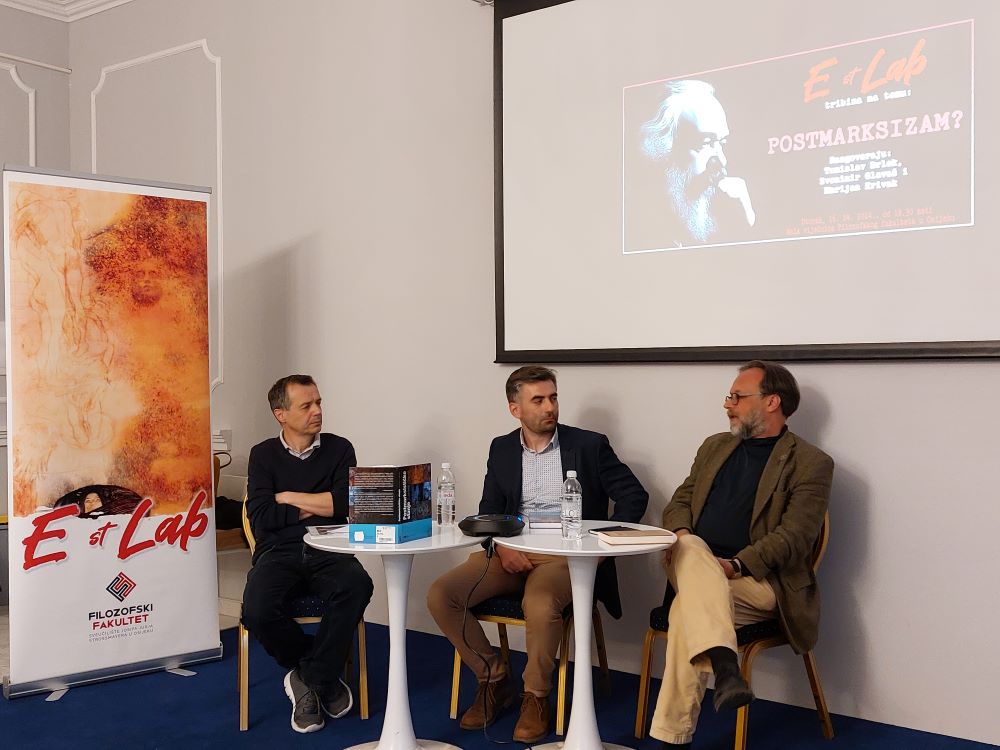 The Aesthetics Laboratory at FFOS, our well-known EstLab, marked three years of continuous activities and actions concerning books, film, music and… philosophy. And it did so, in its own spirit, in the best possible way! The jubilee 50th event was held on Tuesday, 16 April 2024 in a well-filled Room 39 at FFOS. Our guests represented the “post-Marxist condition”. From Zagreb came Zvonimir Glavaš, author of the book of the same name and, incidentally, one of our “Osijek students”, together with the renowned literary theorist and literary historian Tomislav Brlek. In conversation with the author of these lines, they discussed numerous topics related to literary theory and political theory, all within the context of a topos that has been present in the humanities for more than a quarter of a century: post-Marxism.
First, the question was raised as to what so-called “theory” means today (Why Theory?) after the declaratively proclaimed “end of philosophy”. Theory, in both the literary and political sense, addresses numerous neuralgic questions that still keep alive the very “matter of thinking” (Heidegger). Following its initial “appearance” in the classic Laclau-Mouffe volume Hegemony and Socialist Strategy (1985), post-Marxism became established as a cultural phenomenon through two books by Stuart Sim (1998/2000).
Tomislav Brlek explained the many connections among various post-isms. Both postmodernism and poststructuralism form part of the theoretical legacy invoked by nominal “post-Marxists”. The author of Postmarksističko stanje, Zvonimir Glavaš, presented his motivation for writing the book, which is a published version of his dissertation. Through the conversation among the three participants, examples of some of the most important literary-political theories crystallised, particularly those associated with the major French philosophers of the second half of the 20th century.
The discussion covered Jacques Rancière and his phrase “zoon politikon as a literary animal”; Deleuze and Guattari’s famous book on Kafka and minor literature was also addressed, while the provocative work Spectres of Marx (1993) by Derrida formed a kind of “crescendo” of the entire discussion. Somewhat heretical from the standpoint of Marxist orthodoxy, this book raised the whole question of “post-Marxism” interpretively to the highest reaches of so-called “deconstruction”. Derrida’s idea of justice as the only human category that cannot be deconstructed is deeply inspired by the spirit/spectre of Marx’s thought. As, incidentally, was the music of GANG OF FOUR, which framed the whole event in a dance-smart way! mk
 “I write to survive,” Kristian Novak told us on Tuesday, 19 March 2024 in the well-filled Ceremonial Hall at FFOS, in his characteristic style, openly and without restraint exposing the painful process of writing, painful for him and for many others. This recipe for life, as we might call it, runs through Kristian’s literary and scholarly trajectory, which, as it turned out, intertwines at many points, much like the “braids” of narration in his novels, as described by his editor at the Ocean More publishing house, Kruno Lokotar. It became clear that the role of the “write-and-erase” board is crucial to his very existence, because the path towards a rounded story contains many possible routes and returning to a particular word or scene proves just as important as moving forward. One particularly fascinating moment came about five minutes after a question from the audience, asked by a young aspiring author, when you realised that Kristian had described with remarkable precision the process of creating a literary character or portraying an event crucial to the development of a novel’s plot. In those moments it became clear that he is both an excellent lecturer and entertainer, because through effortless self-ironic humour he demonstrated in practice what he says he does best: the self-reflective first person through which he lays bare, almost to the point of discomfort, his characters and their actions. He returned several times to precisely those moments when an obsessive idea takes shape and to the way form affects the final content. He also conveyed both the importance and the burden of the author’s decision regarding the manner in which characters speak from the pages of a book and the significance of the language in which they speak. It became clear that his decision to characterise figures not only through descriptions of their actions but also through their speech, the choice of textual format and linguistic variety, and the constant conflict between the standard language and the Međimurje dialect, was entirely deliberate. These nuances of linguistic choice reflect the intersection of Kristian’s fields of activity, as he himself calls them, those of the writer and the linguist, fields that meet in the method of autoethnography, a deep prose immersion in the landscapes of Međimurje and its people. Introduced into the conversation by the gentle voice of Teta Liza and the traditional song “Međimurje, kak si lepo zeleno”, we sought to unravel the duality of feeling inspired by this beautiful part of Croatia, so close, as I understand it, to the feeling of sevdah. Saudade, morna, that simultaneous feeling of sadness and happiness, seems almost to be a defining feature of Međimurje tradition and its culture of living, while standing in obvious contrast to the darkness faced by the characters in Novak’s novel Črna mati zemla, perhaps the most “Međimurje” of all his works. Kristian nevertheless emphasised that the people of Međimurje today have distanced themselves from traditional music and that weddings there tend to feature the somewhat more contemporary Pejaković and Stavros. We also concluded that there has been a shift in his literary motifs, from geographically specific issues such as coexistence with Roma people or migrant smuggling in Ciganin, ali najljepši, towards the much more universal crime-report motifs of Slučaj vlastite pogibelji, which could have taken place anywhere.
Kristian’s obsession and precision in narration are also evident in his dissertation of more than 500 pages, Višejezičnost i kolektivni identiteti iliraca. Jezične biografije Dragojle Jarnević, Ljudevita Gaja i Ivana Kukuljevića Sakcinskoga, in which, through the correspondence of members of the Illyrian movement, he managed to paint a lesser-known picture of the role of bilingualism in the creation of Croatian identity. He showed how the Illyrians, most of whom were German speakers, demonstrated through learning Croatian the way in which language can reshape not only linguistic, but also social reality. Particularly interesting was his account of the life and work of Dragojla (Karolina) Jarnević, another example of a woman who, in a different time and society, might have been recognised as a scholar, but instead had to endure the constant neglect of her work as an educator and author.
Kristian also revealed a detail from his life that determined yet another of his roles, that of editor of a literary work, in his words perhaps the most difficult role of all, though not because of the author whose work he edited. That author was in fact his Croatian-language teacher, Ivan Pranjić, a man whom Kristian perhaps has to thank for his decision to engage in literary writing as well. Perhaps the most intimate part of the conversation was his description of the method Professor Pranjić used to teach his pupils to write compositions, encouraging them to write in their own Međimurje language so that they could express what they thought and felt. In this miniature from Kristian’s childhood, and in his voice, one could sense all the gentleness and persistence with which a teacher feels the importance of language, the security familiar words provide when written down and seen on paper. One might say that this fragment from the past found its mirror image a few decades later in the synergy of teacher-writer and pupil-editor, but it may also be an image of Kristian Novak as writer and scholar, an obsessive seeker of the truth that sets one free.
Tanja Gradečak
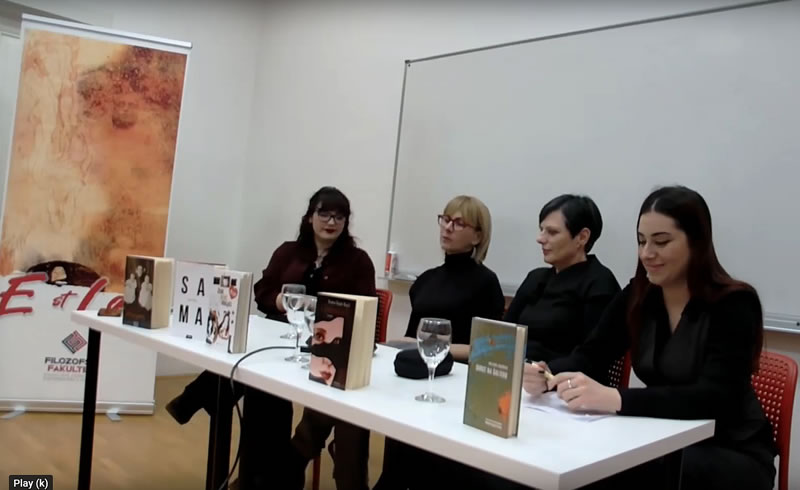 The forum “A New Generation of Croatian Women Writers”, organised by the Aesthetics Laboratory of the Faculty of Humanities and Social Sciences in Osijek, was held on 23 January 2024 at 6 p.m. in Room 54 at the Faculty. The theme “A New Generation of Croatian Women Writers” forms part of the project Poezija u sjeni(ci), whose primary aim is to introduce literary and poetic creativity while encouraging students’ independent literary expression. Memories and experiences are what Croatian women writers offer as an emancipatory path or as a reminder of the need for broader social sensitisation. The Croatian women writers of the new generation who follow such literary paths and who inspired the forum and its thematic framework are the award-winning authors Ivana Šojat and Julijana Adamović. Ivana Šojat is a translator and writer with a rich body of work encompassing poetry, essays, short stories, novellas and novels, most notably the multiple award-winning novel Unterstadt, which also received an award-winning stage adaptation at the Croatian National Theatre in Osijek. The most prominent work of Julijana Adamović, likewise a multiple award winner, is the short-story collection Kako su nas ukrali Ciganima. Adamović also gives form to her education and interests by publishing literary works for children. Although Ivana Šojat and Julijana Adamović are established and award-winning writers whose work needs no special introduction, we believe that their appearance at EstLab will allow them, above all through their experiences and memories, to present their work and engagement from another perspective and perhaps open for those present many questions that have until now remained closed. The conversation with the writers was moderated by EstLab members Lucija Leventić and Martina Ivanović.
 In keeping with EstLab’s original idea of the educational role of art, the first conversation of the year was held on Tuesday, 9 January 2024 in Room 39 with people who stand out from the crowd, and whom we like to highlight precisely because they themselves very rarely do so. Zagreb’s Močvara Club and the associated URK (Association for the Development of Culture) were presented as a unique phenomenon on the Croatian art scene since the 1990s. EstLab member Tanja Gradečak spoke about Močvara and URK with one of their initiators, Kornel Šeper, while reflections of the events in and around Močvara and URK could also be found in the story of Slamanje and the Osijek-based Slama Association, represented by Šimun Padovan, Hrvoje Dešić and Marko Pernarčić (Hrvoje and Marko are, incidentally, our alumni, so FFOS genuinely has something to be proud of :)).
It became clear that the beginnings of the stories of Močvara and Slamanje were connected with the need to escape the dullness of everyday life and an environment that very often restricts people through prescribed patterns of behaviour and the entertainment on offer, which young people, and those not quite so young, are constantly seeking. Driven by the need to hear and create something different from the cultural offerings of the late 1980s and early 1990s, Kornel began by playing music at his local community centre that could not be heard on the radio or in Zagreb clubs at the time. He then became involved with the avant-garde artists gathered around Kugla glumište and, bringing together friends and acquaintances with similar views in the Association for the Development of Culture, travelled a path from squatting in Kuglana and adventures on the Ponikve meadow to the struggle for space in the former Jedinstvo factory, where Močvara remains today, awaiting the celebration of its 25th anniversary. The activities of Močvara and another of Kornel’s projects, Zli bubnjari, were very often connected with protest actions through which they helped various civil-society organisations promote the active participation of citizens and young people in decisions affecting their lives. Despite this, Kornel defines himself neither as an artist, although he has played for years in the band Šumski, nor as an activist, although in retrospect what he does in the association and club could be called prototypical activism. The point is that all the ideas and events connected with him and his collaborators grow organically out of a need to act, without any particular master plan or ambition. Consequently, the story of financing the association and club through projects is inevitably connected with what the people at Močvara call “administrative violence”, because it forces people into prescribed frameworks and consumes on paperwork the energy that could otherwise be invested in organising concerts and exhibitions or publishing albums and books.
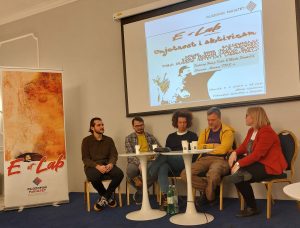 The story of Močvara is the best example of how such undertakings very often require a single enthusiastic and creative individual, but also of how, without a community of people who share and spread that enthusiasm, many undertakings would fail or never begin at all. This was also exemplified by our interlocutors from the Slama Association in Osijek, Šimun, Hrvoje and Marko Pernarčić, musicians gathered around the bands Harvo Jay and Čuvarkuća and around Slamanje, who have intertwined visual and musical art in many different and surprising ways. They show how a bottom-up movement, a need to be other and different that official institutions often fail to recognise, is always present somewhere in the background and occasionally erupts in beautiful volcanoes of creativity. The struggle for physical space where people eager for artistic events can gather, and the need to maintain continuity, are what Šimun identified as most important when it comes to alternative and so-called underground undertakings. This is the educational aspect to which we repeatedly returned, because we concluded that giving young people the opportunity to see that music and art can be different from what YouTube and Spotify algorithms expose them to is the only way to resist the violence of kitsch and the commercialisation of art, an all-pervasive trend to which we are exposed almost every day. Particularly important was Hrvoje’s statement that he creates music for himself, not for the needs of software that analyses melodies and rhythms in order to identify what will attract the most listeners and potentially earn the most money. The conversation also touched on the role of artificial intelligence in the creation of artworks, and, as Marko concluded, he sees no particular danger in it: it is simply a fact, just as it is a fact that art often operates within Aristotle’s mimetic theory of imitating reality and others.
It became clear that Kornel, Šimun, Hrvoje and Marko, guided by an aesthetics of the different, the strange and often the absurd, perhaps precisely because, as Umberto Eco suggests, the ugly and the different are actually more interesting, turned their associations into sources of activism in opposition to the social and artistic mainstream. Močvara and URK were, and still are, a kind of incubator on whose stage many Croatian and international artists of various profiles have presented their work or learned their craft, while Slama and Slamanje, in the almost intimate, squatter-like atmosphere of Osijek’s Tvrđa, radiate their own distinctive creative energy. Just as Močvara has for years placed Zagreb on the international map of alternative and subversive culture, informing and educating tens of thousands of visitors, Slama is a place where young people’s energy is channelled into pure positivity, inviting us to look at the more beautiful side of the world in which we live.
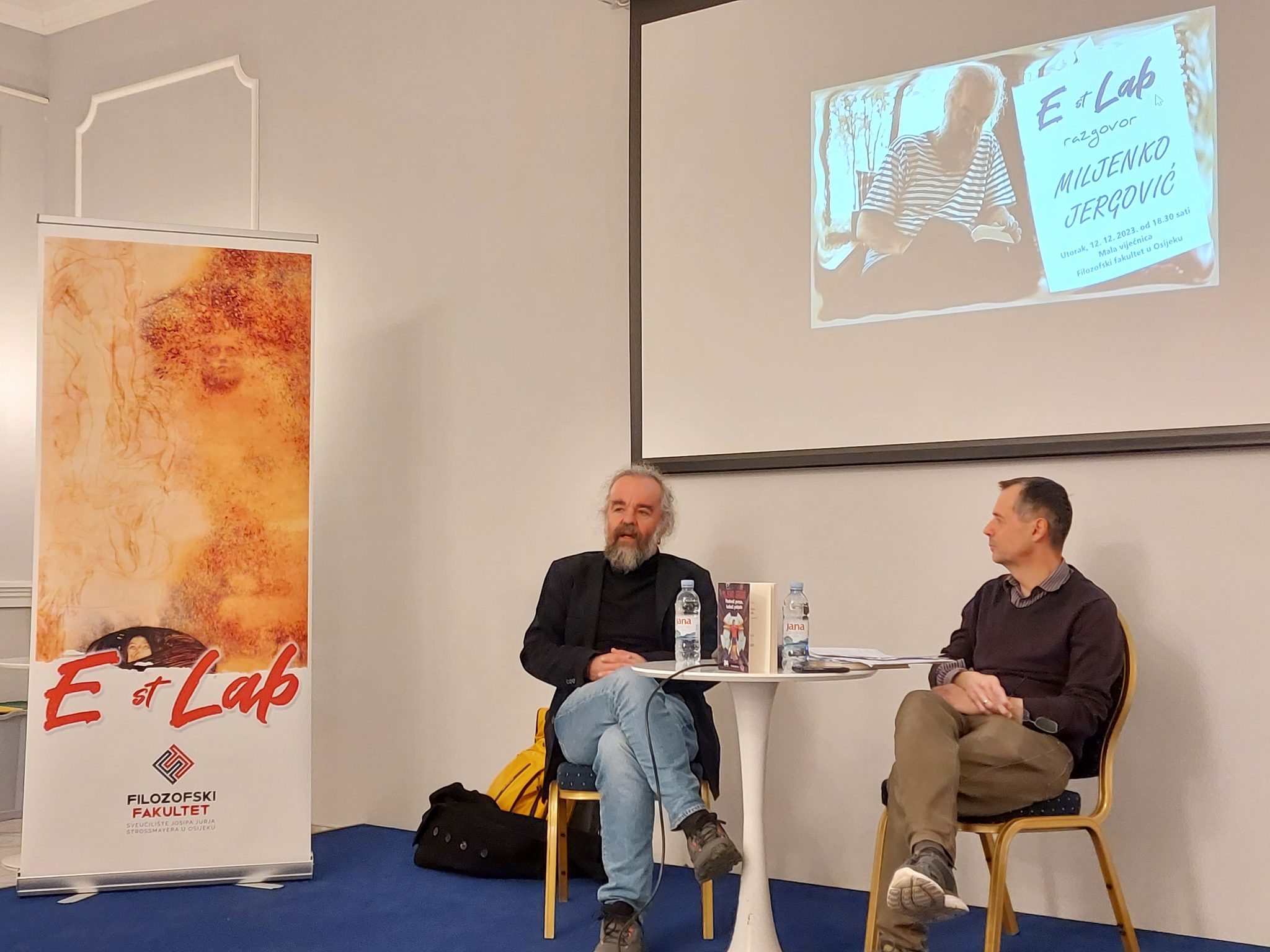 What is the essence of the globally popular sport called FOOTBALL? Why are wars fought over football, both imaginary-ideological and real ones? Finally, what is the meaning of this sport’s presence in our lives here, lives so exposed to all manner of ideological and other manipulation and to the exploitation of the mass of loyal subscribers, the so-called “supporters”?
We sought answers to these questions in conversation with Miljenko Jergović. For anyone in this region who may somehow not already know, Jergović is one of the intellectual leading figures of Bosnian and Croatian narrative literature. As he describes himself, for example, in one of his own novels, he is “a national outcast with a Balzacianly extensive oeuvre, who wanders Zagreb acting as his own shadow and pretending not to exist”… (Herkul, Fraktura, Zagreb, 2019, p. 152).
We attempted to improvise answers to the above questions in an EstLab conversation between the author of these lines and the writer in question, one of the most eminent guests to date at the FFOS Literary Forum. A year after the FIFA World Cup in Qatar and another in the series of “historic successes” of the sacrosanct idea of the Vatreni, the conversation was about football, prompted by a book published that year, a kind of Jergović “intimate diary” entitled Mudrost poraza, ludost pobjede (Fraktura & 24 sata, Zagreb). Yet much more could be learned from the conversation. For example, Jergović sees the essence of this popular sport in the “spirit of the game itself”. He also believes that watching a football match requires a certain “solitude”. It is an almost contemplative-metaphysical ritual, a kind of “epistemology” of a phenomenon seemingly familiar to everyone. Finally, we arrived at an answer to why the “essence itself” of football, through a series of accidents and contingencies, came to expression in the final of the World Cup in Qatar on 18 December 2023!? According to both interlocutors, the reception organised for the Croatian national football team, the universally “sacred Vatreni”, and the meaning of the game of football have nothing whatsoever in common! Why? Precisely because the essence of football derives from the “spirit of the game itself”, whereas Zagreb’s main square witnessed a carnival of forced national exaltation.
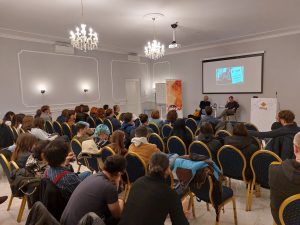 And it is good that this is so. For just as the essence of philosophy can be derived from poetry, and just as Nietzsche saw the birth of tragedy in the spirit of music, football too can be read “in the spirit of the game”, never as the meaning of life itself, as is so often the case in Croatia.
Almost three decades after the cult Sarajevski Marlboro (1994), Jergović has, volens nolens, established himself as one of the most influential writers of his generation. In terms of the scope of his work, indisputably so… But also because of his rare gift for storytelling. It was precisely this “art of storytelling” that he lucidly revealed before a large audience on 12 December in Room 39 at FFOS. Were all the questions posed above answered? Of course NOT. But we had the opportunity to spend time with one of the most important and most translated figures and one of the most authoritative novelistic-narrative-essayistic voices in literature within our close geographical coordinates. It was worth it…
mk
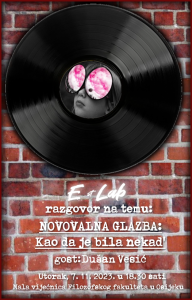 On Tuesday, 7 November 2023, members and friends of EstLab had the opportunity to discuss a topic that rarely fails to arouse special interest among music lovers, given its unparalleled artistic, sentimental and epochal significance. For some in the audience and on stage, mostly the more mature among us, it represents nothing less than a decisive cultural current that simply seemed destined to be born and shaped in this region, precisely the current in which they themselves once found their place. For others, those who never had the opportunity to witness first-hand the colossal concerts and performances in the basement of the Faculty, it cannot fail to evoke a sense of profound historical and creative fascination.
We are speaking, of course, about the music of the “New Wave”, rock and YU-punk in this region, a phenomenon about which few are more qualified to speak than Dušan Vesić, one of the most prominent rock critics and a frequent companion of Yugoslav musicians. He is, above all, a man who, as the title of his book Zamisli život suggests, lived through the entire story in a way that may seem unimaginable to some today, truly “as if it happened long ago”. True, “it all came out of Buldožer in one way or another”, but it is evident that “Haustor” and “Prljavo kazalište” can still make people sing who are now the same age as their original audiences, something few performers anywhere in the world can claim. Few creative currents, let alone “waves”, produce such a wealth of expression in the music of a single generation, which is why comparisons according to today’s standards are entirely inappropriate. Who was the best? The most important? “Azra” or “Valjak”? And what about “Pankrti”? “Paraf”… “Termiti”? Who had the bigger concert or sold more tickets? Who played in a basement, and who in an arena? Was “Sunčana strana ulice” more successful than “S’ vetrom uz lice”?
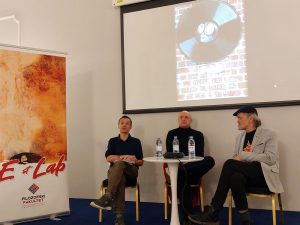 The answers to these questions are as impossible as they are unimportant. What matters, however, is recognising why that creative period flourished with such extraordinary creativity, what conditions gave rise to it, and why it became a source of the most sincere nostalgia among those who lived through it. The fact is that, at least in this region, no creative movement established after the “New Wave” has matched the versatile vision of the 1980s. Yet there is one thing we have not given up on: asking whether such a movement might nevertheless emerge again.
ab
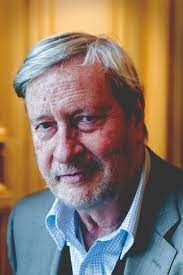 Gianni VATTIMO (1936-2023) belongs to that legacy in the history of 20th-century, and also 21st-century, philosophy that we usually call postmodernism. Yet that is too simple. Perhaps even wrong.
For this diligent student and scholarship recipient in German philosophy devoted his key work, La fine della modernità (The End of Modernity, 1985), to 20th-century hermeneutics. His primary interlocutors in the book are Hans-Georg Gadamer and Martin Heidegger, but also Friedrich Nietzsche, who preceded them in the spiritual-intellectual legacy on which they drew.
“Thoughts that are going to change the world come on doves’ feet.” What does this quotation from Thus Spoke Zarathustra tell us? In fact… everything! At least as far as Pier Aldo Rovatti and, most decisively, Vattimo are concerned, as the two originators of the so-called “weak thought” (Il pensiero debole). What is this so-called “weak thought”? It is, in fact, Vattimo’s response to the whole “strong” history of Western philosophy of subjectivity, that is, to the complex constituted by onto-theo-cosmo-anthropology. In other words, metaphysics.
Heidegger remains his principal point of orientation. In an idea found in the work of the most famous 20th-century German bard of the so-called hermeneutics of facticity, more precisely in Identität und Differenz (1957), we encounter the term Verwindung. It can mean overcoming, convalescence, or recovery from illness. Hidden here is the thought of another, different beginning (der andere Anfang). And what could be more relevant today, once again, for those of us in need of the “matter of thinking”? For the idea of a “new beginning” also contains what Nietzsche had already identified as the possibility of “active nihilism” and thus the necessity of the coming Übermensch. By understanding reality as a distinctively artistic-aesthetic existence, through a kind of resistance and the vitality of “becoming”, this figure would replace the “strong”, and usually violent, absolutisation of Being. Yet that same absolutisation remains, unfortunately, the foundation of corporate capitalism and the technosphere today. The corporation thus survives as a supra-social and supra-state absolute of the “end of history”. All of this presents itself as the legacy of the philosophy of Spirit, Reason, the Absolute and, finally, the Idea as the highest definition of that Absolute in Hegel’s Science of Logic. And that logic has brought us to the endlessly perpetuated real ontology of submission to commodity idols and “voluntary servitude”, as well as to “psychotechnologies of desire control” (Ž. Paić, Doba oligarhije).
VATTIMO certainly did not imagine his Transparent Society in this way. (After all, the title of the eponymous essay in the book bears a question mark /?/.) Where does he find hope in the bottomless abysses of a society of “generalised communication”? Nowhere other than in a kind of invocation of a hermeneutic view of history, in which an “oblique”, or “parallactic” (Žižek), perspective offers the possibility of affirming the Other and the Different. The “weak” in Vattimo’s phrase for “thought” is actually a strong resistance to the dominant absolutisation of Eurocentric contemporaneity, and sovereignty. In other words, it is the power of the local, dialectal and vernacular, which demands, not only in the media, a space for becoming.
Here Vattimo opposes the all-pervasive “historian’s narrative”, much as W. Benjamin did in his famous Theses on the Philosophy of History, invoking his own version of Marx’s “historical materialism” (!?). Yet, I would say, Vattimo is much closer to Gilles Deleuze and his inauguration of philosophy as the “creative construction of becoming”. How can a different world be realised? Out of chaos, or perhaps chaosmos, maybe through the immanence of life, as Deleuze, whom Foucault called the most important philosopher for the coming 21st century, might propose?
Gianni Vattimo directed his project towards the idea of a more noble and more humane, rather than merely “weaker”, (post-)Modernity. His weak thought seems all the stronger in these post-historical times, in contrast to the legacy of classical Modernity, despite its absolute projects and the catastrophic outcomes of so-called “progress”.
mk
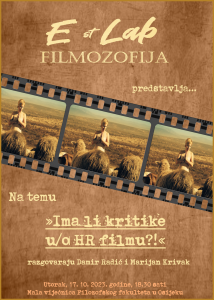 On Tuesday, 17 October 2023, members and supporters of EstLab confronted the prospect of critical thought in and about Croatian film and, given that the concept of contemporary Croatian film undoubtedly exists, the question of whether anything approximating serious, uncompromising film criticism also exists within the domestic film “industry”. As a source of insight into this issue, the role of guest on the stage of the Small Council Hall at the Faculty of Humanities and Social Sciences in Osijek was played impeccably by the distinguished Croatian filmmaker, writer and literary and film critic Damir Radić, who reflected on the anthological works, as well as the artistic failures, of the major directors who have marked cinema in democratic Croatia. It is true that war themes, though at varying levels of explicitness, often dominate as an allegedly indispensable aesthetic element of domestic cinema. Yet it by no means follows from this that Croatian cinema is in principle infected by nationalist sentiment or religious fundamentalism, as is the case with the engagement of most reactionary currents in state media, nor that healthy criticism is consequently absent; on the contrary, it grows stronger. Indeed, if one merely considers the work of actors and directors such as the “self-published” Ljubomir Kerekeš or the high-budget and only apparently critical Vinko Brešan, it is difficult to find a sacred cow of Croatian state-building mythology or bourgeois morality that has resisted being put on screen. This is best demonstrated by Schmidt’s universally acclaimed Ljudožder vegetarijanac, as well as Agape and Metastaze; Dević and Jurić’s war drama Crnci; and Matanić’s adaptation of Karakaš, Kino Lika.
Admittedly, among the lapses of Croatian cinema, most of which are not worth mentioning, it is not difficult to find chimerical revelations that merely confirm the prevailing ideological constellation. Yet the most dangerous form of conformism is not the one that sycophantically and overtly identifies with reactionary opinion, but rather the one that obscures a transgressive position while successfully feigning a moment of subversion. Nevertheless, drawing on the provocative spirit of Zagreb’s Film Authors’ Studio as well as the tradition of the Serbian “Black Wave”, domestic cinema, and film criticism along with it, has undoubtedly distinguished itself within the region, perhaps representing some of the highest cultural achievements of independent Croatia. Yet, in comparison with, for example, the richness of production and cinematic expression in the Nordic countries, it has still not managed to produce a significant indigenous form beyond the normative frameworks of the culture industry. One might think, for instance, of Denmark’s Dogme 95. All of this calls, and this might be taken as the conclusion of this rather polemical discussion, for the continued practice of merciless film criticism.
ab
YouTube recording of the event: https://youtu.be/coejYmZV98w
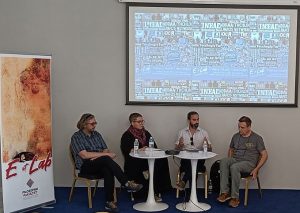
On Wednesday, 24 May 2023, the EstLab Forum entitled “Media and Technology” was held in the Small Ceremonial Hall of the Faculty of Humanities and Social Sciences in Osijek, organised by the Technosphere section of the Aesthetics Laboratory and the FUZ&JA science popularisation programme. The invited guest was Mario Hibert, Associate Professor at the Department of Comparative Literature and Library Science, Faculty of Philosophy, University of Sarajevo. Faculty professors and members of the Aesthetics Laboratory Milijana Mičunović and Boris Badurina also took part in the conversation, with Boris Bosančić acting as moderator.
The introductory part of the forum reflected on the accelerated, and in some segments invasive, development of information and communication technology over the past seventy years, which ultimately led to the disproportionate penetration of digital media, online portals, social media and the like, into every aspect of human life, thereby making them the most powerful and influential factor in contemporary society.
As M. McLuhan warned us long ago, media are not merely communication intermediaries but all forms of technology; in other words, an equals sign must be placed between the two concepts. This type of equivalence suggests that information and media (digital) literacy means far more than accessing, analysing, evaluating, creating and distributing information in different media forms. Understanding information and communication technologies as forces of a new ecosystem also entails extending the semiotic understanding of literacy to the cognitive level of the ability to understand the technological environment. By offering this media-ecological introduction to a conversation about the “operating systems of our lives”, the aim is to emphasise the importance of moving away from the instrumental paradigm, the skill of using media/technology, and towards questions of how to live in relation to an environment that replaces critical thinking with the automation of sense and meaning. The fact that, instead of a radically open social imaginary, we have received the implosion of neoliberal globalisation and replaced cyber-idealism with cyber-cynicism means that every discussion of media/technology today should really be nothing other than a reminder of the collapse of sociality brought about by platform-based disciplining and algorithmic data extraction, the behavioural surplus of on-life existence.
 The forum also addressed the concepts of algorithmisation and disruption, examining how the “invisible algorithmic hand” operates in the media sphere and how capitalism became involved in the entire story. In other words, the discussion also considered how today’s platform and surveillance capitalism, focused on data extraction and the manipulation of user attention, affects fundamental democratic norms and institutions. Phenomena closely connected with social media, such as confirmation bias and its role in politics, were also discussed, as was the unavoidable phenomenon of post-truth as the worst product of general mediatisation.
In the final part of the forum, participants discussed whether technological development, which has given the media immense power, could now take that power away in light of the recent shocking development of artificial intelligence, the most current flagship of technological development. The present situation with the media is such that they are finding it increasingly difficult to deal with the negative consequences of their own technology-supported development, manifested in the swarming of inaccurate, erroneous and malicious information, post-truths, half-truths and the like in the media sphere. Artificial intelligence can multiply such content indefinitely while being unable, at the same time, to identify it as inaccurate, erroneous or malicious. Could such a situation, in the near or more distant future, result in one of the worst possible scenarios, the collapse of our society, or perhaps of the media themselves? This remains an open question.
Boris Bosančić and Mario Hibert
YouTube recording of the event: https://youtu.be/CXhepam4A1s
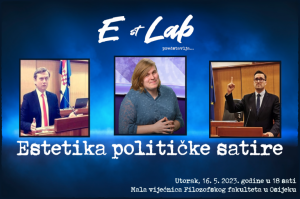 Do you watch television? Television? TV? Well… that is the dark interface sitting somewhere in a prominent place in the family living room, in front of which parents and the other members of the household gather. When? Once it was around 8 p.m., then around 7:30, and now usually around 7. Because… that is “PRIME TIME”… the most important time of day, from the cave to the bourgeois salon. Because people, by nature, do not “strive for knowledge”, as old Aristotle would have it, but “… for television” (Matko Sorić, Koncepti postmodernističke filozofije, Zadar, 2010). I know, I know… young people of your generation rarely, if ever, watch TV; there are mobile phones, laptops, computers, tablets… But you still (surely!) know that TV exists? Or… What happens when you are no longer on television and remain only on the YouTube platform? It is not funny at all, I suppose… (At least we “old farts” suspect as much.) My comrades from EstLab, and I in particular, have long been subscribers to PRIME TIME. Many of you younger independent thinkers know Borna, Domagoj and Jan… while we older people also remember Zvonko Hrabar (also known as Branko Đapić, that legendary educator from these parts). Somewhere around 2016, they carried out an unprecedented “subversion” in the television ether of Our Beautiful Television (our beloved HTV). And… that “Montirani proces” lasted several Sundays… in the PRIME TIME of Croatian homes! Unbelievable… Until those in power caught on… “visiting time had expired” (the much-missed Đorđe Balašević wrote the line, and Domagoj devoted the most emotional fifteen minutes of our favourite programme to him). Uhhh… there were some good things on that N1 TV platform. From Borna’s pedagogical effort around “Ribanje i ribarsko prigovaranje” to Domagoj’s ultimate “Utjerivač socijalne pomoći/nekretnine”… and then Jan, the actor of the best “back-of-the-head roles”, until he became the legendary Rear Admiral Dobro in Zovica. Let us get serious… hmmm… What is “satire”? From Juvenal through Erasmus… to Alan Ford and Monty Python, satire… SATIRISES! Once again I quote my favourite political philosopher: “there is no better starting point for thought than laughter” (W. Benjamin: The Author as Producer).1 EstLab members fulfil your wishes (I’m kidding… they are only our wishes!), inviting PRIME TIME to say something about the “Aesthetics of Political Satire”.
The Prime Time crew, the strongest critical thinkers among Croats!? Yes? No? And perhaps there will also be talk about some Balkan spaces close to us? You never know… In any case, come to Room 39 at our Faculty on 16 May at 6 p.m. It will be worth it… Financially, certainly not, but we guarantee a Socratic “corruption of the youth”. Guaranteed…
mk
1 Lecture delivered at the Institute for the Study of Fascism in Paris on 27 April 1934, while I am writing this on 27 April 2023!
YouTube recording of the event: https://youtu.be/fD0XI6TM48Y
 What is TRANSITION? Why does it still make sense to speak about this phenomenon from the vocabulary of the “semi-peripheral” countries of “our” part of Europe and its civilisational culture? After all, WE here in Croatia have achieved great, even magnificent, things: accession to the European Union, entry into NATO and, finally, entry into the financial eurozone. And yet we are still in a kind of “transition”. Why?
These and many other questions were addressed by the guest of the Aesthetics Laboratory at FFOS, Hajrudin Hromadžić, Head of the Department of Cultural Studies at the Faculty of Humanities and Social Sciences in Rijeka, in our relocated “Agora”, before numerous students and only a handful of colleagues. Through the conversation between the author of these lines and the guest, conducted in a friendly but no less instructive and provocative atmosphere, many local “taboo topics” were “opened up”. Following a brief introduction to Hromadžić’s operational concept of “culture”, attention turned to many concepts that remain latently suppressed here. All of them were published the previous year in his book LEKSIKON TRANZICIJE (Disput, Zagreb, 2022).
We began, through a fortunate alphabetical coincidence, with the concept of ANTIFASCISM. Indeed, the entire Lexicon is to some extent animated by this commitment. It quickly became clear that what is considered part of a civilised world founded on the achievements of the modern Enlightenment is far from self-evident in the former Yugoslav region, including “Our Beautiful Homeland”. HH suggestively reactivated the legacy of Antifascism, but also that of so-called TITOISM. The author thus revealed that, as part of his methodological decision, he placed these terms in the same conceptual framework as what is called “Enlightenment”. And that is something still worth fighting for! Especially in the societies of our former state, where historical revisionism prevails and latent fascist tendencies and relics of a dark past are encouraged, even by ruling structures.
In a more “relaxed” atmosphere, terms closer to the spirit of the age were also addressed. Thus the conversation included INFLUENCER, SELFIE and EVENT, while particular humour was devoted to interesting ideological-media constructs such as the Croatian notion of the UHLJEB. Finally, the true “climax” of this “event”, rather than “Event”, was a discussion of FOOTBALL as one of the foundations of the locally dominant hyper-turbo-emotionally exalted and almost religiously understood concept of Statehood. For Croats, “football” is much more than a game; it is a kind of sacred object of identification.
After the conversation between HH and the author of these lines, a series of questions revealed strong interest in LEKSIKON TRANZICIJE and in the author’s views, on issues ranging from religion and war veterans all the way to the ideologeme of the WEST! This was another in the series of intellectually engaged EstLab “events”. And we, the undersigned, are convinced that this is the final line of defence protecting the reliquiae reliquiarum of the HUMANITIES, still present only in traces. Dixi et salvavi animam meam!
mk
YouTube recording of the event: https://youtu.be/-CXDvy5eg6c
 On 14 March 2023, the Faculty of Humanities and Social Sciences in Osijek, under the organisation of the Aesthetics Laboratory, hosted the distinguished regional author Josip Mlakić. At the beginning of the conversation, the discussion focused on the state of the Croatian and regional literary scene. Mlakić was then presented as a highly ambitious writer (Gajin) with a broad repertoire of themes. On several occasions, the author also highlighted his own successes in film, which was of particular interest to part of the audience. Although the author distanced himself from the predominance of certain apocalyptic and “dark” atmospheres, Senković drew attention to them. Such resonances and moods are crucial to Mlakić in portraying the contemporary condition, alongside a skilfully developed literary discourse. Mlakić emphasised that he likes to write in the tradition of great modern writers, and accordingly a significant part of the conversation turned to Ivo Andrić.
The novel Na Vrbasu tekija was written boldly, as an attempt to improvise alongside Ivo Andrić. It was both interesting and instructive to hear once again about this great writer and about the distinctiveness of Andrić’s style, which may seem naïve to some because it relies on folk idioms, although it is anything but naïve (Gajin). Alongside the strictly literary dimension, it was inevitable to comment on Ivo Andrić’s “political status”, which Mlakić also approached critically. Dystopia was described as speaking above all about our present and our contemporary orientations. For example, the novel Planet Friedman depicts the devastation of the land and the emptiness of the ocean: “Thousands of shipwrecked people threw messages in bottles into the sea, with no one for them to reach.” In this tone, certain historical perspectives and “events” were examined as media opium for the masses. Several other novels by Mlakić were mentioned: Evanđelje po Barabi (written from the perspective of the Jewish rebel Barabbas, imagining the life of Jesus), O zlatu, ljudima i psima (an apocalyptic perspective, the future and Bosnia and Herzegovina), and Druga Noina arka (about the end of the world as we know it, greed and ruthlessness, and a mountain inhabited by the worker Noah and the shepherd Ibrahim). The specific Bosnian fatalism and contemporary lack of prospects were mentioned several times, although not everyone agreed with this view (Senković). The conversation was interesting, particularly because of its focus on the great writer Andrić. Participants were Josip Mlakić, Igor Gajin and Željko Senković. There were also several questions and comments from interested members of the audience, which greatly contributed to the quality and atmosphere of this cultural event.
Željko Senković
YouTube recording of the event: https://youtu.be/p0X2khL5laA
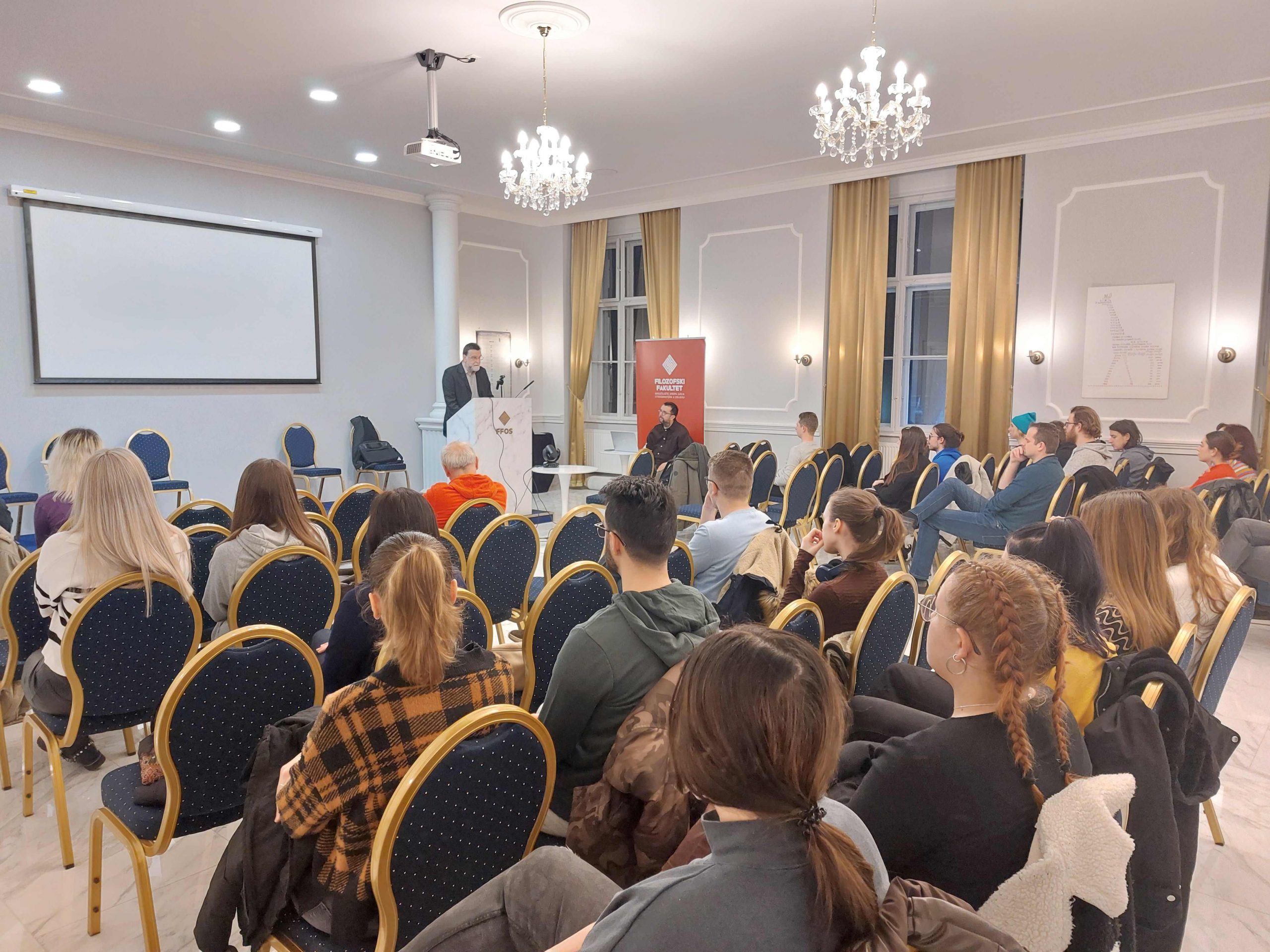 https://youtu.be/p0X2khL5laA On Thursday, 19 January 2023, Prof. Igor Mikecin, PhD, from the Department of Philosophy at the Faculty of Humanities and Social Sciences in Zagreb, delivered a guest lecture in the Small Council Hall of the Faculty on the topic Thinking and Listening: Hērakleit – Parmenid – Platōn – Aristotel.
Within the inherited philosophical doctrine of the senses, from the Greeks onward, at the latest with Platōn and Aristotel but already in Parmenid, thinking and seeing are singled out as the two most valuable forms of sensory perception in contrast to all others. Among these, the sense of sight is assigned an exceptional role, primarily because of its contribution to the cognition of truth and its inner affinity with thinking. Indeed, thinking itself is defined by analogy with seeing, as seeing or contemplating (theoria) or beholding (thea) thought. At the same time, the sensible and the non-sensible, that is, sensory perception and non-sensory thinking, are set against one another and sometimes even separated. The non-sensible is defined as the only true, eternal, immutable and always self-identical realm, accessible solely to thought, while the sensible, as that which is always unequal and constantly changing, perceptible only to the senses, is subordinated to the non-sensible as its appearance. In such an opposition to thought, sensory perception is therefore not genuine cognition but deceptive and merely similar to truth. The analogy between seeing and thinking has consequences not only for understanding the nature of thought, but also for the distinctive givenness of what is thinkable and sensibly perceptible, that is, for the interpretation of the being of beings as such. The fact that listening is subordinated to seeing reveals the forgetting of hearing in philosophy. With the forgetting of hearing comes the forgetting of the dimension of listening in thought. This forgetting further appears as a forgetting of the essence of thought and of what is genuinely to be listened to and heard. The precedence of seeing over listening, videocentrism, is decisive for the entire history of philosophy from Platōn to Hegel. Dismantling the rule of vision is now a fundamental challenge for philosophy. Connected with this is the task of overcoming the separation between the sensible and non-sensible, as well as between thinking and sensory perception. Behind the opposition of sensory perception and non-sensory thinking, listening must be discovered as a distinguished mode of perceptive attention (noein) and as a fundamental character of gathering discernment (legein). This task can truly be undertaken only on the condition of historical recollection: first, of the distinction between thought and sensory perception in Platōn and Aristotel; second, of the determination of discernment in Hērakleit and Parmenid; and, finally, of the origin of the distinction itself.
 Courts judge… Courts award, but they also pass judgement. Yet all of us in the humanities know very well that this kind of civic institution of the court follows only the logic of law. Formal law, at that. Such law is governed by paragraphs, protocols and procedures. But Law in this sense does not necessarily mean justice, that is, Justice. Walter Benjamin spoke about all this a full century ago in his famous essay “Zur Kritik der Gewalt” (Critique of Violence). Unfortunately, law and justice are very often two different “things”. We therefore need, and indeed must, step outside the formal framework of law.
On a rainy Osijek evening, 18 January, EstLab made precisely this “step”. At FFOS it hosted a programme entitled “Women’s Court – A Feminist Approach to Justice”. The event was devoted to the eponymous gathering held in Sarajevo between 7 and 10 May 2015. Staša Zajović, representing the renowned Women in Black from Belgrade, and Nela Pamuković from Zagreb’s Centre for Women War Victims – Rosa, moderated the visit of four women who had participated in that “Women’s Court”. Following a brief but highly evocative introduction to the event by Staša Zajović, a documentary film by Filip Markovinović, produced by Women in Black, was screened. The film record genuinely fulfilled the central intention of those who initiated this unique action by women from across the former Yugoslavia: to leave behind a lasting document of a historical event. Dynamic and expressed through a rhythmic cinematic language, the film undoubtedly left a deep impression and mark on everyone watching in Room 39 at FFOS. Yet an even stronger impression came from the renewed testimony of three women who had participated in the court/conference and appeared in the film. With the support of feminist psychotherapist Marijana Senjak, the three women once again testified live before the audience after the screening. Their dramatic and tragic experiences were recounted by Marica Šeatović from Novska and Jovanka Carević and Milica Miladinović from Zagreb.
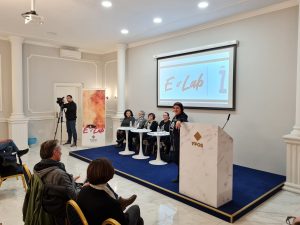 Particularly emotional and harrowing was the testimony of one of the women, who had been a victim of rape in Zagreb during the dark wartime years of the 1990s. Her testimony produced an especially intense sense of shock and compassion in the room. Women, like men, were humiliated and exposed to the most brutal violence simply because they were of the “wrong nationality”. One of these courageous women, an ethnic Croat, when asked by her abusers how she, as a Catholic, could have married a Serb, replied: “No, I married a Human Being.”
As Staša Zajović later noted, however, our primary feeling in confronting these Women should not be pity, and their testimony should not serve merely as mourning for the suffering they endured. The emotion should be one of Resistance and Courage. Women’s courage, but also Human courage in general. Indeed, this was a distinctive experience in our local environment, made possible through the hospitality of the Faculty and the Aesthetics Laboratory. In Osijek it was an emotional and cathartic event unlike anything previously recorded, in this form “unseen” and “unheard”, and exceptionally inspiring for reflection. It was also authentic in the sense of Agamben’s well-known discourse from the book subtitled The Archive and the Witness (Remnants of Auschwitz, 1998).
The organisers also intended to bring this testimony into an academic framework. This proved equally appropriate and philosophically meaningful. With a dedication to my friend Staša, I can conclude that the event and its articulation followed the lines of analysis found in Hannah Arendt and Shoshana Felman. YES, the “Women’s Court” opened a framework for revealing the “legal unconscious”. The feminist approach to justice thus “opened the door” to the trial or trials that will inevitably one day have to take place on the territory of the successor states of the former Yugoslavia. Namely, a “trial of the court” and, even more importantly, a “trial of the history of violence” (Arendt, Felman) in this region.
In the end, I can only say, on behalf of us Comrades from EstLab: “Thank you, Women!” For both your visit and your testimony… To be courageous as you are remains a permanent signpost for all of us who attended this unique evening at FFOS. mk
YouTube recording of the event: https://youtu.be/KxtQ3yoMGEE
What is the “necessity of philosophy”? And is philosophy still “necessary” for anyone today at all? Finally, what could that necessity consist in when everything is “programmed” for us?
The guest who rounded off this year’s season of forums within the DIJA-LOGOS section of the Aesthetics Laboratory, appearing before students and interested members of the public on Tuesday, 13 December, was Ivan Milenković. Anyone even moderately informed about the “matter of thinking” in this region needed no introduction beyond his name. A long-standing editor at the Third Programme of Radio Belgrade and an associate of the Institute for Philosophy and Social Theory, he is one of those people who regard their vocation as a rare privilege, but also as the continuous task of exposing all the anomalies of this planet, which we still, perhaps unjustly(?), call the “world”. Put simply, Ivan is an indispensable interlocutor in all matters concerning the remaining spaces of FREEDOM around us.
How can the existence of philosophy be saved? Or how can we save our souls at all today? “People… write!” And again… “write”. Even when it seems as though the writing is against the wind! (S vetrom uz lice, 1986, is one of the most important albums by the cult Belgrade band EKV.) Ivan Milenković therefore devoted his introductory excursus to the necessity of thinking the whole. And that, in fact, IS philosophy! Even when it proceeds from as provocative a position as that embodied in the work of Gilles DELEUZE. Deleuze, Nietzsche, Machiavelli and, last but not least, Hannah Arendt were the principal subjects of the dialogue Milenković conducted with Boško Pešić, Professor of Philosophy at FFOS. In the lively and polemical dialogue, the conclusion was also reached that today we are witnessing precisely that “banality of evil” so masterfully described by Arendt. On the other hand, Deleuze’s thought of “contingency”, as the accidental beginning of thinking, emerges as the necessity of every possible survival of what we call philosophy! Namely, the art of inventing, shaping and producing concepts.
What makes a philosopher, according to our friend Ivan? A philosopher must never accept a situation in which everyone relates to them through “pats on the back” and approval. A philosopher must produce discomfort, resistance and intolerance around themselves through their provocative stance(!?). When those around you feel uncomfortable in your company, then you are a genuine PHILOSOPHER. Refusing to flatter anyone, such a person “forces” others to… think.
Ivan Milenković certainly left no one in the audience indifferent. His commanding performance and the impressive thoughtfulness of the views he expressed were undoubtedly a “protreptikos” (Aristotle), an “exhortation to philosophy”.
EstLab thanks him wholeheartedly, and not only for that! mk
YouTube recording of the event: https://youtu.be/Ru15oQWygHY
On Tuesday, 6 December 2022, “Saint Nicholas” brought the members and supporters of EstLab, as well as all other interested people who might yet become supporters, a visit from “one of the three” from Feral and their VIvaLUDEŽ studio, Viktor Ivančić. The conversation with this leading figure of independent journalism revealed a whole series of moments illustrating the distinctiveness of this distinctive journalistic discourse. Yet this is not merely a matter of “journalism”, but of something even more important… namely, FREEDOM. It is also connected to the very “matter of thinking” advocated by the members of the Aesthetics Laboratory at the Faculty of Humanities and Social Sciences in Osijek since its foundation. Reading, writing… thinking and conversation, especially CRITICAL DISCOURSE, form part of an endeavour that introduces much more into the matter itself. And that is… the remaining meaningfulness of something like philosophy and the humanities an sich.
Viktor Ivančić is an internationally award-winning journalist, essayist, novelist, satirist of the reality around us and columnist behind the cult Bilježnica Robija K… Above all, however, he is a persistent Lucifer, read: light-bearer, exposing every kind of manifestation of the “cosmic force of stupidity” (Krleža, Na rubu pameti), and not only among Croats. If, as young men, the Feral group emerged as critics of socialist Yugoslavia, they continued that mission, in a more recognisable media form and with more detailed analysis, in our sovereign and democratic “Croatia”. Whereas in the SFRY they dealt with Party structures and the petrified “unnatural” system, in the successor states, following Rastko Močnik’s diagnosis, they point to the sinister fate of “natural fascist-generating tendencies”. Nota bene, this is also a structural global problem. That Ivančić is also a philosophically self-aware author is demonstrated by the title of his novel Vita activa. He also uses literary form as a mode of approaching the grotesque “wastelands of historical reality” in his political study Točka na U. Yet for us he appears above all as an Enlightenment figure through his distinctive generic hybrid Radnici i seljaci, subtitled in a “Montaignean” manner as Essays. The reminiscence of the almost forgotten history of the spaces we inhabit could be understood as a pedagogical effort towards educating a “critical consciousness”.
The conversation unfolded in an exceptionally dynamic atmosphere. FFOS students were able to learn a great deal about the journalistic profession, which, as Ivančić says, has today become a “subjugated profession”, not only in the country in which we live. His presentation showed that this should by no means be the case and that journalism can appear as a category of the PUBLIC GOOD. In this sense, FREEDOM and CRITICAL THINKING are indispensable both in the media sphere and in preserving philosophy and the humanities in themselves. A lively and highly engaged discussion followed the conversation. Ivančić, himself a highly competent reader of philosophy, particularly Hannah Arendt, Agamben, Foucault and Sloterdijk, proved to be a stimulating interlocutor and a “light-bearer” of courageous and FREE expression concerning all the anomalies of the society in which we live. mk
YouTube recording of the event: https://youtu.be/gvZTr2EgmUA
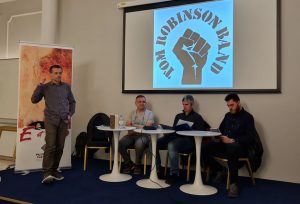 At the event held on Tuesday, 8 November 2022, as is fitting for any philosophical discussion, the EstLab panel considered Agamben’s thought in several distinctive ways, producing some highly intriguing conclusions. The concept of the so-called “state of exception” occupies a privileged place in Agamben’s bibliography, and the parallels between his perhaps best-known work, the book Homo sacer, and this concept were drawn conscientiously and successfully, with the aim of presenting and thoroughly analysing his overall influence. If anything, what mattered were precisely creative questions rather than uniform answers, repeated for the hundredth time, seeking to penetrate the sophistication of Agamben’s theory. What, in fact, is a state of exception, and what makes it so exceptional? How does it arise, and why? What conditions are indispensable for its application, and does it also exist in other socio-political frameworks apart from the state and government? The discussion inevitably abounded in a wealth of perspectives, ranging from modern literature to examples from popular culture, while the insights achieved in interaction with an animated audience merely confirmed that this form of academic discourse has a place in the mission of seeking truth and knowledge, perhaps even more so than any other.
YouTube recording of the event: https://www.youtube.com/watch?v=5TrYxC3dSKc
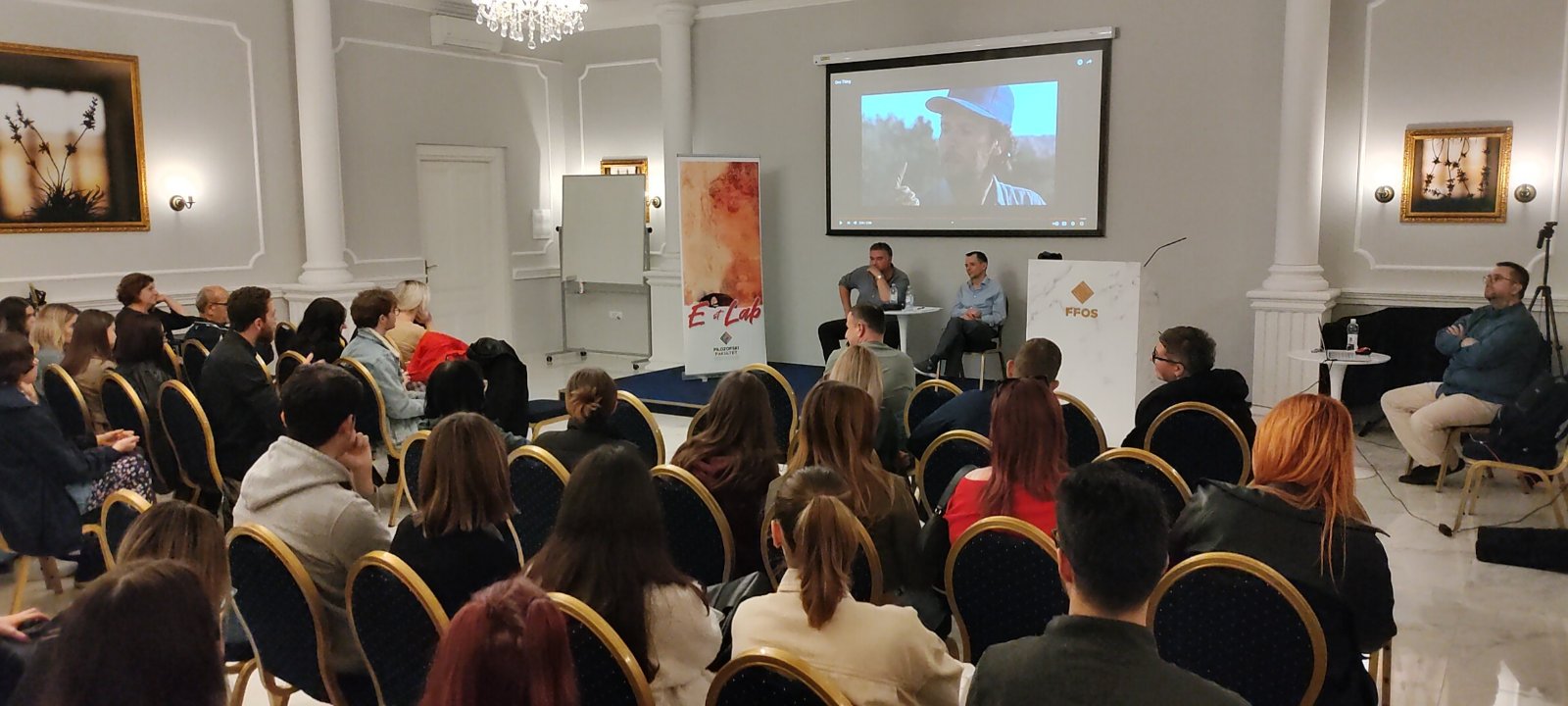 The first “event” of the new EstLab season, our now well-known Aesthetics Laboratory at FFOS, was held in Room 39 of the Faculty of Humanities and Social Sciences in Osijek. The guest of the forum/philosophical conversation was Prof. Boran Berčić, PhD, Full Professor with tenure at the Department of Philosophy, Faculty of Humanities and Social Sciences in Rijeka. The topic was more than intriguing! The title “The Meaning of Life of Boran Berčić. Philosophy as a Possible Answer?” paraphrased the cult 1980s film Monty Python’s The Meaning of Life. The conversation immediately began with the direct question of what the most important philosophical question is, at least for the invited guest of this conversation, or guided lecture, as the event might most appropriately be defined. Instead of the almost expected answer that it was the question in the title, the inquiry into the “meaning of life”… we were told that it is instead the relationship between FACTS AND VALUES. Berčić thereby revealed his inclination towards a need extremely important to analytic philosophers: that “things be clarified”. The entire conversation offered a series of interesting and unusual arguments in support of the idea that, in fact, everything that can be said should be said clearly and intelligibly.
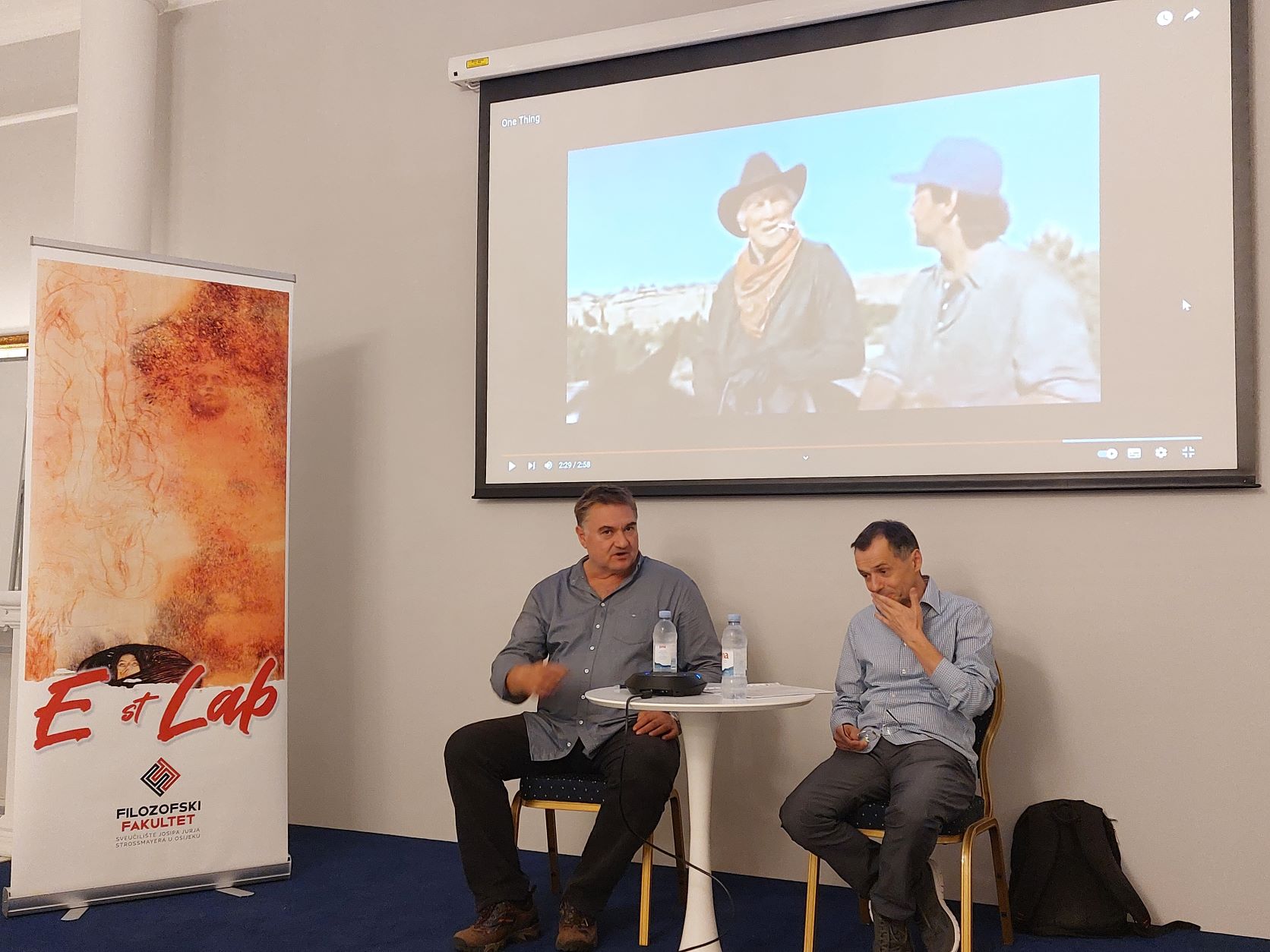 Boran Berčić served for many years as President of the Croatian Society for Analytic Philosophy. This is the source of his mode of philosophical thinking. The epochal work of his oeuvre, a two-volume book with an openly fateful(!) title, reveals itself simply as… Philosophy (2012). For a full decade it has been a textbook we openly admire, but, even more importantly, one we continually question. In the book Boran Berčić provides a “comprehensive overview of the main themes and currents of philosophical thought”. That is the “textbook description”… Yet through the conversation with Berčić, many important questions crystallised concerning our everyday, but equally decisive, PROBLEMS posed by a “philosophy of life”. Berčić’s approach to philosophy is therefore not historical but problem-oriented. In the introductory text to Philosophy, the author states: “To know what we should do, we must know why we live.” And further… “logically speaking, in order to know why we do anything, we would have to know why we live at all… The question of the ‘meaning of life’ is the logical structure of our reasons for action.” Through the examination of many such and related problems, “the meaning of Boran Berčić’s life” gradually revealed itself. It could be summed up as: DOING PHILOSOPHY. For in a world in which work is not held in particularly high regard, such an effort of thought proves all the more precious.
The event drew a large audience to the Faculty. Following the conversation between Berčić and M. Krivak, his fellow student from the Faculty of Humanities and Social Sciences in Zagreb during the “happy 1980s”, a discussion followed with a whole series of questions from interested members of the audience. And is there any other, more important meaning of philosophical conversation?
mk
On Thursday, 2 June 2022, a conversation on peace and war was held. University professors Goran Rem, Igor Gajin and Željko Senković discussed different Krležian perspectives on the topic. From the great writer’s initial framework, peace emerged as fragile and unattainable, similar to a “love illusion”. Yet his pronounced emphasis on wartime suffering and tragedy, especially the cycle of stories about the reality of the First World War, Hrvatski bog Mars, can also be read inversely, as an encouragement towards recognising fundamental humanistic ideals. The interlocutors highlighted the polymorphism of modern discourse, within which even the conceptual pair “peace-war” can be thought only as an apparently divided reality. Krleža’s approach to reality as such is polemological, while peace, on the other hand, is neither static nor unquestionable, but always a relational category, achievable within the dynamism of life and the world. Alongside the author’s familiar motifs that war runs counter to “normal human reason”, that it is a manifestation of “stupidity spreading without limit” and “gorillism”, the historical context of Krleža’s thinking about war was considered, illuminating a horizon extending from his so-called socialism to our so-called modern postmodernism.
We live in an age of masses cheering frenzied dictatorships. Between despair and indifference, perhaps we encounter only “former people”. It was precisely Krleža who confronted the dark forces within us and sought radical change, while the many insights of his artistic truths were guided by a critique of war as a disgrace to the “dignity of intelligence and morality”. War lives within man like a “hungry hyena”, driven by timeless stupidity, while the only victor in every war is death. In numerous texts, from essays and short stories to poetry, this great writer exposed the meaninglessness and horror of war. Yet the decisive question is how to think and realise peace, that fragile phenomenon resembling a “love illusion”.
In a packed lecture room at the Faculty of Humanities and Social Sciences in Osijek, an interesting dialogue developed among students, colleagues and invited professors. By the end, the discussion moved from Krležian motifs to the meaning of literature and artistic truth in general. We hope that such inspiring conversations will contribute to further research into Croatian literature and culture.
Željko Senković
On Tuesday, 24 May 2022, a forum organised by EstLab was held at the Faculty of Humanities and Social Sciences in Osijek. The forum was entitled What Does Krleža’s “EUROPE TODAY” (1933/2022) Tell Us? The occasion was Krleža’s essay of the same name, first published in 1935, whose immediate relevance can easily be connected with the Europe in which we find ourselves today. Particularly when one observes Europe “stumbling” through contemporary global political events. One unavoidable question, for example, is: can the “European project” today be thought independently of NATO’s billions spent on armaments? Or, is there anything in Krleža’s cynical-critical approach to the existing reality of Europe then that is not also relevant to the Europe we “live” TODAY?
Among those discussing these topics were philosopher and sociologist Tonči Valentić from the Faculty of Textile Technology in Zagreb, together with professors from the Faculty of Humanities and Social Sciences in Osijek: poet and theorist Goran Rem, theatre scholar Ivan Trojan, and philosopher Marijan Krivak.
Did Krleža prophetically anticipate our contemporary world? Is he truly, particularly through his essays, short stories, theatre and novels, a “contemporary of Europe”? Is Krleža significant on a global scale as well? And finally, no less importantly, what is his relationship with Osijek, particularly in the context of his famous “Osijek Lecture”?
As with Krleža himself, many polemical tones prevailed. The unquestioned “devotion” of media spectacle culture to the actually existing image of Europe also reveals itself as a manipulative illusion, as it did in Krleža’s time and even more so today. Realistically, no one today would be prepared to die on the barricades for the European Constitution! (Which, for example, the still-living philosopher Jürgen Habermas advocates.)
In an interesting discussion before a well-filled Faculty audience, many questions were asked, but some answers were also offered. One of them was that Europe must follow its philosophical idea and foundation. Thus, as in Krleža’s time and even more so today, Europe remains our enduring destiny and… task.
mk
 On Tuesday, 19 April 2022, an event entitled “Literature in the Technosphere” was held in the Small Council Hall of the Faculty of Humanities and Social Sciences in Osijek, organised by the Technosphere section of EstLab, the FFOS Aesthetics Laboratory, and the FUZ&JA science popularisation programme. The invited guest was award-winning writer Zoran Roško, a professor of philosophy and comparative literature and a reference librarian at Zagreb City Libraries. He was joined in the discussion by Milijana Mičunović, Davorin Ćuti and Boris Bosančić, members of the Aesthetics Laboratory at the Faculty. The discussion concerned the development of technology in general and, in particular, the development of information and communication technology and its flagship field, artificial intelligence. What lies behind the seemingly “innocent” thought “that one day a machine might work, and think, by itself”? What are the ultimate possibilities of artificial intelligence, which has developed from facial recognition to the point where it can generate faces itself (https://generated.photos/faces)? What is the role of algorithms as an increasingly widespread tool in scholarly research?
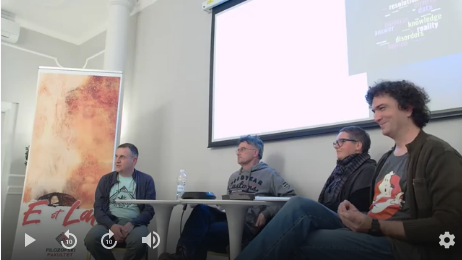 As noted in the discussion that followed, biotechnological development in general inaugurated the age of posthumanism, characterised by opposing views of the development of information and communication technology and the related change in humanity’s relationship with the environment, animals and its own being. From optimistic perspectives such as transhumanism (D. Haraway), which even anticipate the transformation of the human body into information, the idea of uploading the mind to a computer, to bioconservative (F. Fukuyama) and openly antihumanist (N. Land) positions, posthumanism also brings with it a certain degree of distrust towards the future.
The possibility that we live in a simulation prompted a very lively discussion in which Zoran Roško offered several highly intriguing and original theses. Life in a simulated universe does not presuppose that the simulation must necessarily be digital, as in the film The Matrix, which, according to our guest, offers a highly limited and inadequate portrayal of the relationship between computer and human. It may also involve an analogue form of simulation, or perhaps a type of simulation still entirely unknown to us.
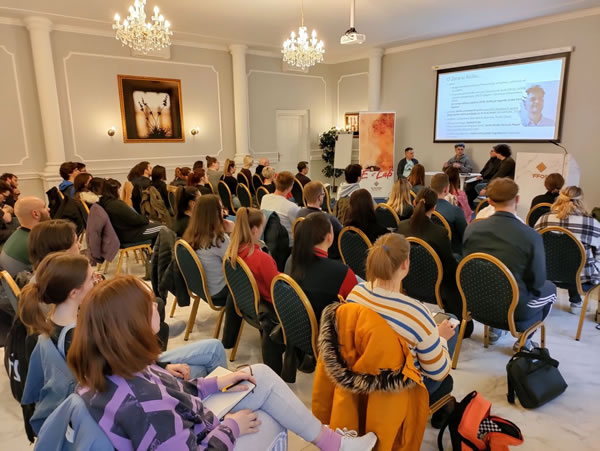 According to Zoran Roško, everything is technology, so when we speak about technology in the ordinary sense of the word, we are actually referring to the “technology of technology”. Even Being itself is a kind of technology! Another intriguing question posed to Zoran Roško later in the discussion concerned a different kind of intelligence, inorganic intelligence, which he addressed in his latest novel Bogart i Seranoga, and the possibility that such intelligence might actually exist.
Through these and similar questions, a highly stimulating and interesting discussion continued, at moments extending beyond the boundaries of conventional thinking about technology and its possibilities thanks to Zoran Roško’s exceptional erudition, eloquence and literary imagination. Although fundamentally a writer, Zoran Roško fully justified the invitation to a conversation in the Technosphere, encouraging everyone present, including a large number of students, to reflect further on the role of technology in our lives and the possible directions of its future development.
bb
On Tuesday, 15 March 2022, EstLab, the FFOS Aesthetics Laboratory, organised a forum entitled “From the Tractatus to Language Games: ‘The Wittgenstein Case’”. The invited guest was Kristijan Krkač, PhD, Professor at the Zagreb School of Economics and Management (ZŠEM). The conversation also included Boris Bosančić and Marijan Krivak, professors at the Faculty of Humanities and Social Sciences in Osijek.
The occasion for the conversation was the centenary of the bilingual German/English edition of Tractatus logico-philosophicus (1922). At the time, the book completely transformed the “mental map” on which the so-called “history of philosophy” was drawn. Krkač, certainly one of the most dedicated and persistent scholars of Ludwig Wittgenstein and his work in this region, introduced the discussion provocatively. He claimed that Wittgenstein was, in fact, an “accidental philosopher”(!?). To some extent, his engagement with this “discipline” of the humanities resulted from the many disruptions of his life, through which this “modern Leonardo” sailed across the turbulent sea of his many intellectual and scientific inclinations. For Wittgenstein was an engineer, an aeronautical designer, an innovator in mechanical engineering… he was a painter, an architect, a passionate music lover, a competent pianist… and, last but not least, a philosopher!
A lively discussion developed around Wittgenstein’s philosophy, particularly its second phase, represented by Philosophical Investigations. What is LANGUAGE for Wittgenstein? To what extent does his understanding of language differ from that defined or identified by W. Benjamin and M. Heidegger, the most important “philosophers of language” of the 20th century? Can one speak in his work of a prophecy of the coming “artificial” and “machine” modes and languages of communication? To what extent is Wittgenstein “responsible” for the loss of the “human dimension” of language? Is he a kind of founder of the so-called “philosophy of science”?
Through these and similar questions, a highly provocative and inspiring discussion unfolded. During a debate that approached two hours in length, many problematic areas concerning the concept of language and philosophy in general came to the surface. The Wittgenstein forum generated a great many questions and comments and showed that the lecturer and guest, Prof. Krkač, succeeded in arousing strong interest among FFOS students and professors. Ultimately, this was one of the best-attended events organised by EstLab during the first year of its activities.
mk
What have you done, Bulldozer One? And you, the one who was the most diligent in dredging through our mental images and senses?
Dear Marko, we remember our meeting in chilly Osijek in November, and… we cannot express all the feelings that overwhelmed us in your presence. Hey… the conceptual artist who created Pljuni istini u oči had come to visit us! Perhaps not the very best record produced in the Yugoslav region, for there were magnificent sound carriers “in this land of peasants on the mountainous” Balkans, but certainly one of the most important and influential. For all our punk pioneers and young new-wave artists encountered precisely a “truth” that needed to be spat in the face, carried forward by Buldožer and… FREEDOM.
After the fact, many came to know the frontman of this band as a jazz-rock singer-songwriter. Brecelj was also an original chansonnier with a distinctive idiom, not without wit and human, all too human humour. Coctail (1974) was the only album “offspring” of Marko’s varied and variety-infused, unrepeatable spark of genius. From Rdeči bar to Duša in jaz, there came a Požar of emotions and a Časopis of intelligent insights. Yet it was also a “philosophy of RESISTANCE”. Resistance to everything primitive and barbaric that befell us in this region at the beginning of the 1990s. (But also a memory of what things were like in Osijek at Ljubo Trovač’s!?)
When you told us about your experience of playing and creating in the former country, one thing remained beyond doubt: your love for Osijek, perhaps the most beautiful city in your memory. Your love for the City was also caused by your love for a girl. That November at the Faculty, you explained this attachment to Osijek. It was a City, as you said, “open” to EVERYTHING. Thank you for reminding us of that.
We at EstLab, fully aware of the importance and significance you bestowed on us by coming to visit, put Tvojo ploščo s tremi komadi on the turntable. Parada, Majmuni, Trotoari… evoke for us the idea and concept of art as resistance. You never reconciled yourself to the “cosmic force of human stupidity”. Like Krleža in his eponymous novel, you showed us what it means to live and play On the Edge of Reason.
What “are you doing, Bulldozer One?”
“I’m going to paradise… the end… my native land” (Pljuni istini u oči, Buldožer, 1975).
And then what? Then… “NEW, NEW TIMES” for us Comrades from EstLab are not simply… the same old shit. For, as our dear Osijek guest would say: “NEW TIMES, comrades, bring with them NEW TASKS.” This was what our Comrade and HUMAN BEING MARKO “underlined” “at the end of his presentation”.
mk
You can watch Marko Brecelj’s guest appearance at the Aesthetics Laboratory in November 2021 at:
On Tuesday, 21 December 2021 at 7 p.m., in the Small Council Hall of the Faculty of Humanities and Social Sciences in Osijek, an event organised by the Literary Club of the Aesthetics Laboratory featured a discussion of Dostoevsky, the timeless Russian writer whose novels have left an indelible mark on world literature, but also on each of us…
Participants in the conversation were Željko Senković, Igor Gajin and Boris Bosančić. A recording of the event is available at https://youtu.be/QbNjfLro_uU
MARKO BRECELJ was a Yugoslav, Slovenian and Koper-based multimedia artist. A rock musician, poet, chansonnier and persistent performer/entertainer. His work is immensely important to the cultural imaginary of artistic and intellectual circles in this region. Marko Brecelj is the author of one of the strongest singer-songwriter debuts on the Slovenian and Yugoslav scenes. His Koktel (1974), arranged under the direction of Bojan Adamič (!), is a genuine “unknown gem” and a masterpiece of eccentric chanson and jazz-rock fusion. Yet Brecelj is best known as the frontman of the alternative-rock giants from Ljubljana, BULDOŽER. Their debut album PLJUNI ISTINI U OČI (1975) is one of the most subversive artistic attacks on the Yugoslav rock establishment of the period.
→ We spoke with him in the form of “TESTIMONY – answers to questions and without questions”. All of this took place within EstLab’s Drugom stranom programme. This unique event, Marko Brecelj’s guest appearance at FFOS, could be witnessed on 9 November at 7 p.m. A recording is available at https://youtu.be/Q2OHAYaZvAk.
Read more about the event on the EstLab Radio page >> here.
Kilometar mora je vrlo val is a line by Branko Maleš, first presented in concert, in a journal and at readings in 1975, and published in book form in 1978 in the volume Tekst. Its humorous and absurd brightness, which without mockery, and through the fantastic footwork of sonic-rhythmic games, healed the pathetic world of an increasingly exhausted History, had at the same time to exist somewhere else as well. And of course it did, in Sound, in Music, in the Ljubljana band Buldožer, in their Monty Python-like album Pljuni istini u oči.
The poet from Novi Sad, Vojislav Despotov, was doing something similar in the form of ultra-playfulness, while the first punk explosion, or the work of deconstructing concrete historical phrases, was played in 1976 and 1977 by the Rijeka band Paraf! By then it was already wonderful, and too late to put on the brakes. All the emerging punks had long been listening to Buldožer, to that first album recorded in the predominantly active official language of the SFRY, and this excellent move placed the album permanently high on the radio charts of that State.
Thanks to that album, Pljuni istini u oči, one can say in the Yugoslav context that the concrete body of the shift away from glam and prog rock truly began as Buldožer’s playful NEW WAVE. This enabled all the wise music editors in the region to provide an alternative, first and foremost, to the dominance of Bijelo dugme, which itself had indeed just pushed certain boundaries and integrated intergenerational strands, but had embraced the glam-style heroism of Yugoslav stars and accepted what it in fact was, as Darko Glavan put it: shepherd rock. Buldožer, however, is the Other. It is melodic and compositionally exciting, while its lyrics are desacralising and anti-pathetic, thematically extraordinarily precise in playfully challenging the most worn-out thematic slime, whether it came from music charts or from mass-media programmes, televised or printed. Buldožer is the most creative deconstructor of socialist realism, which sophisticatedly transformed itself into the most popular Yugoslav band of the mid and late 1970s. Yet Buldožer’s proto-new wave brought reserves of Intelligence that liberated the punks from both Intelligence and non-intelligence and gave them space on stage. And so they arrived, not caring about cleverness, but sneering and getting angry or proto-aestheticising their dirtiness, and they arrived before, on their second and third albums, they too accepted the fate of stadium bands. By then it was already the mid-1980s, and that was that. (Goran Rem)
→ The conversation entitled “Drugom stranom – Prehistory”, part of the New Wave cycle of conversations about time, space and above all music at the Aesthetics Laboratory of the Faculty of Humanities and Social Sciences in Osijek, can be found at: https://www.youtube.com/watch?v=q-aGRCoeseo&ab_channel=EstLabRadio
A recording of the first programme/episode is available at https://youtu.be/q-aGRCoeseo.
 “In the history of humankind, metaphysics will remain inscribed as the place where truth was supposed to appear unhindered in its eternal form. Regardless of the long-lost pride that such an attitude and similar ones once bestowed upon metaphysics, even today it appears not only as a cautionary mode of human thought but also as the desire for that thought, at any cost, to cross the boundary of what it can know. Despite this, each of those errors conceived by metaphysics and denounced in modernity can retrospectively bear authentic witness to the dimensions of life into which people clearly, and with reason, placed their expectations in this way. Metaphysical thought, as Hannah Arendt notes, was therefore never arbitrary in its philosophical systems, and still less meaningless. On the contrary, it carries and reveals ‘the only clues we have as to what thinking means to those who engage in it’. Failing to recognise this background is entirely correlated with a superficial contempt for the beyond, with all the characteristics of the dictatorship of the visible. Noticing these traces of transcendence, Nietzsche concludes in his distinctive way: ‘We have abolished the real world: what world is left? The apparent one perhaps? … But no! With the real world we have also abolished the apparent one!’
Although the content of old philosophical concepts has in most cases been compromised, the nihilism left behind by them as a signpost mediates the world of appearances in an equally unconvincing way. The invisible world beyond and the visible world here, and especially their shared metaphysical past, clearly cannot easily be understood without one another. Even when deprived of meaning, they point towards our primordial experiences. This is also what Kant’s supreme philosophical scandal concerning reason addresses: the unsettling fact that ‘the existence of things outside us (from which we derive the whole material for cognition even for our inner sense) must be accepted merely on faith, and that no satisfactory proof can be opposed to anyone who takes it into his head to doubt it’. Kant knew very well that, despite this, all needs of reason demand urgency. Even the understanding, which establishes criteria for itself in its search for truth, does not possess the capacity to limit reason in its need to create its own meaning. Bearing this in mind, Arendt boldly concludes that truth and meaning are evidently not the same. The fundamental error, preceding all other metaphysical errors, lies in the delusion that meaning can be created exclusively according to the model of the truth it represents. The infinite space of the speculative activity of reason is one thing, while the innate desire of the understanding for knowledge is quite another. According to Arendt, this distinction must be made clearly and decisively.” (Boško Pešić)
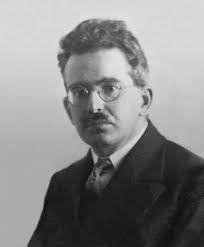 The first event of EstLab’s Dija-Logos section, entitled “100 Years of Capitalism as Religion”, was held in the FFOS Aesthetics Laboratory (Room 40) on Tuesday, 12 October 2021 at 6:30 p.m. For epidemiological reasons, the number of participants was limited. A recording of the event is available at https://youtu.be/Zp1V38z8sWQ . Read more about the event on the Dija-Logos section page > 100 Years of Capitalism as Religion.