
 Literature and philosophy call into question the essence of everything that is, enchant the world and illuminate being as relation. Yet in an age dominated by mass stupidity, when the radiance of logos (word and meaning) is fading, we are called upon to reconsider our place and orientation and to decipher the hieroglyphs of a lost humanity. The capacity for thought within us seeks life in a world that has emptied life of all content. We must avoid the comfort of the cushions of apocalyptic thinking, for genuine poiesis calls for a specific nomadic practice in which a turn and a different way of living/thinking become urgent. Literature, meanwhile, is a mode of thought in which elementary questions of existence are constantly raised: What are we actually doing? What is truly our own? What is our cosmos? In this sense, through reading the great works of classical and modern literature, and through conversations, forums, book presentations and other gatherings, the Literary Club will discuss answers and questions that are never stated once and for all, but instead express our self-knowledge through great literature.
EVENTS
14 October 2025
EstLab Forum: Does “Post-Yugoslav Literature” (Still) Exist? – guest Boris Postnikov
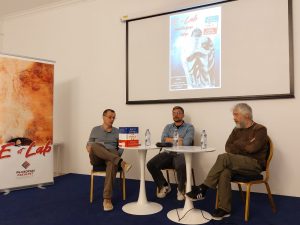 What is the “Literary Republic of Yugoslavia”? What, then, is the (post-)Yugoslav literary field? And is it even possible to speak freely about the toponym called YUGOSLAVIA?… at least within the so-called “academic establishment”?
An affirmative answer to the final questions in this series shows that – YES, IT IS! On Tuesday, 14 October, Boris Postnikov was a guest at FFOS. Boris Postnikov. The author of the book mentioned in the opening sentence spoke with the participants and audience at the first session of the new season of Osijek’s Aesthetic Laboratory. The main thesis of the publication’s narrative – also accepted by numerous literary theorists and historians of literature – is that even after the dissolution of the country once known as the SFRY, a “shared cultural space” continues to exist. It is inhabited by writers who do not wish to be confined within any canonical “national space”. The continuity of “post-Yugoslav literature” must therefore be taken into account by all future research into literary developments in this region.
Among other things, the conversation examined the role and position of the most prolific “post-Yugoslav” writer, Miljenko Jergović, as well as the role of Dubravka Ugrešić in defining this “literary field”. The discussion also addressed self-declared “post-Yugoslav” writers such as Marko Pogačar and, in particular, Aleš Debeljak. The final conclusion of the discussion was that there can be no dispute about the diversity and vitality of literary/cultural phenomena that emerged after the dissolution of Yugoslavia. “Post-Yugoslav literature” is an unquestionable fact of a free, universal space beyond national Croatian, Serbian, Slovenian and other literatures within the territory of the former state.
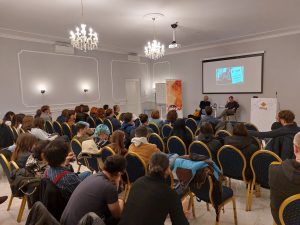
In conversation with the book’s reviewer Igor Gajin, as well as with the author of these lines, the author considered numerous aspects of literature and Yugoslavism, a topic that provocatively entered the terrain of exclusivity cultivated by local nationalist “cultural gatekeepers”. In the well-filled Room 39 at FFOS, one thing was confirmed… YES, it is possible to speak freely about reading and writing in the spirit of the Yugoslav cultural tradition.
mk
29 April 2025
The Crime and Punishment of Aesthetics – Conversation with Drago Hedl
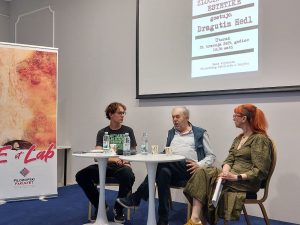 In a special edition of the Aesthetic Laboratory held on 29 April 2025, the distinguished journalist, publicist and writer Drago Hedl was our guest. Entitled “The Crime and Punishment of Aesthetics”, the event brought together an audience interested in topics at the intersection of journalism, literature and social criticism.
The conversation with Drago Hedl opened numerous questions about the boundaries between truth and fiction, the role and responsibility of the writer, and the power of aesthetics in shaping narratives about real crimes. Through dialogue and reflection, the discussion addressed ethical dilemmas related to the aesthetic representation of violence and the role of literature in shaping (or obscuring) social justice. Fundamental questions were also raised about the nature of literary confession: is it truly a stripping bare of life, can what is true be beautiful, and what is beautiful be true? In an atmosphere of poetic forensics and aesthetic examination, the meeting created space for reflecting on the role of art in confronting social trauma, particularly in times when institutions often fail to provide appropriate punishment in response to crimes committed.
The audience showed great interest in the topic, and the event continued with informal conversations after the official programme.
18 March 2025
The Sensual Language of Criticism and Literature: EstLab Conversation with Nataša Govedić
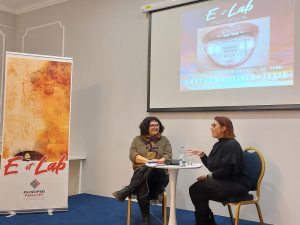 In today’s age of highly specialised knowledge, when experts operate within very narrow fields of science or art, we rarely encounter those almost Renaissance-like personalities who effortlessly sail the seas of different forms of knowledge, connecting distant, often invisible and seemingly untouchable shores through their work. One such personality is undoubtedly Nataša Govedić, as we had the opportunity to discover during the conversation held on Tuesday, 18 March at 6:30 p.m. as part of an EstLab gathering.
As we became acquainted with Nataša Govedić’s work and activities, it became clear that she is an experienced navigator who skilfully and effortlessly connects art and science, literature and theatre, poetry and language, reading and living, school and life. The conversation began with the topic of school and life, and through her latest book, Praise of Unbound Hands – Courageous Readings and Critical Pedagogies, Govedić opened important questions about how well schools truly prepare students for life and how spaces of freedom can be found within institutional education, whether as a student or a teacher. It was emphasised that such a space can truly come alive only if it encourages creative expression and critical thinking.
The conversation then continued with the topic of sensuality in language, or what the author herself calls the “eros of creation”. Nataša Govedić emphasised the importance of exploring sensory experience when giving linguistic form to personal experiences of a book, a performance or music. Such an approach allows us, through criticism and creative expression, to recreate ourselves in a multitude of different ways.
Special attention was given to the current state of literary and artistic criticism. The discussion highlighted the problem of the contemporary world being flooded with information, making it difficult to find one’s authentic voice and distinguish constructive criticism from mere fault-finding. Nataša supported her insights and reflections with ideas from her book Oscar Wilde Leaves Prison, or Your Favourite Art Is Called Criticism, further enriching the conversation.
During the gathering, many topics emerged spontaneously, and the audience had an opportunity to experience a unique intellectual journey. Thanks to the wealth of insights offered by Nataša Govedić, everyone present left the event enriched with new ideas and fresh perspectives.
10 December 2024.EstLab Conversation: EstLab: Minor Literature? (guest Gloria Lujanović)
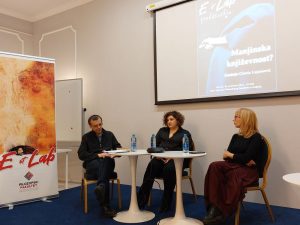 On Tuesday, 10 December, the final EstLab event of the year was held. Gloria Lujanović was the guest of this distinctive “literary evening”. This Croatian writer, originally from Bosnia and Herzegovina, spoke about two of her notable books published during the previous year. One was the distinctive poem FATHER, while the other was a contribution to the “culture of memory”, a record of the wartime suffering of Bosnian Croats in the Lašva Valley, HEART OF THE LAND.
The discussion also problematised the concept of so-called “minor/minority literature”, and the author expressed her attachment to Croatian national identity. At the same time, however, she also acknowledged her regional belonging to Bosnian literature. This distinctive positioning of Gloria Lujanović was itself one of the topics discussed with the author by the acclaimed and award-winning writer Ivana Šojat and EstLab co-founder Marijan Krivak.
Finally, the phenomenon of literary “fairs” was also discussed, prompted by the author’s journalistic piece on that year’s Interliber. The event, which attracted considerable interest from those present, opened a range of questions about the place of books and the humanities in contemporary society. Gloria Lujanović offered her first-hand perspective on this phenomenon.
mk
19 March 2024
EstLab Conversation: Writer and Scholar – The Autoethnographic Landscapes of Kristian Novak
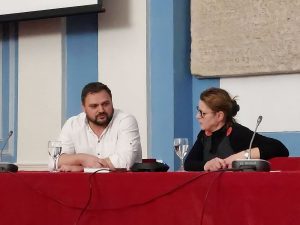 “I write in order to survive,” Kristian Novak told us on Tuesday, 19 March 2024, in the well-filled Ceremonial Hall of FFOS, in his characteristic style, openly and without restraint laying bare what is, for him and for many others, the painful process of writing. This recipe for life, as we might call it, extends throughout Kristian’s trajectory as both writer and scholar, two paths which, as became apparent, intertwine many times, just like the “braids” of narration in his novels, as described by his editor at the publishing house OceanMore, Kruno Lokotar. It became clear that the role of the “write-and-erase” board is crucial to his very existence, since the path toward a completed story has many possible routes, and returning to a particular word or scene proves just as important as moving forward. Particularly fascinating was a moment some five minutes after a question from the audience, asked by a young aspiring author, when you realise that Kristian had managed, with almost astonishing precision, to describe the process of creating a literary character or depicting an event crucial to the development of a novel’s plot. In those moments, it was apparent that he is also an excellent lecturer and entertainer, using effortless, self-ironic humour to demonstrate in practice what he says is his greatest strength: the self-reflective first person through which he exposes his characters and their actions almost to the point of discomfort. He repeatedly returned to those moments when an obsessive idea acquires form and to the way in which form influences the final content. He also managed to convey both the importance and the weight of an author’s decision regarding the way characters speak from the pages of a book, and the significance of the language in which they speak. It became clear how deliberate his decision had been to characterise his figures not only through descriptions of their actions but also through their speech, the choice of textual format and the linguistic variety itself, in the enduring tension between the standard language and the Međimurje dialect. These nuances of linguistic choice are precisely a reflection of the intersection between Kristian’s fields of activity, as he himself calls them: those of the writer and the linguist, fields that meet in the method of autoethnography and in a deep prose immersion into the landscapes of Međimurje and its people. Introduced into the conversation by the gentle voice of Teta Liza and the traditional song “Međimurje, kak si lepo zeleno”, we were invited to unravel the duality of feeling evoked by this beautiful part of Croatia, a feeling very close to sevdah, as I understand it. Saudade, morna, this simultaneous feeling of sadness and happiness, seems almost to be a fundamental characteristic of Međimurje’s tradition and way of life, yet it stands in obvious conflict with the darkness faced by the characters in Novak’s novel Črna mati zemla, perhaps the most “Međimurje-like” of all his works. Kristian nevertheless points out that people in Međimurje today have distanced themselves from traditional music and that somewhat more contemporary Pejaković and Stavros are now heard at weddings there. We also concluded that there has been a shift in his literary motifs, from geographically specific ones, such as coexistence with the Roma community or the smuggling of migrants in Gypsy, but the Most Beautiful, toward the far more universal crime-report motifs of The Case of My Own Demise, which could have taken place almost anywhere.
Kristian also demonstrates his obsessive attention to detail and narrative precision in his dissertation of more than 500 pages, Multilingualism and Collective Identities of the Illyrians. Linguistic Biographies of Dragojla Jarnević, Ljudevit Gaj and Ivan Kukuljević Sakcinski, in which he used correspondence between members of the Illyrian movement to portray a lesser-known image of the role of bilingualism in the formation of Croatian identity. He demonstrated that the Illyrians, most of whom were German speakers, used the process of learning Croatian to illustrate how language can reshape not only linguistic, but also social reality. Particularly interesting was his portrayal of the life and work of Dragojla (Karolina) Jarnević, yet another example of a woman who might have been recognised as a scholar in another time and society, but who instead had to endure the constant neglect of her work as an educator and author.
Kristian also revealed a detail from his life that defined yet another of his roles, that of editor of a literary work, a task that, in his words, may have been the most difficult of all, though not because of the author whose work he edited. That author was his Croatian-language teacher, Ivan Pranjić, the man whom Kristian may perhaps thank for his decision to become involved in writing literary works. Perhaps the most intimate part of the conversation was his description of the method Professor Pranjić used to teach his pupils how to write essays, encouraging them to write in their own Međimurje language so they could express what they thought and felt. In this miniature from Kristian’s childhood, but also in his voice, one could sense all the gentleness and persistence with which a teacher recognises the importance of language and the sense of security offered by familiar words when they are written down and seen on paper. It could also be said that this fragment from the past found its mirror image in the synergy between teacher-writer and pupil-editor several decades later, while perhaps also reflecting Kristian Novak himself as both writer and scholar, an obsessive seeker of the truth that liberates.
Tanja Gradečak
23 January 2024
EstLab Forum: “A New Generation of Croatian Women Writers” – guests Julijana Adamović and Ivana Šojat
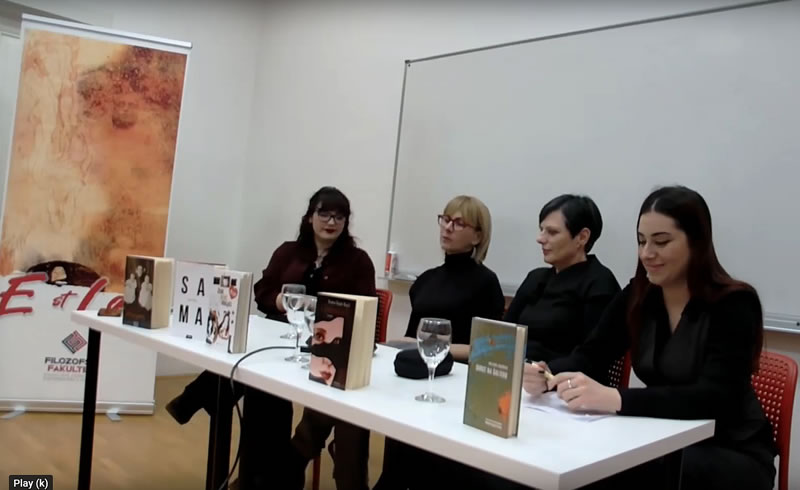 The forum “A New Generation of Croatian Women Writers”, organised by the Aesthetic Laboratory of the Faculty of Humanities and Social Sciences in Osijek, was held on 23 January 2024 at 6 p.m. in Room 54 of the Faculty of Humanities and Social Sciences in Osijek. The topic of the forum, “A New Generation of Croatian Women Writers”, formed part of the project Poetry in the Shade, whose primary aim is to introduce participants to literary and poetic creation while encouraging students to develop their own literary expression. Memories and experiences are what Croatian women writers offer as a path toward emancipation or as a reminder of the need for broader social sensitivity. The Croatian women writers of the new generation who follow such literary paths, and who inspired the forum and its thematic framework, are the award-winning authors Ivana Šojat and Julijana Adamović. Ivana Šojat is a translator and writer with a rich body of work encompassing poetry, essays, short stories, novellas and novels. Particularly notable is her multi-award-winning novel Unterstadt, which was also adapted into an award-winning stage production at the Croatian National Theatre in Osijek. The most prominent work by Julijana Adamović, herself also the recipient of numerous awards, is the short-story collection Kako su nas ukrali Ciganima. Adamović’s education and interests are also reflected in her publication of literary works for children. Although Ivana Šojat and Julijana Adamović are established and award-winning writers whose work hardly requires special introduction, we believe that their appearance at EstLab, above all through their experiences and memories, will present their work and engagement from a different perspective and perhaps open numerous questions that have until now remained closed. The conversation with the writers was moderated by EstLab members Lucija Leventić and Martina Ivanović.
12 December 2023
The Wisdom of Defeat, the Madness of Victory – with Miljenko Jergović on Football, Writing and… Philosophy
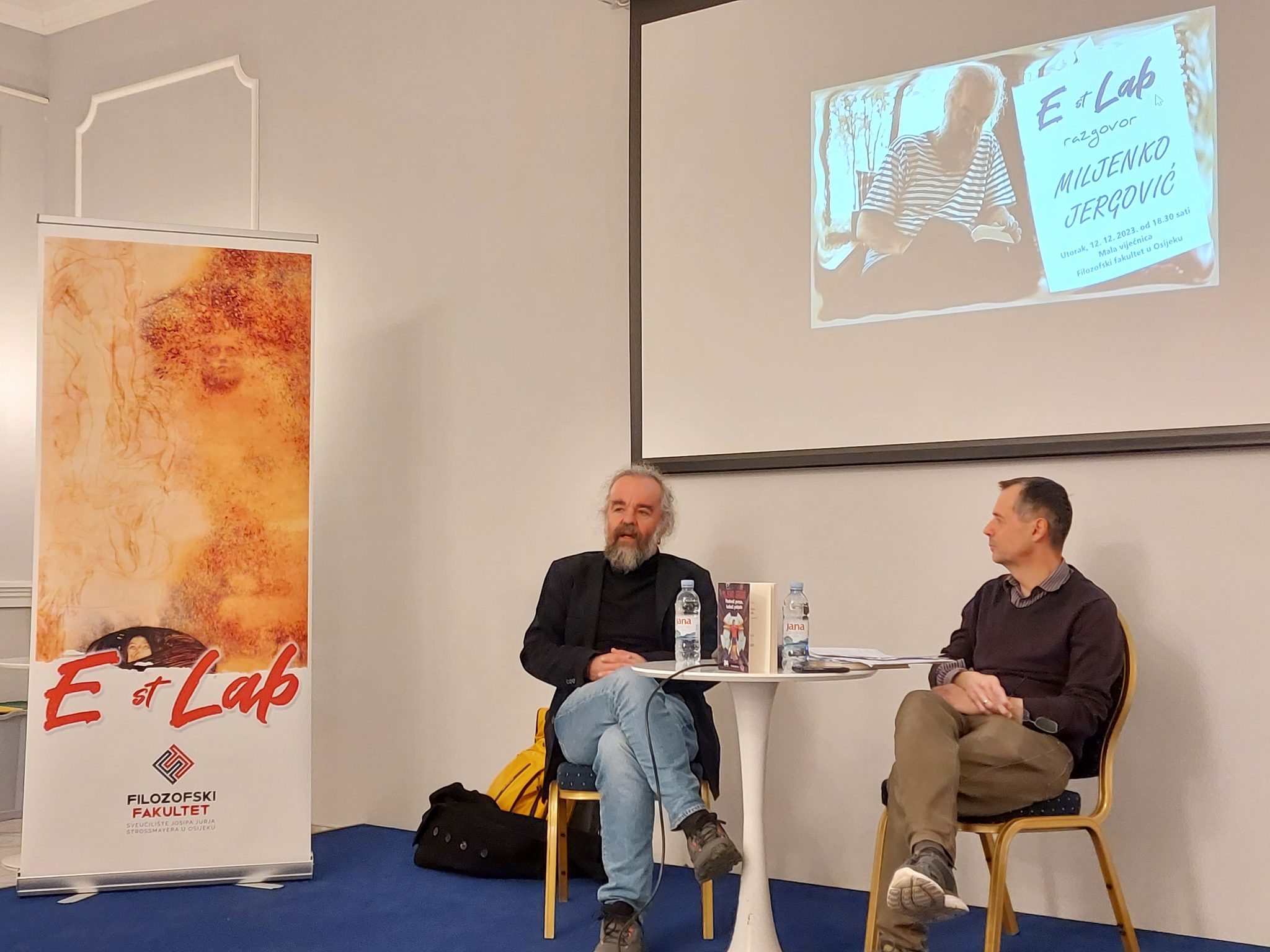 What is the essence of the globally popular sport called – FOOTBALL? Why are wars fought over football, both imaginary-ideological ones and real ones? Finally, what is the meaning of the very presence of this sport in our lives here, lives so exposed to all manner of ideological and other manipulations and abuses of the masses of devoted subscribers, the so-called “fans”?
We sought answers to these questions in a conversation with Miljenko Jergović. For anyone in this region who may not already know, Jergović is one of the leading intellectual figures of Bosnian and Croatian narrative literature. As he describes himself, for example, in one of his own novels, he is a “national outcast with a Balzacianly extensive oeuvre, wandering around Zagreb pretending to be his own shadow and pretending not to exist”… (Herkul, Fraktura, Zagreb, 2019, p. 152).
We attempted, meanwhile, to improvise answers to the questions posed above during an EstLab conversation between the author of these lines and the writer himself, one of the most eminent guests to date at the FFOS Literary Forum. One year after the FIFA World Cup in Qatar and yet another in the series of “historic successes” of the sacrosanct idea of the Vatreni, the discussion therefore focused on football, prompted by the book published that year, a kind of Jergović “intimate diary” entitled The Wisdom of Defeat, the Madness of Victory (Fraktura & 24 sata, Zagreb). The conversation, however, revealed much more. For example, Jergović sees the essence of the popular sport in the “spirit of the game itself”. He also argued that watching a football match requires a certain kind of “solitude”. It is almost a contemplative, metaphysical ritual, a kind of “epistemology” of a phenomenon seemingly familiar to everyone. Finally, we also arrived at an answer as to why the “very essence” of football – through a series of accidents and contingencies – came to expression during the final of the World Cup in Qatar on 18 December 2022!? According to both interlocutors, the public reception of the Croatian national football team, the “sacred Vatreni” to everyone, and the meaning of football as a game have nothing in common! Why? Precisely because the essence of football arises from the “spirit of the game itself”, while what took place in Zagreb’s main square was a carnival of forced national exaltation.
 And it is good that this is so. For… just as the essence of philosophy may be derived from poetry, and just as Nietzsche saw the birth of tragedy in the spirit of music, so too can football be interpreted “in the spirit of the game”, and certainly not as the meaning of life itself (as is often the case in Croatia).
Almost three decades after the cult Sarajevo Marlboro (1994), Jergović has, volens nolens, established himself as one of the most influential writers of his generation. In terms of oeuvre, unquestionably so… But also through his rare gift for storytelling. It was precisely this “art of storytelling” that he lucidly revealed before a large audience on 12 December in Room 39 at FFOS. Were all the questions posed above answered? Of course, NO. But we had the opportunity to spend time with one of the most significant, most widely translated and most accomplished novelistic, narrative and essayistic figures in the field of literature within our immediate geographical region. It was worth it…
mk
14 March 2023
Writer Josip Mlakić at the Aesthetic Laboratory of FFOS
YouTube recording of the event: https://youtu.be/-CXDvy5eg6c
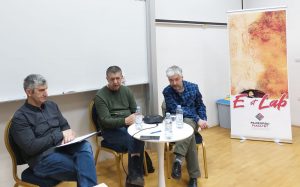 On 14 March 2023, the Faculty of Humanities and Social Sciences in Osijek, through the Aesthetic Laboratory, hosted the distinguished regional author Josip Mlakić. At the beginning of the conversation, the state of the Croatian and regional literary scene was discussed. Mlakić was then introduced as a highly ambitious writer (Gajin), with a broad range of themes. On several occasions, the author also highlighted his achievements in film, which was particularly interesting to part of the audience. Although the author distanced himself from the predominance of certain apocalyptic and “dark” atmospheres, Senković emphasised them. For Mlakić, such resonances and moods are crucial to depicting the contemporary condition, supported by a technically well-developed discourse. Mlakić explained that he likes to write in the tradition of major modern authors, and consequently a significant part of the conversation focused on Ivo Andrić.
The novel Na Vrbasu tekija was written boldly, as an attempt to compose variations alongside Ivo Andrić. It was both interesting and instructive to hear once again about this great writer and about the distinctive Andrić-like style, which may seem naïve to some because of its reliance on folk idioms, although it is anything but naïve (Gajin). Alongside the strictly literary dimension, it was unavoidable to comment on Ivo Andrić’s “political status”, which Mlakić also addressed critically. Dystopia was described as speaking primarily about our present and our contemporary orientations. For example, the novel Planet Friedman portrays a devastated land and empty oceans: “Thousands of shipwreck survivors threw messages in bottles into the sea, with no one for them to reach.” In this context, certain historical perspectives and “events” were examined as a form of media opium for the masses. Several other Mlakić novels were also mentioned: The Gospel According to Barabbas (written from the perspective of the Jewish rebel Barabbas, imagining the life of Jesus), Of Gold, People and Dogs (an apocalyptic perspective, the future and Bosnia and Herzegovina), and The Second Noah’s Ark (about the end of the world as we know it, greed and ruthlessness, and a mountain inhabited by the worker Noah and the shepherd Ibrahim). Specific Bosnian fatalism and contemporary hopelessness were mentioned several times, although not everyone agreed with this interpretation (Senković). The conversation was interesting, particularly because it addressed the great writer Andrić. Participants included Josip Mlakić, Igor Gajin and Željko Senković. There were also several questions and comments from the interested audience, which greatly contributed to the quality and atmosphere of this cultural event.
Željko Senković
2 June 2022
EstLab Conversation: Krleža on Peace and War
On Thursday, 2 June 2022, a discussion about peace and war was held. University professors Goran Rem, Igor Gajin and Željko Senković discussed different Krležian perspectives on the topic. From the original framework established by the great writer, peace emerged as fragile and unattainable, similar to an “illusion of love”. However, the emphatic depiction of wartime suffering and tragedy, particularly in the cycle of short stories portraying the reality of the First World War, Croatian God Mars, can also be understood inversely, as an encouragement toward insight into fundamental humanistic ideals. The interlocutors emphasised the polymorphic nature of modern discourse, within which even the conceptual pair “peace-war” can be thought of only as an apparently divided reality. Krleža approaches reality itself polemologically, while peace, on the other hand, is neither static nor unquestionable, but always a relational category realised within the dynamism of life and the world. Alongside the author’s well-known motifs that war runs contrary to “normal human reason”, represents “stupidity expanding without limit” and constitutes “gorillism”, the historical context of Krleža’s thinking about war was also considered, illuminating a horizon extending from his so-called socialism to our so-called modern postmodernism.
We live in an age of masses cheering for frenzied dictatorships. Between despair and indifference, perhaps we encounter only “former people”. Krleža confronted the dark forces within us and wanted to change things at their roots, while many insights contained in his artistic truths were guided by a criticism of war as a disgrace to the “dignity of reason and morality”. War lives within human beings like a “hungry hyena”, driven by timeless stupidity, while the only victor in every war is death. In numerous texts, from essays and short stories to poetry, this great writer exposed the absurdity and horror of war. Yet the decisive question remains how to think and realise peace, that fragile phenomenon resembling an “illusion of love”?
In a packed lecture hall at the Faculty of Humanities and Social Sciences in Osijek, an interesting dialogue developed among students, colleagues and invited professors. Toward the end of the conversation, the discussion moved from Krležian motifs to the meaning of literature and artistic truth in general. We hope that such inspiring conversations will contribute to further research into Croatian literature and culture.
Željko Senković
21 December 2021
EstLab Conversation: Writing and the Metamorphoses of the Soul. Fyodor Mikhailovich Dostoevsky
On Tuesday, 21 December 2021 at 7 p.m., in the Small Council Hall of the Faculty of Humanities and Social Sciences in Osijek, as part of the activities of the Literary Club of the Aesthetic Laboratory, a discussion was held about Dostoevsky, the timeless Russian writer whose novels have left an indelible mark on world literature, but also on each of us…
The participants in the discussion were: Željko Senković, Igor Gajin and Boris Bosančić. A recording of the event is available at https://youtu.be/QbNjfLro_uU
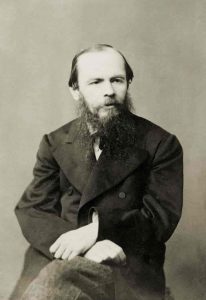 Fyodor Mikhailovich Dostoevsky (1821–1881) is a writer of world significance who exerted an extraordinary influence on our era. Both contemporary and timeless, he wrote masterpieces such as “Crime and Punishment”, “The Brothers Karamazov”, “Notes from Underground” and “The Idiot”. As a man he suffered (surviving a mock execution before a firing squad and imprisonment in Siberia), while as a writer he narrated brilliantly and developed a poetics of the transformation of humanity. This great connoisseur of the soul explored the inner spaces of human beings, with their many “basements and floors”, searching for freedom and purity capable of overcoming the horrors of the external world: “To take a new step, to utter a new word, is what people fear most.” Faced with evil and misfortune, Dostoevsky devoted his entire oeuvre to affirming personality and love, frequently addressing suffering and faith: “All people are connected by mysterious threads, and a true relationship to life is measured by unconditional love that transcends the limits of reason.” Igor Gajin, Boris Bosančić and Željko Senković discussed the fundamental characteristics of this great writer.
“In every person’s memories there are things they do not reveal to everyone, but only to friends. There are also things they will not tell even their friends, but only themselves, and then only in confidence. Finally, there are things a person is afraid even to reveal to themselves, and every decent person has quite a few such things.” (F. M. Dostoevsky: Notes from Underground)
6 May 2021
Writing and Freedom. Kafka’s Short Stories
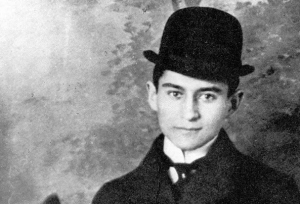 The second EstLab event featured a presentation and discussion of Kafka’s short stories, lesser-known short texts by the famous writer, led by Professor Željko Senković. The adjective “Kafkaesque” is used to describe the absurdity and paradoxical nature of many aspects of modern society. Even if he was indifferent toward life, Kafka resisted an organised world that insists on our replaceability and produces redundant people. We do not know how truly to exist amid the advance of the inhuman, and so we merely survive as shadows of what we could and should have been. Kafka’s sentence is stripped bare, and therein lies the distinctive beauty of his prose. For him, writing is a form of prayer, but also a service to the devil. By presenting absurd and monstrous images of the world as lies, he expresses simple and relentless truths, revealing the abyss and desert of the modern simulacrum of power. He cannot be reduced to any established aesthetics or politics of our age; he remained distant from every ideology, yet nevertheless represents a wind of freedom and resistance. What does Kafka tell us, this writer who did not wish to teach or serve as a guide?
Participants in the discussion were: Željko Senković, Marijan Krivak, Boško Pešić, Milijana Mičunović and Boris Bosančić.