
 What is FILM PHILOSOPHY? Or, rather, when is FILM PHILOSOPHY? Film Philosophy happens/comes into being/takes place when all of us who strive to think about the reality around us “seize kairos by the forelock”. When we (re)think what appears to be unthinkable – the image. The “art of moving images” requires us to stop. To stop? Yes, precisely to stop before an image that is moving. We must pause and ask ourselves, ‘What have we just seen?’, what message is conveyed to us by the moment in time that has just passed, captured on the cinema screen? How do we experience it…, think it?! For film is a “real ontology of time” (Deleuze), or a “form that thinks” (Godard); by happily joining the ‘love of wisdom’, philosophy, with the ‘love of film’, cinephilia, we Socratically bring forth within ourselves… FILM PHILOSOPHY. Pretentious? Immodest? No! Only in this way do we “seize the opportune moment”, kairos, understanding our own time as conceived through images. From The Birth of a Nation and Triumph of the Will all the way to Breathless and Fight Club, we strive to follow one principle – think about what you watch!
EVENTS
4 June 2024
Metastases (of Croatian Reality) – Film Screening and Conversation with Branko SCHMIDT
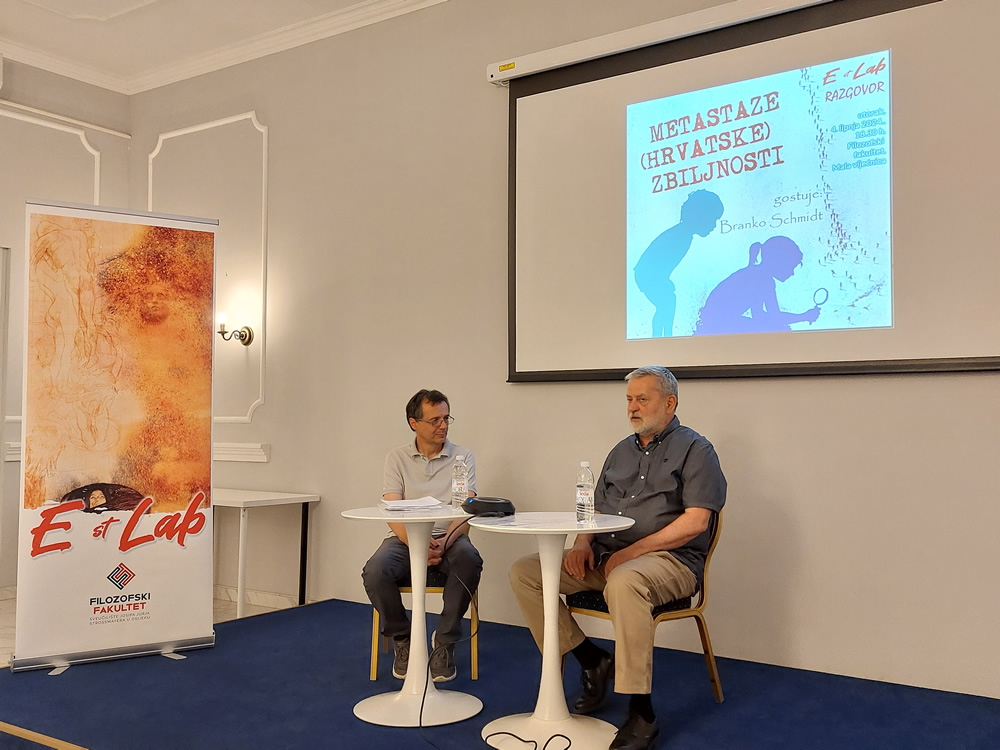 The final EstLab event of this academic year offered those present a rarely exciting, “metastasising” experience. Our guest was Branko Schmidt. The recent recipient of the Vladimir Nazor Lifetime Achievement Award in the field of film art spoke – with the author of these lines – about Metastases. (The cult film, by the way, was once again screened for those interested before the conversation itself.)
Everyone present, including director Schmidt himself, considers this film remarkably resistant to socio-cultural change and capable of withstanding the passage of time, remaining equally innovative and fresh a full 15 years after it was made. During the conversation, Branko recalled many memories and newly acquired experiences connected with the shooting itself. We also learned how he met Alen Bović. Indicatively for the environment in which we live, Bović had to use a pseudonym when publishing the novel Metastases, fearing radical reactions to his literary debut… and who knows what else. For in Metastases (of Croatian reality!), Ivo Balenović depicts both the metaphorical and literal disintegration of a group of young people during the local post-war transition, all under the banner of hooliganism and violence associated with the creation of our “Beautiful Homeland”.
Schmidt revealed that this film also represented a kind of metamorphosis within his own body of work. His collaboration with Balenović and the film’s leading actor, Rene Bitorajac, also produced another important film of Croatian cinema (and beyond) from those years, Vegetarian Cannibal (2012).
Ultimately, Schmidt proved to be an inspiring interlocutor, but also someone who remained disappointed by certain phenomena in the country in which we live, among them a certain persistence of fascist tendencies, particularly in connection with the so-called “football supporter subculture”. Our homeland remains burdened by many “metastasised” deviations, and the director of the cult film also commented on the result of our most recent parliamentary elections.
As a native Esseker – and also a wartime television cameraman in the devastated city of Osijek during the early 1990s! – Schmidt is certainly a legitimate witness capable of passing on his experience to younger generations in a country that, in many respects, could and should have been different. Metastases is a film that makes us aware of all this in a disturbing yet intellectually stimulating way. Fortunately, we can also enjoy it as a bursting, humorous, witty and full-blooded genre film. Believe me, it remains not only the most important but truly the best Croatian film since independence. mk
25 May 2024
EstLab Forum: On Acting without Acting – guest Bogdan Diklić
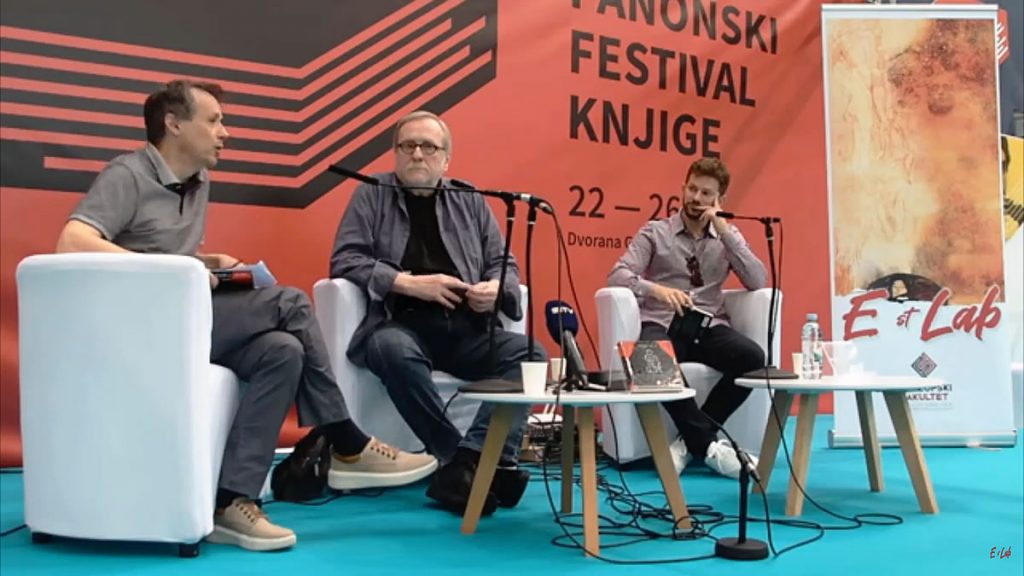 Acting is lived, felt… contemplated. This “contemplation”, which we so greatly lack, took place on “Youth Day” itself, as part of the Pannonian Festival of Literature. The second edition of this event hosted perhaps “the most important living actor” (B. Pešić) “in this region” (Hladno pivo). And… an intellectual encounter between Bogdan Diklić and EstLab took place! The conversation with this doyen of the artistic “vocation of acting” included the younger Osijek actor Antonio Jakupčević, as well as the author of these lines. The discussion focused primarily on the latest, “updated” edition of Diklić’s book On Acting without Acting (4th ed., 2023). This book – small in format but great in spirit – contains a kind of (ta)O-isms, witty lessons and pieces of wisdom. Naturally, they emerge from Bogdan Diklić’s rich, half-century-long acting experience. Exceptionally perceptive and witty, the actor also offered several of his other views on acting, both in theatre and in film and television. In addition to the expected discussion of the cult film The Marathon Family (1982), the conversation also covered Diklić’s formative TV series by Srđan Karanović and Rajko Grlić, Grlom u jagode (1975–1976), Goran Marković’s classic National Class (1978), and the distinctive masterpiece of Croatian alternative cinema, the “artistic pearl” by Bobo Jelčić, A Stranger (2013). Diklić spoke very emotionally about his incarnation of Slavko, a man from Mostar confronted with “waiting for Dragan”, a kind of Godot in this allegorical work. YES… in the conversation with Diklić, there truly was reflection. In many respects, Bogdan proved to be an exceptionally inspiring interlocutor in confronting the essence of art. Particularly concerning the triadic relationship between writer-viewer-actor. In Kairos, namely, “skill… becomes art”. And the actor and his experience become – LIFE itself. mk
Does Criticism Exist in Croatian Film?
17 October 2023
 On Tuesday, 17 October 2023, members and supporters of EstLab were confronted with the prospect of critical thinking within and about Croatian film and – given that the concept of contemporary Croatian film undoubtedly exists – with the question of whether there is also something approximating serious, uncompromising film criticism within the domestic film (so-called) industry. Thus, as a source of insight into the aforementioned issue, the role of guest on the stage of the Small Council Hall at the Faculty of Humanities and Social Sciences in Osijek was flawlessly performed by the distinguished Croatian filmmaker, writer, and literary and film critic Damir Radić, who reflected on the canonical works (as well as artistic failures) of the greatest directors who have marked the cinema of democratic Croatia. It is true that war themes (although at varying levels of explicitness) frequently dominate as an allegedly indispensable aesthetic element of domestic cinema. However, this in no way means that Croatian cinema is inherently infected with nationalist sentiment or religious fundamentalism, as is the case with the orientation of most reactionary currents in state media, nor that healthy criticism is therefore absent. On the contrary, it becomes stronger. Indeed, if we merely consider the work of actors and directors such as the “self-published” Ljubomir Kerekeš or the high-budget and only superficially critical Vinko Brešan, it is difficult to find a sacred cow of Croatian state-building mythology or bourgeois morality that has resisted being brought to the screen. This is best demonstrated by Schmidt’s universally acclaimed Vegetarian Cannibal, as well as Agape and Metastases; Dević and Jurić’s war drama The Blacks, and Matanić’s adaptation of Karakaš, Kino Lika.
Admittedly, among the lapses of Croatian film – most of which are not worth mentioning – it is not difficult to find chimerical revelations that merely confirm the given ideological constellation. Yet the most dangerous form of conformism is not the one that overtly and sycophantically identifies itself with reactionary opinion – but precisely the one that obscures a transgressive position while successfully pretending to be subversive. However, inheriting the provocative spirit of the Zagreb Film Authors’ Studio as well as the tradition of the Serbian “Black Wave”, domestic cinema (as well as film criticism) has undoubtedly distinguished itself within the region – perhaps representing some of the highest cultural achievements of independent Croatia. Yet, in comparison with, for example, the richness of film production and cinematic expression in the Nordic countries, it has still not managed to produce a significant indigenous form outside the normative frameworks of the culture industry. Here we might consider, for example, Denmark’s Dogme 95. All of this calls – and this might be taken as the conclusion of this rather polemical discussion – for the continued practice of merciless film criticism.
ab
Screening of the Film White Riot
13 April 2021
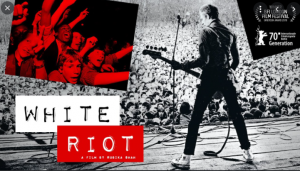 On Tuesday, 13 April 2021, from 6 to 8 p.m., the first activity within the Film Philosophy section (headed by Prof. Marijan Krivak, PhD) was held – a screening of the film White Riot (2020), directed by Rubika Shah, via the Zoom platform.
The screening of White Riot was made possible by Dina Pokrajac, Programme Director of the SUBVERSIVE FILM FESTIVAL (the film opened the 13th Subversive Film Festival at the Kinoteka cinema in Zagreb on 28 November 2020).
The cinematic language of White Riot is subordinated to the energy of new-wave and punk rhythm. It is an extremely important document of philosophical-political “cognitive mapping” (Fr. Jameson). Its relevance in speaking out against racism, hatred and fascism is invaluable as an incentive for discussion about the educational role of philosophy and art within our own environment as well.