
 What is the Technosphere? What kind of radical paradigm shift in thought does it represent, one that, in this highly technologised world, no longer submits to the old metaphysical view of the world? What is meant when we say that, within the Technosphere, what is at stake is the “immanent transcendence” of life itself? In the words of our guest, within the Technosphere “everything is in constant transformation and nothing has a permanent essence any longer.” The Technosphere “…has no fixed goals and no purposeful history. Its driving force is information.” What, then, can we expect from artificial mind, that is, artificial intelligence and artificial life, which, thanks precisely to this binary phenomenon – at once miraculous and monstrous – information, inevitably emerge and develop within the Technosphere? Is information truly the key concept of the age in which we live…? And finally, what is the aim of artificial intuition, one of the author’s most intriguing expressions, perhaps the greatest challenge to everything human…?
EVENTS
EstLab Forum: Media and Technology: The End of Society or the End of Media? – guest Assoc. Prof. Mario Hibert, PhD (24 May 2023)
YouTube recording of the event: https://youtu.be/coejYmZV98w
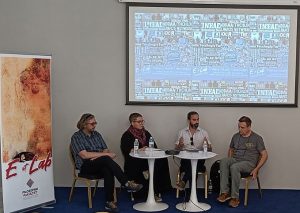
On Wednesday, 24 May 2023, the EstLab Forum entitled “Media and Technology” was held in the Small Ceremonial Hall of the Faculty of Humanities and Social Sciences in Osijek, organised by the Technosphere section of the Faculty’s Aesthetic Laboratory and the FUZ&JA science popularisation programme. The invited guest was Mario Hibert, Associate Professor at the Department of Comparative Literature and Library Science at the Faculty of Philosophy, University of Sarajevo. Professors of the Faculty of Humanities and Social Sciences and members of the Aesthetic Laboratory Milijana Mičunović and Boris Badurina also participated in the discussion, with Boris Bosančić acting as moderator.
The introductory part of the forum reflected on the rapid, and in certain segments invasive, development of information and communication technology over the past seventy years, which has ultimately led to the unprecedented penetration of digital media (online portals, social media, etc.) into every aspect of human life. In this way, digital media have become the most powerful and influential factor in contemporary society.
As M. McLuhan warned us long ago, media are not merely intermediaries of communication but encompass all forms of technology. In other words, an equality sign should be placed between these two concepts. This kind of equivalence suggests that information and media (digital) literacy represents far more than access to, analysis, evaluation, creation and distribution of information in different media forms. Understanding information and communication technologies as forces within a new ecosystem also means extending the semiotic understanding of literacy to the cognitive level of the ability to comprehend the technological environment. By introducing the discussion of the “operating systems of our lives” through this media-ecological perspective, the aim is to emphasise the importance of moving away from an instrumental paradigm – the skills of using media/technologies – toward questions of how to live in relation to an environment that replaces critical thinking with the automation of meaning and significance. The fact that, instead of a radically open social imaginary, we have received the implosion of neoliberal globalisation, and have replaced cyber-idealism with cyber-cynicism, means that any discussion about media/technology today should essentially be nothing other than a reminder of the collapse of sociality brought about by the emergence of platform-based disciplining and algorithmic data extraction, the behavioural surplus of on-life existence.
 The forum also addressed the concepts of algorithmisation and disruption, particularly how the “invisible algorithmic hand” operates within the media space and how capitalism has become involved in the entire process. In other words, the discussion also considered how today’s platform and surveillance capitalism, focused on data extraction and the manipulation of user attention, affects fundamental democratic norms and institutions. Phenomena closely related to social media were also discussed, such as confirmation bias and its role in politics, as well as the unavoidable phenomenon of post-truth, described as the worst product of general mediatisation.
In the final part of the forum, the discussion also considered whether technological development, which has granted media immense power, might now take that power away in light of the recent shocking development of artificial intelligence, currently at the forefront of technological development. The present situation with media is such that they are finding it increasingly difficult to cope with the negative consequences of their own technology-driven development, manifested in the proliferation of inaccurate, false and malicious information, post-truths, half-truths and similar content within the media space. Artificial intelligence can multiply such content indefinitely while at the same time being unable to recognise it as inaccurate, false or malicious. Whether such a situation could, in the near or distant future, result in one of the worst possible scenarios – the collapse of our society, or perhaps of the media themselves – remains an open question.
Boris Bosančić and Mario Hibert
————————————————————————————————————————————————————–
EVENTS
Literature in the Technosphere: A Conversation with Zoran Roško (19 April 2022)
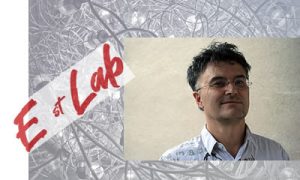 On Tuesday, 19 April 2022, an event entitled “Literature in the Technosphere” was held in the Small Council Hall of the Faculty of Humanities and Social Sciences in Osijek, organised by the Technosphere section of EstLab (the Aesthetic Laboratory of FFOS) and the FUZ&JA science popularisation programme. The invited guest was the award-winning writer Zoran Roško, a professor of philosophy and comparative literature and a reference librarian at Zagreb City Libraries. He was joined in conversation by Milijana Mičunović, Davorin Ćuti and Boris Bosančić, members of the Aesthetic Laboratory of the Faculty of Humanities and Social Sciences. The discussion generally concerned the development of technology, particularly the development of information and communication technology and its leading field, artificial intelligence. What lies behind the seemingly “innocent” idea “that one day a machine might work (and think) on its own”? What are the ultimate possibilities of artificial intelligence, whose development has progressed from facial recognition to creating faces itself (https://generated.photos/faces)? What is the role of algorithms as an increasingly widespread tool in scientific research?
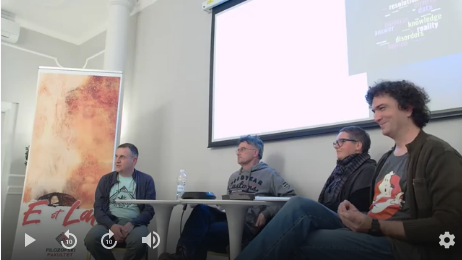 As mentioned in the discussion that followed, biotechnological development in general has inaugurated the age of posthumanism, characterised by opposing views on the development of information and communication technology and the related change in humanity’s relationship with the environment, animals and its own being. Ranging from optimistic perspectives such as transhumanist ones (D. Haraway), which also foresee the transformation of the human body into information (the idea of uploading the mind into a computer), to bioconservative (F. Fukuyama) and openly antihumanist (N. Land) positions, posthumanism also brings with it a certain degree of distrust toward the future.
The possibility that we live in a simulation prompted a very lively discussion in which Zoran Roško presented several highly intriguing and original theses. According to our guest, living in a simulated universe does not necessarily imply a digital form of simulation such as that depicted in The Matrix – in his view, a highly limited and deficient representation of the fusion between computers and humans – but may also include an analogue form of simulation, or perhaps a type that remains entirely unknown to us.
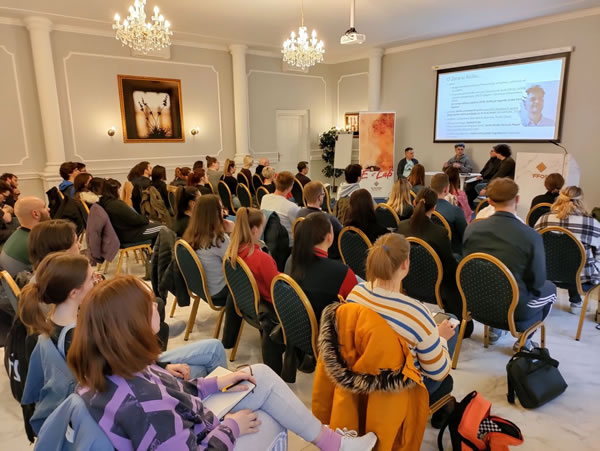 According to Zoran Roško, everything is technology, so when we speak of technology in the usual sense of the word, we are actually referring to the “technology of technology”. Even being itself is a kind of technology! Another intriguing question posed to Zoran Roško during the discussion concerned a different kind of intelligence – inorganic intelligence – which he explored in his latest novel Bogart i Seranoga, particularly regarding the possibility of its actual existence.
Through these and similar questions, a highly stimulating and engaging discussion continued, at times reaching beyond the boundaries of conventional thinking about technology and its possibilities, thanks to the exceptional erudition, eloquence and literary imagination of Zoran Roško. Although primarily a writer, Zoran Roško fully justified the invitation to participate in a Technosphere discussion by encouraging everyone present, including a large number of students, to continue reflecting on the role of technology in our lives and the possible directions of its future development.
bb
————————————————————————————————————————————————————–
Technosphere and the “Transcending” of Life – A Conversation with Žarko Paić (1 June 2021)
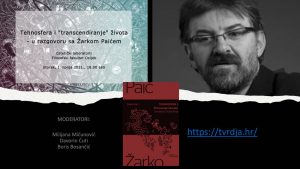 The first event of the TECHNOSPHERE section of the AESTHETIC LABORATORY (EstLab) of the Faculty of Humanities and Social Sciences was held via the FFOS Zoom platform on Tuesday, 1 June 2021. Our guest was ŽARKO PAIĆ, a university professor, sociologist and philosopher, author of numerous papers and books in philosophy, sociology, cultural theory and contemporary art, the theory of science, media and related fields, editor-in-chief of the influential journal TVRĐA (https://tvrdja.hr/), and deputy editor-in-chief of the renowned annual publication EUROPSKI GLASNIK… Žarko is also the author of the five-volume work entitled Technosphere – a kind of ontology of the digital age – after which this EstLab section was named!
Moderators of the conversation: Boris Bosančić, Milijana Mičunović, Davorin Ćuti.