
A rhetorical question… Of course, music is much more than that to us. Music is the energy that sets our – LIFE – in motion (and not only aesthetically, through sensory cognition). “My life is New Wave,” as an urban punk fighter from this region once said. The first front of our “struggle” is P(otpuno) U(vredljivo) N(egiranje) K(lasike) [Completely Offensive Negation of the Classics], as written on the cover of Darko Glavan’s legendary booklet. But New Wave is also nouvelle vague… Structurally, music has quite a lot in common with the art of moving images. Does music, then, also have something to do with the very “matter of thinking”? Again, rhetorically… For us at EstLab, it is also a decisive experience of the meaning of existence itself! We think music, listen to philosophy, watch literature, read films… Our fundamental experience of music is “the birth of the tragedy of our contemporaneity from the spirit of music”. Or an event that transforms Pink Floyd (we love them!) into punk fluid. In other words, the experience that permeates us is the one that says: “Spit Truth in the Eye” (Buldožer, 1975). All of these are merely sketches of our conversations about music, listening sessions of musical paideia, and live performances. And Truth? Of course, we do not speak of it as something unquestionable… because today the “matter of thinking” is the search for – MEANING. The meaning of “musical philosophy” itself – from the spirit of punk and New Wave – is also RESISTANCE to what exists. Philosophically, this is the proposal of a “non-fascist life” (Deleuze & Guattari). Ergo: for us, music is the “metaphysics of real happiness” (Badiou). Join us in the thoughtful/meaningful adventure of everything that moves us, delights us… makes us happy!
Members of the Music Section: Boško Pešić, Marijan Krivak and Boris Bosančić
R e c e n t E v e n t s
8 December 2025
Sejo Sexon at EstLab, FFOS
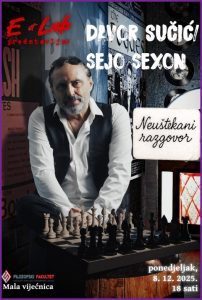 On 8 December 1980, John Lennon was killed. On that day, with him, a certain “spirit” of rock ‘n’ roll also disappeared while rock ‘n’ roll “was still young”. EstLab wanted to evoke Lennon’s authenticity and playfulness through an equally sincere and, indeed, playful figure of the YU-ROCK scene – Sejo Sexon!
The frontman, “soul and body” of ZABRANJENO PUŠENJE, Davor Sučić (aka SEJO SEXON), was a guest – through EstLab’s new “acquisition”, Goran Faletar – on 8 December 2025, in a packed Room 39 at FFOS. He truly is a source of “good spirit”, one of the “Sarajevo crowd”, while ZABRANJENO PUŠENJE is marking its longevity on the scene with its fourth (4th!) consecutive “unplugged concert” in Osijek.
 During the conversation, the audience had an opportunity to learn about the origins of one of the longest-running – and also one of the most important – rock bands of the former Yugoslavia, as well as hear testimony about the pivotal moments when Sučić revived the band in 1997 with the definitive album FILDŽAN VIŠKA. It was also a triumphant entry onto the Croatian rock scene. At that point, after many years spent in the background behind Nenad Janković (aka Dr NELE KARAJLIĆ), SEJO SEXON stepped into the “spotlight” in the best possible way as guitarist, singer and principal songwriter of ZP.
During the conversation, we also learned that “DAIDŽA”, Elvis J. Kurtović (Mirko Srdić), pushed the major hit “Možeš imat moje tijelo” as the only song from the album Fildžan Viška written in “proper” Croatian… We also learned that, for Sejo Sexon, the essence of rock ‘n’ roll lies in the openness and sincerity of songs and music, something ZABRANJENO PUŠENJE has been offering its audience for more than four decades. Indeed, through this event, 45 years after Lennon’s death, the spirit of “rock and roll” was revived once again, together with that of “Good Friends”: Sejo Sexon and his devoted audience.
mk
11 November 2025
EstLab Conversation with Paraf Frontman Valter Kocijančić: “And the Day Had Started So Beautifully”
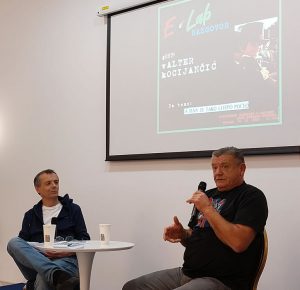
 And the day ended so beautifully with a conversation and encounter with a representative of punk, a free spirit and an authentic example of a rock poet, Valter Kocijančić, bearer of the original, primordial sound of Paraf. Students and lovers of music of resistance had the opportunity not only to listen but to experience punk, on 11 November in a lecture hall at FFOS, where, through a kind of listening session, we travelled back to a time when young people uncompromisingly sought their place in the universe and, with memorable melodies and simple lyrics, hit straight in the head anyone looming over them (even when it was the People’s Militia). Valter vividly showed us that this period gave punk its maxim: YOUNG PEOPLE who ACT in search of their FUTURE. In his lyrics, Valter described and portrayed what was happening around him, just as it was, the realities of everyday life; the goal was not to theorise, but to signal that we were dissatisfied and to move (as another punker/rocker would say: move, change). Punk was not merely the scream of hopeless youth unable to submit to authority; no, the punk of a band such as Paraf was a powerful expression of those who believed in a movement of free spirits who, through their rebelliousness, overthrow regimes(?) whose sole aim is to suppress all action and change:
 Everything is in perfect order
The yellow lines are respected
Children happily wave their little flags
(…)
And something tells me something tells me
Something tells me something tells me
(You are infected you are infected
You are infected you are infected)
Valter testified to this, and we, lovers of punk, pass it on: our own times also need punk, they need young people who, if not ready to act, will at least detect the existing (metastasised) cancers of society.
Luka Prijić
15 April 2025
Completely Offensive Negation of the Classics – guest Branko Kostelnik
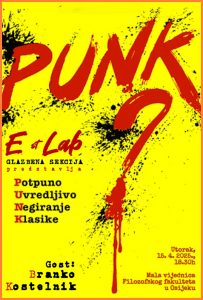 Room 39 at FFOS buzzed and rumbled that Tuesday, 15 April 2025. And for a good hour and a half! What was happening? What caused this tectonic phenomenon at FFOS? Cui bono?
For those who still do not know, we attempted to answer the question: What is PUNK? EstLab was joined by Branko Kostelnik, Head of the Programme and Exhibition Activities Department at Zagreb’s Museum of Contemporary Art, a sociologist of culture, lecturer at VERN… But, most importantly for us, a long-standing rock critic, historian, producer and organiser of rock concerts. Together with him, we attempted to answer the aforementioned question, namely: what is PUNK?
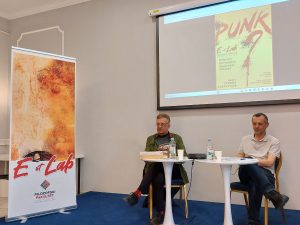 For a good hour and a half, we discussed the meaning of punk music, its habitus, and its significance for the possibility of young people – but also all those who once listened to it and those who still devotedly present and practise it today – to change the social circumstances in which they live. Or at least to point toward an artistic “rhythm of rebellion”… The CLASH, SEX PISTOLS, The JAM… Talking Heads, RAMONES, Television… STIFF LITTLE FINGERS, Gang of Four, TOM ROBINSON Band… all of them fundamentally shaped the formative years of the two interlocutors. The conversation attempted to make clear that the humanities in particular – if they still wish to survive at all – cannot do so without the inspiration left to us by the music of punk and New Wave. Did all of this reach the young people at the Faculty, our students? Out of the corner of my eye (and ear!), I saw the young bodies present surrendering themselves to the PLEASURE of that “rhythm of rebellion”. And what better proof could there be that the purpose of this conversation and music had been fulfilled?
mk
8 October 2024
Music of RESISTANCE AND FREEDOM – 40 Years after the Red Album: guest Pero Lovšin
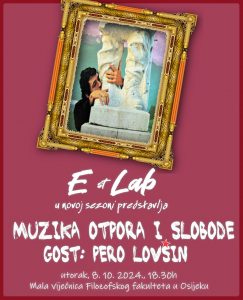 Room 39 at our Faculty, on Tuesday, 8 October 2024, echoed with punk. We hosted Pankrti, of course, through their “spokesman”. At the first EstLab forum of the new season, Peter Lovšin spoke with the author of these lines. A favourite “rebel with a cause” from some of our long-gone days, Pero uncompromisingly revealed before a packed audience the artistic provocation of punk; of Pankrti. It became clear that he still has something to say to new generations. Loud and clear, through music and words. Alongside the presentation of their “Red Album” and a discussion of Pankrti and their resistance to the rigid socialist regime, the conversation also addressed the political-cultural solidarity of bands (and other artists) across the territory of the former Yugoslavia.
FROM THE ANNOUNCEMENT: Freedom? What does freedom mean? Or… Freedom? What does FREEDOM mean (to us)? As the local – though, alas, long-gone! – rock poet and undisputed Messiah of this region once said: “Freedom is not the mutual caressing of idiotic heads… Freedom is a Woman, take her.” And YES, one day in that mythical year 1977, Gregor Tomc travelled to London to bring back evidence of that FREEDOM… in the form of vinyl records. Naturally, it was – the then emerging – PUNK. It was a “cry of freedom”. And all this at the conservative dawn of Anglo-Saxon neoliberalism. Down south, in the westernmost republic of Yugoslavia, there appeared… PANKRTI. In the spirit of the anarchic cry that “they don’t know what they want… but they know how to get it” (Sex Pistols), these Bastards entered the Yugoslav rock scene like a storm sweeping away everything before it. This “storm”, this rumble, struck the SC Gallery in Zagreb in late autumn of ’77. The aforementioned poet welcomed his Ljubljana comrades with the lyrics of his first single: “I shave my beard and moustache to look like Pankrti” (Azra, Balkan, 1979). Although Houra’s (or actually Cvetković’s!?) Kazalište beat them to the release of a debut album – while the landmark debut by Rijeka’s Paraf appeared somewhat later – PANKRTI conceived and shaped their long-playing record most convincingly. https://www.youtube.com/watch?v=_xekKeGc0bE&t=1494s.
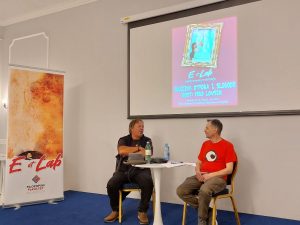 Dolgcajt was the most authentic image of growing up amid the greyness of torn-up city streets, in what was then a deadly boring Ljubljana. (Whose illness the boys from Kodeljevo and Šiška had already described in the single “Lublana je bulana”.) From Kruh in igre to Podgane iz Ljubljane… It was a cultural SCANDAL. An artistic-political provocation par excellence. But also pure ENERGY, something unprecedented in this region until then. Naturally, this could not pass without a State Award!(?) – the “Seven Secretaries of SKOJ”. State favourites, then, Pankrti(!), long before their fellow citizens from Laibach, employed overidentification as an artistic excess (visible on the cover of their second album https://www.youtube.com/watch?v=zp8Z16C0Gqs). “Behind the Iron Curtain, old women pull a red beet.” Was that irony? Hmmm…
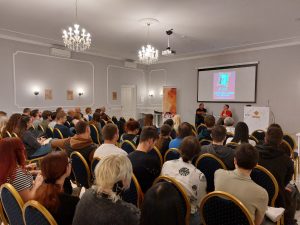 Anyway, now for the main point. Forty years ago came the strongest blow against the stale ideological slogans of an already weary socialist Yugoslavia. RED ALBUM – was it subversion? Or was it a revival of authentic “communism and FREEDOM”!? Does the language of music still think critically about the reality it sings of and depicts? Are there still young and rebellious musicians with an idea/message? Hmmm… Neither Pero’s Ljubljana nor the Ljubljana of the revolutionary-minded Pankrti is the same anymore. Everything is different… and sadder. Yet a ray of light appeared at the end of this musical conversation. The young people present, FFOS students, spontaneously enjoyed themselves (some even jumping!) to Pankrti’s anthem, the rebellious “Bandiera Rossa”!
mk
9 January 2024
EstLab Forum “Art and Activism” – guest Kornel Šeper and members of the Slama Association – Šimun Padovan, Hrvoje Dešić and Marko Pernarčić
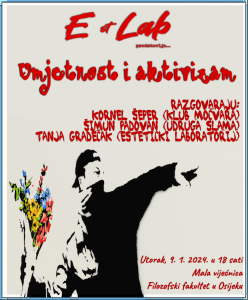 In keeping with EstLab’s original idea, namely the educational role of art, the first conversation of the year was held on Tuesday, 9 January 2024, in Room 39 with people who stand out from the crowd – people we like to highlight precisely because they themselves rarely do so. Zagreb’s Močvara Club and the associated URK (Association for the Development of Culture) were presented as unique phenomena on the Croatian art scene since the 1990s. EstLab member Tanja Gradečak spoke about Močvara and URK with one of their conceptual initiators, Kornel Šeper, while reflections of the events in and around Močvara and URK could also be found in the story of Slamanje and the Osijek-based Slama Association, represented by Šimun Padovan, Hrvoje Dešić and Marko Pernarčić (Hrvoje and Marko are, incidentally, our alumni, so FFOS truly has something to be proud of :).
It became clear that the beginnings of both Močvara and Slamanje were connected with the need to escape the stagnation of everyday life and an environment that too often constrains people through prescribed patterns of behaviour and entertainment, something young people – and those somewhat less young – are constantly seeking alternatives to. Driven by a need to hear and create something different from the cultural offerings of the late 1980s and early 1990s, Kornel began by playing music in his local community centre that could not be heard on the radio or in Zagreb clubs at the time. He then became involved with avant-garde artists gathered around Kugla Glumište and, bringing together friends and acquaintances of similar convictions within the Association for the Development of Culture, travelled a path from squatting in Kuglana and adventures on the Ponikve meadow to the struggle for a venue in the former Jedinstvo factory, where Močvara remains today as it approaches its 25th anniversary. The activities of Močvara and another of Kornel’s projects, Zli bubnjari, were often connected with protest actions through which they helped various civil society organisations promote the active participation of citizens and young people in decisions affecting their lives. Despite this, Kornel does not describe himself either as an artist, although he has played in the band Šumski for years, or as an activist, even though what he does through the association and club could, in retrospect, be called prototypical activism. The point is that all the ideas and events connected with him and his collaborators arise organically from the need to act, without any particular master plan or ambition. This is also why the story of financing the association and club through projects is inevitably connected with what the Močvara community calls “administrative violence”, because it forces people into prescribed frameworks and consumes energy on paperwork that could otherwise be invested in organising concerts and exhibitions or publishing albums and books.
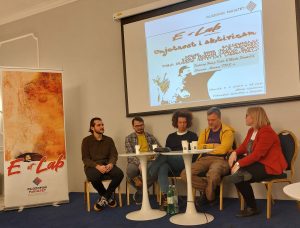 The story of Močvara is perhaps the best example of how undertakings of this kind very often require one enthusiastic and creative individual, but also how, without a community of people who share and spread that enthusiasm, many initiatives would either fail or never begin. Another example was provided by the interlocutors from Osijek’s Slama Association, Šimun, Hrvoje and Marko Pernarčić, musicians gathered around the bands Harvo Jay and Čuvarkuća and the Slamanje project, who have intertwined visual art and music in many different and surprising ways. In doing so, they demonstrate how this grassroots movement – the need to be different and other, often unrecognised by official institutions – always remains somewhere in the background and occasionally erupts in beautiful volcanoes of creativity. The struggle for a physical space in which people seeking artistic events can gather, and the need to maintain continuity, were what Šimun highlighted as most important when it comes to alternative and so-called underground initiatives. This is the educational aspect to which we repeatedly returned, because we concluded that offering young people an opportunity to discover music and art different from what YouTube and Spotify algorithms expose them to is the only way to resist the violence of kitsch and the commercialisation of art, an overwhelming trend to which we are subjected almost every day. Particularly important in this respect was Hrvoje’s statement that he creates music for himself, not for the needs of software that analyses melodies and rhythms in order to identify those likely to attract the most listeners and potentially generate the most money. The conversation also turned to the role of artificial intelligence in creating works of art and, as Marko concluded, he sees no particular danger in it; it is simply a fact, just as it is a fact that art often operates within Aristotle’s mimetic theory of imitating reality and others.
It became clear that Kornel, Šimun, Hrvoje and Marko, guided by an aesthetics of the different, the strange and often the absurd – perhaps precisely because, as Umberto Eco suggests, the ugly and the different are actually more interesting – have turned their associations into sources of activism opposed to the social and artistic mainstream. Močvara and URK were, and remain, a kind of incubator on whose stage numerous Croatian and international artists of different profiles have performed or honed their craft, while Slama and Slamanje, in the almost intimate, squatter-like atmosphere of Osijek’s Tvrđa, radiate their own specific creative energy. Just as Močvara has for years placed Zagreb on the international map of alternative and subversive culture, informing and educating tens of thousands of visitors, Slama is a place where the energy of young people is channelled into something purely positive, inviting us to look at the more beautiful side of the world in which we live.
7 November 2023
EstLab Forum “As If It Had Once Been” – guest Dušan Vesić
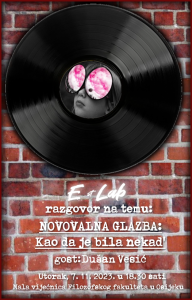 On Tuesday, 7 November 2023, EstLab members and friends had an opportunity to discuss a topic that rarely fails to arouse particular interest among music lovers, considering its unparalleled artistic, sentimental and epochal significance. For some of those present in the audience and on stage – mostly the more mature among us – it represents nothing less than a decisive cultural current that simply seemed destined to be born and take shape in this region, precisely the current in which they themselves once found their place. For others (those who never had the opportunity to witness first-hand the colossal concerts and performances in the basement of the Faculty), it cannot fail to evoke a sense of profound historical and creative fascination.
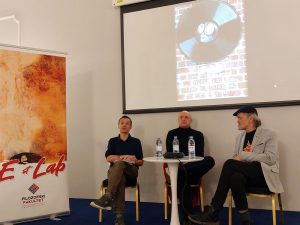 We are, of course, speaking about the music of the “New Wave”; rock and YU-punk in this region, a phenomenon that few people are more qualified to discuss than Dušan Vesić, one of the most prominent rock critics and a frequent companion of Yugoslav musicians. Above all, he is a man who – as the title of his book Imagine a Life suggests – was immersed in this entire story in a way that may today seem unimaginable to some, truly: “as if it had once been”. It is true: “All of it came out of Buldožer in one way or another”, yet it is evident that “Haustor” and “Prljavo kazalište” can still inspire people who are now the same age as their original audience to sing along, something few performers anywhere in the world can boast of. Few creative movements, let alone a “wave”, produce such a wealth of expression in the music of a single generation, which is why comparisons according to contemporary standards are entirely inappropriate. Who was the best? The most important? “Azra” or “Valjak”? And what about “Pankrti”? “Paraf”… “Termiti”? Who played the bigger concert or sold more tickets? Who played in a basement, and who in an arena? Is Sunčana strana ulice more successful than S’ vetrom uz lice?
The answers to these questions are as impossible as they are irrelevant. What matters, however, is recognising why that creative period flourished with creativity to the extent that it did, what conditions enabled its emergence, and why it became a source of such sincere nostalgia among those who experienced it first-hand. The fact is that – at least in this region – no creative movement has emerged after the “New Wave” that could rival the versatile vision of the 1980s. Yet one thing we have not given up on is continuing to ask the question: “could there still be another one?”
ab